Thank you for visiting SNEWPapers!
Sign up free
Western Union
Hannibal, Marion County, Missouri
What is this article about?
Emigrants are thronging the National Road through Indianapolis en route to Iowa, Illinois, Indiana, Wisconsin, Minnesota, and Missouri, using various transport. They appear healthy and well-behaved, expected to be good citizens. Commentary promotes Missouri for its cheap, fertile lands and trade advantages along the Mississippi.
Merged-components note: These two components form a single coherent article discussing emigration trends and promoting settlement in Missouri, with sequential reading order and adjacent bounding boxes indicating continuation.
Clipping
OCR Quality
Full Text
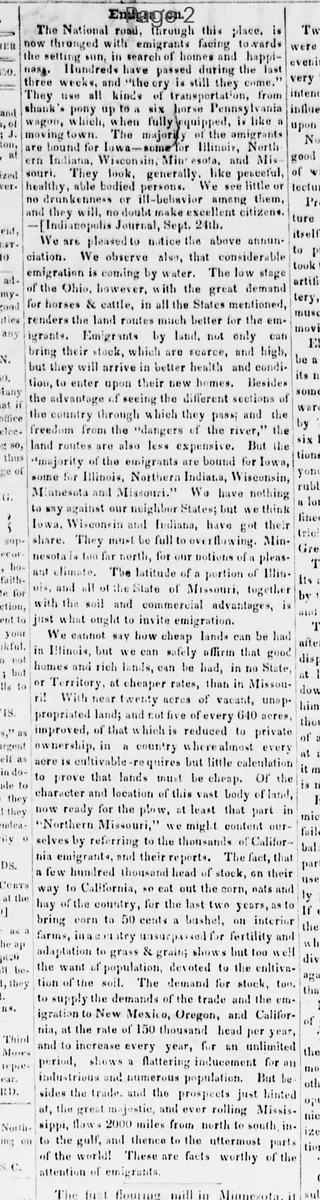
-[Indianapolis Journal, Sept. 24th.
We are pleased to notice the above annunciation. We observe also, that considerable emigration is coming by water. The low stage of the Ohio, however, with the great demand for horses & cattle, in all the States mentioned, renders the land routes much better for the emigrants. Emigrants by land, not only can bring their stock, which are scarce, and high, but they will arrive in better health and condition, to enter upon their new homes. Besides the advantage of seeing the different sections of the country through which they pass; and the freedom from the "dangers of the river," the land routes are also less expensive. But the "majority of the emigrants are bound for Iowa, some for Illinois, Northern Indiana, Wisconsin, Minnesota and Missouri." We have nothing to say against our neighbor States; but we think Iowa, Wisconsin and Indiana, have got their share. They must be full to overflowing. Minnesota is too far north, for our notions of a pleasant climate. The latitude of a portion of Illinois, and all of the State of Missouri, together with the soil and commercial advantages, is just what ought to invite emigration.
We cannot say how cheap lands can be had in Illinois, but we can safely affirm that good homes and rich lands, can be had, in no State, or Territory, at cheaper rates, than in Missouri! With near twenty acres of vacant, unappropriated land; and not five of every 640 acres, improved, of that which is reduced to private ownership, in a country where almost every acre is cultivable--requires but little calculation to prove that lands must be cheap. Of the character and location of this vast body of land, now ready for the plow, at least that part in "Northern Missouri," we might content ourselves by referring to the thousands of California emigrants, and their reports. The fact, that a few hundred thousand head of stock, on their way to California, so eat out the corn, oats and hay of the country, for the last two years, as to bring corn to 50 cents a bushel, on interior farms, in a country unsurpassed for fertility and adaptation to grass & grain; shows but too well the want of population, devoted to the cultivation of the soil. The demand for stock, too, to supply the demands of the trade and the emigration to New Mexico, Oregon, and California, at the rate of 150 thousand head per year, and to increase every year, for an unlimited period, shows a flattering inducement for an industrious and numerous population. But besides the trade, and the prospects just hinted at, the great majestic, and ever rolling Mississippi, flows 2000 miles from north to south, into the gulf, and thence to the uttermost parts of the world! These are facts worthy of the attention of emigrants.
What sub-type of article is it?
What keywords are associated?
Where did it happen?
Domestic News Details
Primary Location
Indianapolis
Event Date
Sept. 24th
Outcome
emigrants expected to make excellent citizens; promotion of cheap lands and economic opportunities in missouri.
Event Details
Hundreds of emigrants have passed through this place on the National Road in the last three weeks, heading west to Iowa and other territories using various transportation. They appear peaceful and healthy. Commentary notes advantages of land routes over water and promotes Missouri for its fertile, inexpensive lands, commercial advantages, and need for population due to trade and emigration demands.