Thank you for visiting SNEWPapers!
Sign up free
The Caledonian
Saint Johnsbury, Caledonia County, Vermont
What is this article about?
Reports from Mexico during the Mexican-American War detail Santa Anna's recruitment and guerrilla activities, US army struggles with disease and volunteer expirations, peace rumors, massacres, and conditions in various fronts including Santa Fe and California. Dated around May 1847.
Merged-components note: Sequential components covering continued reports on the Mexican War, same topic and foreign focus.
Clipping
OCR Quality
Full Text
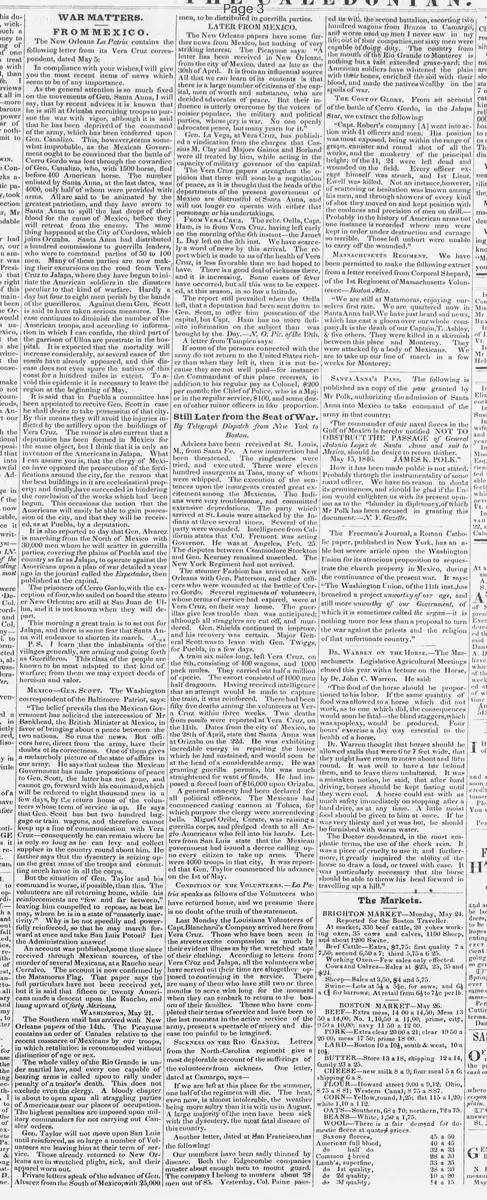
FROM MEXICO.
The New Orleans La Patria contains the following letter from its Vera Cruz correspondent, dated May 5:
In compliance with your wishes, I will give you the most recent items of news which seem to be of any importance.
As the general attention is so much fixed on the movements of Gen. Santa Anna, I will say, that by recent advices it is known that he is still at Orizaba recruiting troops to pursue the war with vigor, although it is said that he has been deprived of the command of the army, which has been conferred upon Gen. Canalizo. This, however, seems somewhat improbable, as the Mexican Government ought to be convinced that the battle of Cerro Gordo was lost through the cowardice of Gen. Canalizo, who, with 1500 horse, fled before 400 American horse. The number enlisted by Santa Anna, at the last dates, was 4000, only half of whom were provided with arms. All are said to be animated by the greatest patriotism, and they have sworn to Santa Anna to spill the last drops of their blood for the cause of Mexico, before they will retreat from the enemy. The same thing happened at the City of Cordova, which joins Orizaba. Santa Anna had distributed a hundred commissions to guerrilla leaders, who were to command parties of 50 to 100 men.
Many of these parties are now making their excursions on the road from Vera Cruz to Jalapa, where they have begun to initiate the American soldiers in the disasters peculiar to that kind of warfare. Hardly a day but four to eight men perish by the hands of the guerilleros. Against them Gen. Scott is said to have taken serious measures. Disease continues to diminish the number of the American troops, and according to information in which I can confide, the third part of the garrison of Ullua are prostrate in the hospital. It is expected that the mortality will increase considerably, as several cases of the vomito have already appeared, and this disease does not even spare the natives of this coast for a hundred miles in extent. To avoid this epidemic it is necessary to leave the region at the beginning of May.
It is said that in Puebla a committee has been appointed to receive Gen. Scott in case he shall desire to take possession of that city. By this means they will avoid the injuries inflicted by the artillery upon the buildings of Vera Cruz. The rumor is also current that a deputation has been formed in Mexico for the same object, but I think that it is only an invention of the Americans in Jalapa. What I can assure you is, that the clergy of Mexico have opposed the prosecution of the fortifications around the city, for the reason that the best buildings in it are ecclesiastical property; and finally, have succeeded in hindering the conclusion of the works which had been begun. This occasions the notion that the Americans will easily be able to gain possession of the city, and that they will be received, as at Puebla, by a deputation.
It is also reported to day that Gen. Alvarez is marching from the North of Mexico with 30,000 men whom he will scatter in guerrilla parties, covering the plains of Puebla and the country as far as Jalapa, to operate against the Americans upon a plan of war detailed a year ago in the journal called the Expectador, then published at the capital.
The prisoners of Cerro Gordo, with the exception of four, who sailed on board the steamer New Orleans; are still at San Juan de Ullua, and it is not known when they will depart.
This morning a great train is to set out for Jalapa, and there is some fear that Santa Anna will endeavor to shorten its march.
P. S. I learn that the inhabitants of the villages generally, are arming and going forth as Guerilleros. This class of the people are known to be most adapted to that kind of warfare; from them we may expect deeds of heroism and valor.
Mexico—Gen. Scott. The Washington correspondent of the Baltimore Patriot, says:
"The belief prevails that the Mexican Government has solicited the intercession of Mr Bankhead, the British Minister at Mexico, in favor of bringing about a peace between the two nations. So runs the news. But officers here, direct from the army, have their doubts of its correctness. One of them gives a melancholy picture of the state of affairs in our army. He says that unless the Mexican Government has made propositions of peace to Gen. Scott, the latter has not gone, and cannot go, forward with his command, which will be reduced to eight thousand men in a few days, by the return home of the volunteers whose term of service is up. He says that Gen. Scott has but two hundred baggage or train wagons, and therefore cannot keep up a line of communication with Vera Cruz—consequently he can remain where he is only so long as he can levy and collect supplies in the country round about him. He farther says that the dysentery is seizing upon the great mass of the troops and committing much havoc in all the corps.
But the situation of Gen. Taylor and his command is worse, if possible, than this. The volunteers are all returning home, while his reinforcements are "few and far between," leaving him compelled to repose, as best he may, where he is in a state of "masterly inactivity." Why is he not speedily and powerfully reinforced, so that he may march forward at once and take San Luis Potosi? Let the Administration answer!
An account was published, some time since received through Mexican sources, of the murder of several Mexicans, at a Rancho near Cerralvo. The account is now confirmed by the Matamoras Flag. That paper says the full particulars have not been received yet, but it is said that fifteen or twenty Americans made a descent upon the Rancho, and hung upward of forty Mexicans.
WASHINGTON, May 21.
The Southern mail has arrived with New Orleans papers of the 14th. The Picayune contains an order of Canales relative to the recent massacre of Mexicans by our troops, in which retaliation is recommended without distinction of age or sex.
The whole valley of the Rio Grande is under martial law, and every one capable of bearing arms is called upon to rally under penalty of a traitor's death. This does not exclude even the clergy. A bloody chapter is about to open upon all straggling parties of Americans near our places of occupation. The highest penalties are imposed upon military commanders for not carrying out Canales' orders.
Gen. Taylor will not move upon San Luis until reinforced, as so large a number of Volunteers are leaving him at their term of service. Those already returned to New Orleans are in wretched plight, sick, and their apparel worn out.
Private letters speak of the advance of Gen. Alvarez from the South of Mexico; with 25,000
The New Orleans papers have some further news from Mexico, but nothing of very striking interest. The Picayune says:
"A letter has been received in New Orleans, from the city of Mexico, dated as late as the 30th of April. It is from an influential source. All that we can learn of its contents is that there is a large number of citizens of the capital, men of worth and substance, who are decided advocates of peace. 'But their influence is utterly overcome by the voices of the noisier populace, the military and political parties, whose cry is war. No one openly advocates peace, but many yearn for it.'"
Gen. La Vega, at Vera Cruz, has published a vindication from the charges that Cassius M. Clay and Majors Gaines and Borland were ill treated by him, while acting in the capacity of military governor of the capital.
The Vera Cruz papers strengthen the opinion that there will soon be a negotiation of peace, as it is thought that the heads of the departments of the present government of Mexico are distrustful of Santa Anna, and will not longer co-operate with either that personage or his undertakings.
From Vera Cruz.
The schr. Oella, Capt. Ham, is in from Vera Cruz, having left early on the morning of the 6th instant—the James L. Day left on the 5th inst. We have scarcely a word of news by this arrival. The report which is made to us of the health of Vera Cruz, is less favorable than we had hoped to have. There is a good deal of sickness there, and it is increasing. Some cases of fever have occurred, but all this was to be expected, at this season, in so low a latitude.
The report still prevailed when the Oella left, that a deputation had been sent down to Gen. Scott, to offer him possession of the capital, but Capt. Ham has no more definite information on the subject than was brought by the Day.—N. O. Pic. of the 19th.
A letter from Tampico says:
If some of the persons connected with the army do not return to the United States richer than when they left it, then it is not because they are not well paid—for instance: the Commandant of this place receives, in addition to his regular pay as Colonel, $200 per month; the Chief of Police, who is a Major in the regular service, $100, and some dozen of other minor officers in like proportion.
Still Later from the Seat of War.
By Telegraph Dispatch from New York to Boston.
Advices have been received at St. Louis, Mo., from Santa Fe. A new insurrection had been threatened. The ringleaders were tried, and executed. There were eleven hundred insurgents at Taos, many of whom were whipped. The execution of the sentences upon the insurgents created great excitement among the Mexicans. The Indians were very troublesome, and committed extensive depredations. The party which arrived at St. Louis were attacked by the Indians at three several times. Several of the party were wounded. Intelligence from California states that Col. Fremont was acting Governor. He was at Angeles, Feb. 25. The disputes between Commodore Stockton and Gen. Kearney remained unsettled. The New York Regiment had not arrived.
The steamer Fashion has arrived at New Orleans with Gen. Patterson, and other officers who were wounded at the battle of Cerro Gordo. Several regiments of volunteers, whose terms of service had expired, were at Vera Cruz, on their way home. The guerrillas give less trouble than was anticipated: although all stragglers are cut off, and murdered. Gen. Shields continued to improve, and his recovery was certain. Major General Scott was to leave with Gen. Twiggs, for Puebla, in a few days.
A train six miles long, left Vera Cruz, on the 8th, consisting of 400 wagons, and 1000 pack mules. They carried out half a million of specie. The escort consisted of 1000 men, half dragoons. Having received intelligence that an attempt would be made to capture the train, it was reinforced. There had been fifty five deaths among the volunteers at Vera Cruz within three weeks. Two deaths from vomito were reported at Vera Cruz, on the 11th. Dates from the city of Mexico, to the 28th of April, state that Santa Anna was at Orizaba on the 22d. He was exhibiting incredible energy in repairing the losses which he had sustained, and would soon be at the head of a considerable army. He was granting guerrilla permits, but was much straightened for want of funds. He had imposed a forced loan of $16,000 upon Orizaba. General amnesty had been declared for all political offences. The Mexicans had commenced casting cannon at Toluca, for which purpose the clergy were surrendering bells.
"Miguel Oribe, Curate, was raising a guerrilla corps, and pledged death to all Anglo Americans who fell into his hands. Letters from San Luis state that the Mexican government had issued a decree calling upon every citizen to take up arms. There were 4000 troops in that city. It was reported that Gen. Taylor commenced his advance on the 1st of May.
Condition of the Volunteers.—La Patria speaks as follows of the Volunteers who have returned home, and we presume there is no doubt of the truth of the statement.
Last Monday the Louisiana Volunteers of Capt. Blanchard's Company arrived here from Vera Cruz. Those who have been seen in the streets excite compassion as much by their evident illness as by the wretched state of their clothing. According to letters from Vera Cruz and Jalapa, all the volunteers who have served out their time are altogether opposed to continuing in the service. There are many of them who have still two or three months to serve who long for the moment when they can embark to return to the bosom of their families. Those who have completed their terms of service and have been to the last moment in the active service of the army, present a spectacle of misery and disease too painful to be imagined.
Sickness on The Rio Grande:
Letters from the North-Carolina regiment give a most deplorable account of the sufferings of the volunteers from sickness. One letter, dated at Camargo, says—
If we are left at this place for the summer, one half of the regiment will die. The heat, even now, is almost intolerable, the weather being more sultry than it is with us in August. A large majority of the men have been sick with the dysentery, the most fatal disease of this country.
Another letter, dated at San Francisco, has the following:
Our numbers have been sadly thinned by disease. Both the Edgecombe companies muster about enough men to mount guard. The company I belong to musters about 28 men out of 85. Yesterday, Col. Paine passed us with the second battalion, escorting two hundred wagons from Brazos to Camargo, and worse used up men I never saw in my life; out of four companies, not sixty men were capable of doing duty. The country from the mouth of the Rio Grande to Monterey is nothing but a vast extended grave-yard; the American soldiers have whitened the plain with their bones, enriched the soil with their blood, and made the natives wealthy on the spoils of war.
The Cost of Glory. From an account of the battle of Cerro Gordo, in the Jalapa Star, we extract the following:
"Capt. Robert's company [A] went into action with 41 officers and men. Its position was most exposed, being within the range of grape, canister and round shot of all the works, and the musketry of the principal height; of the 41, 24 were left dead and wounded on the field. Every officer except himself was struck, and 1st Lieut. Ewell was killed. Not an instance, however, of scattering or hesitation was known among his men, and through showers of every kind of shot they moved on and kept position with the coolness and precision of men on drill. Probably in the history of American arms not one instance is recorded where men were kept in order under destruction and carnage so terrible. Those left unhurt were unable to carry off the wounded."
MASSACHUSETTS REGIMENT.
We have been permitted to make the following extract from a letter received from Corporal Shepard, of the 1st Regiment of Massachusetts Volunteers:—Boston Atlas.
"We are still at Matamoras, enjoying ourselves first rate. We are quartered now in Santa Anna hall. We have just heard sad news, which has cast a gloom over our whole company. It is the death of our Captain, T. Ashley, and five others. They were killed in a skirmish between this place and Monterey. They were attacked by a body of Mexicans. We are to take up our line of march in a few weeks for Monterey.
Santa Anna's Pass.
The following is published as a copy of the pass granted by Mr Polk, authorizing the admission of Santa Anna into Mexico to take command of the army in that country:
"The commander of our naval forces in the Gulf of Mexico is hereby notified NOT TO OBSTRUCT THE PASSAGE of General Antonio Lopez de Santa Anna and suite to Mexico, should he desire to return thither.
May 15, 1846.
JAMES K. POLK."
How it has been made public is not stated. Probably through the instrumentality of some naval officer. We have no reason to doubt its genuineness, and should be glad if the Union would enlighten us with its present opinion as to the "blunder in diplomacy, of which Mr Polk has been accused in granting this document.—N.Y. Gazette.
What sub-type of article is it?
What keywords are associated?
What entities or persons were involved?
Where did it happen?
Foreign News Details
Primary Location
Mexico
Event Date
May 5
Key Persons
Outcome
guerrilla attacks killing 4-8 americans daily; disease reducing us troops, third of ullua garrison in hospital; 55 volunteer deaths in 3 weeks at vera cruz; 2 vomito deaths on 11th; capt. roberts' company: 24 dead/wounded out of 41 at cerro gordo; massacre of 40+ mexicans near cerralvo; 6 massachusetts volunteers killed in skirmish; insurgents executed in santa fe; indian attacks wounding several.
Event Details
Compilation of war updates from Mexico: Santa Anna recruits 4000 at Orizaba, issues guerrilla commissions; guerrillas harass US supply lines from Vera Cruz to Jalapa; disease and vomito epidemic hits US troops; rumors of peace intercession via British minister and deputations offering cities like Puebla and Mexico City; Gen. Alvarez advances with 30,000 for guerrilla war; US army faces volunteer expirations, dysentery, supply issues; Gen. Taylor in inactivity; massacre confirmed near Cerralvo; Canales orders retaliation and martial law on Rio Grande; peace advocates in Mexico City; high officer pay at Tampico; Santa Fe insurrection suppressed; California governance disputes; wounded return from Cerro Gordo; large supply train leaves Vera Cruz; volunteers in poor condition; skirmish deaths for Massachusetts regiment; Santa Anna's 1846 pass revealed.