Thank you for visiting SNEWPapers!
Sign up free
The Virginia Gazette
Richmond, Williamsburg, Richmond County, Virginia
What is this article about?
Letter from Paris praises Duke of Orleans and French nobility for extensive charities to the poor, including British and Irish, contrasting with British practices; discusses admiration for British insolvent debtors act but critiques English prisons and lack of noble involvement in prisoner aid during Lent.
Clipping
OCR Quality
Full Text
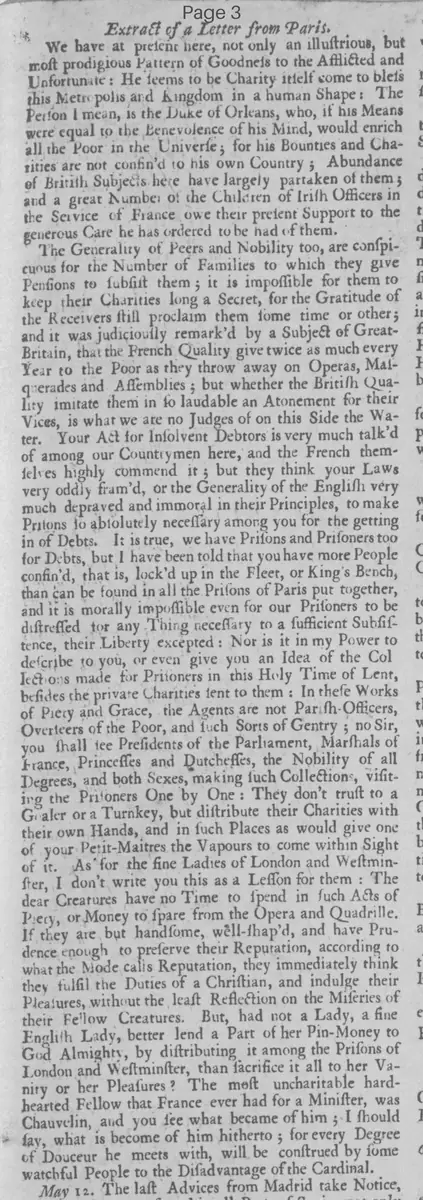
We have at present here, not only an illustrious, but most prodigious Pattern of Goodness to the Afflicted and Unfortunate: He seems to be Charity itself come to bless this Metropolis and Kingdom in a human Shape: The Person I mean, is the Duke of Orleans, who, if his Means were equal to the Benevolence of his Mind, would enrich all the Poor in the Universe; for his Bounties and Charities are not confin'd to his Own Country; Abundance of British Subjects here have largely partaken of them; and a great Number of the Children of Irish Officers in the Service of France owe their present Support to the generous Care he has ordered to be had of them.
The Generality of Peers and Nobility too, are conspicuous for the Number of Families to which they give Pensions to subsist them; it is impossible for them to keep their Charities long a Secret, for the Gratitude of the Receivers will proclaim them some time or other; and it was judiciously remark'd by a Subject of Great-Britain, that the French Quality give twice as much every Year to the Poor as they throw away on Operas, Masquerades and Assemblies: but whether the British Quality imitate them in So laudable an Atonement for their Vices, is what we are no Judges of on this Side the Water.
Your Act for Insolvent Debtors is very much talk'd of among our Countrymen here, and the French themselves highly commend it; but they think your Laws very oddly fram'd, or the Generality of the English very much depraved and immoral in their Principles, to make Prisons so absolutely necessary among you for the getting in of Debts. It is true, we have Prisons and Prisoners too for Debts, but I have been told that you have more People confin'd, that is, lock'd up in the Fleet, or King's Bench, than can be found in all the Prisons of Paris put together, and it is morally impossible even for our Prisoners to be distress'd for any Thing necessary to a sufficient Subsistence, their Liberty excepted: Nor is it in my Power to describe to you, or even give you an Idea of the Collections made for Prisoners in this Holy Time of Lent, besides the private Charities sent to them: In these Works of Piety and Grace, the Agents are not Parish-Officers, Overseers of the Poor, and such Sorts of Gentry; no Sir, you shall see Presidents of the Parliament, Marshals of France, Princesses and Duchesses, the Nobility of all Degrees, and both Sexes, making such Collections, visiting the Prisoners One by One: They don't trust to a Gaoler or a Turnkey, but distribute their Charities with their own Hands, and in such Places as would give one of your Petit-Maitres the Vapours to come within Sight of it. As for the fine Ladies of London and Westminster, I don't write you this as a Lesson for them: The dear Creatures have no Time to spend in Such Acts of Piety, or Money to spare from the Opera and Quadrille. If they are but handsome, well-shap'd, and have Prudence enough to preserve their Reputation, according to what the Mode calls Reputation, they immediately think they fulfil the Duties of a Christian, and indulge their Pleasures, without the least Reflection on the Miseries of their Fellow Creatures. But, had not a Lady, a fine English Lady, better lend a Part of her Pin-Money to God Almighty, by distributing it among the Prisons of London and Westminster, than sacrifice it all to her Vanity or her Pleasures? The most uncharitable hard-hearted Fellow that France ever had for a Minister, was Chauvelin, and you see what became of him; I should say, what is become of him hitherto; for every Degree of Douceur he meets with, will be construed by some watchful People to the Disadvantage of the Cardinal.
What sub-type of article is it?
What keywords are associated?
What entities or persons were involved?
Where did it happen?
Foreign News Details
Primary Location
Paris
Key Persons
Event Details
Description of the Duke of Orleans' extensive charities to the afflicted, including British subjects and children of Irish officers in French service; French nobility's pensions and charities to families, giving more to the poor than to entertainments; praise for British insolvent debtors act but critique of English prisons compared to French; noble collections for prisoners during Lent, distributed personally by high officials and nobility.