Thank you for visiting SNEWPapers!
Sign up free
Letter to Editor
February 15, 1823
Edwardsville Spectator
Edwardsville, Madison County, Illinois
What is this article about?
Abel Seymour from Moorfield writes on December 25, 1822, to J.S. Skinner about Senna seeds: he received imported ones, sent back smaller local Virginia variety for trials by physicians, including a positive note from Dr. Daniel Annin. He details raising 60 bushels of Palma Christi (castor oil beans) on 2.5 acres despite trees, advising single stalks per hill spaced 4x4.5 feet for better yield.
Clipping
OCR Quality
98%
Excellent
Full Text
From the American Farmer.
SENNA AND PALMA CHRISTI
Moorfield, Dec. 25th, 1822.
DEAR SIR,
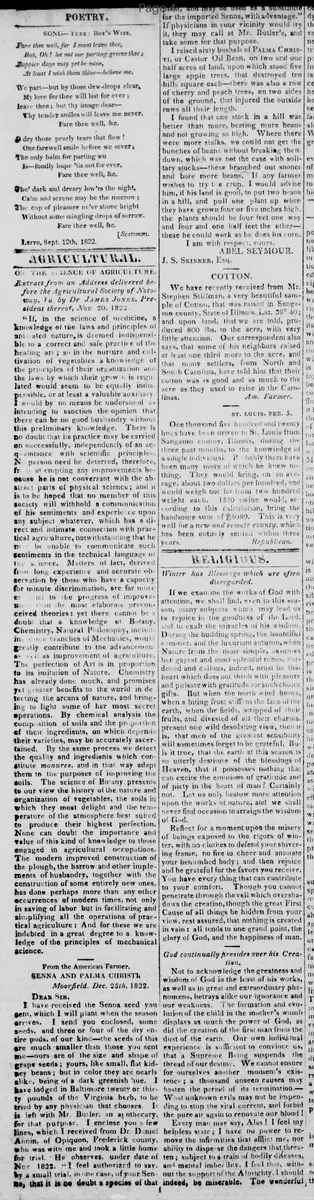
I have received the Senna seed you sent, which I will plant when the season arrives. I send you enclosed, some seeds, and three or four of the dry entire pods, of our kind—the seeds of this are much smaller than those you sent me—ours are of the size and shape of grape seeds; yours, like small, flat kidney beans; but in color they are nearly alike, being of a dark greenish hue. I have lodged in Baltimore twenty or thirty pounds of the Virginia herb, to be tried by any physician that chooses. It is left with Mr. Butler, an apothecary, for that purpose. I enclose you a few lines, which I received from Dr. Daniel Annin, of Opiquon, Frederick county, who was with me and took a little home for trial. He observes, under date of Nov. 1822, "I feel authorized to say, by a small trial, in one case, of your Senna, that it is no doubt a species of that plant and may be used as a substitute for the imported Senna, with advantage." If physicians in your vicinity would try it, they may call at Mr. Butler's, and take some for that purpose.
I raised sixty bushels of Palma CHRISTI, or Castor Oil Bean, on two and one half acres of land, upon which stood five large apple trees, that destroyed ten hills square each—there was also a row of cherry and peach trees, on two sides of the ground, that injured the outside rows all their length. I found that one stock in a hill was better than more, bearing more beans and not growing so high. Where there were more stalks, we could not get the bunches of beans without breaking them down, which was not the case with solitary stocks—these branched out sooner and bore more beans. If any farmer wishes to try the crop, I would advise him, if his land is good, to put two beans in a hill, and pull one plant up when they have grown four or five inches high. The plants should be four feet one way and four and one half feet the other—these he could work as he does his corn.
I am with respect, yours,
ABEL SEYMOUR.
J. S. SKINNER, Esq.
SENNA AND PALMA CHRISTI
Moorfield, Dec. 25th, 1822.
DEAR SIR,
I have received the Senna seed you sent, which I will plant when the season arrives. I send you enclosed, some seeds, and three or four of the dry entire pods, of our kind—the seeds of this are much smaller than those you sent me—ours are of the size and shape of grape seeds; yours, like small, flat kidney beans; but in color they are nearly alike, being of a dark greenish hue. I have lodged in Baltimore twenty or thirty pounds of the Virginia herb, to be tried by any physician that chooses. It is left with Mr. Butler, an apothecary, for that purpose. I enclose you a few lines, which I received from Dr. Daniel Annin, of Opiquon, Frederick county, who was with me and took a little home for trial. He observes, under date of Nov. 1822, "I feel authorized to say, by a small trial, in one case, of your Senna, that it is no doubt a species of that plant and may be used as a substitute for the imported Senna, with advantage." If physicians in your vicinity would try it, they may call at Mr. Butler's, and take some for that purpose.
I raised sixty bushels of Palma CHRISTI, or Castor Oil Bean, on two and one half acres of land, upon which stood five large apple trees, that destroyed ten hills square each—there was also a row of cherry and peach trees, on two sides of the ground, that injured the outside rows all their length. I found that one stock in a hill was better than more, bearing more beans and not growing so high. Where there were more stalks, we could not get the bunches of beans without breaking them down, which was not the case with solitary stocks—these branched out sooner and bore more beans. If any farmer wishes to try the crop, I would advise him, if his land is good, to put two beans in a hill, and pull one plant up when they have grown four or five inches high. The plants should be four feet one way and four and one half feet the other—these he could work as he does his corn.
I am with respect, yours,
ABEL SEYMOUR.
J. S. SKINNER, Esq.
What sub-type of article is it?
Informative
What themes does it cover?
Agriculture
What keywords are associated?
Senna Seeds
Virginia Senna
Palma Christi
Castor Oil Bean
Farming Advice
Physician Trials
Crop Yield
What entities or persons were involved?
Abel Seymour
J. S. Skinner, Esq.
Letter to Editor Details
Author
Abel Seymour
Recipient
J. S. Skinner, Esq.
Main Argument
shares details on cultivating and trialing local virginia senna as a substitute for imported variety and provides practical advice on growing palma christi for higher yields.
Notable Details
Dr. Daniel Annin's Endorsement Of Virginia Senna
Raised 60 Bushels On 2.5 Acres Despite Fruit Trees
Planting Advice: Single Stalk Per Hill, Spaced 4x4.5 Feet