Thank you for visiting SNEWPapers!
Sign up free
The Liberator
Boston, Suffolk County, Massachusetts
What is this article about?
The Glasgow Emancipation Society held its tenth annual meeting on May 1-2, 1847, adopting resolutions expressing support for American abolitionists, condemning slavery, advocating free labor in British colonies via African emigration, and urging action on Indian personal freedom laws.
Clipping
OCR Quality
Full Text
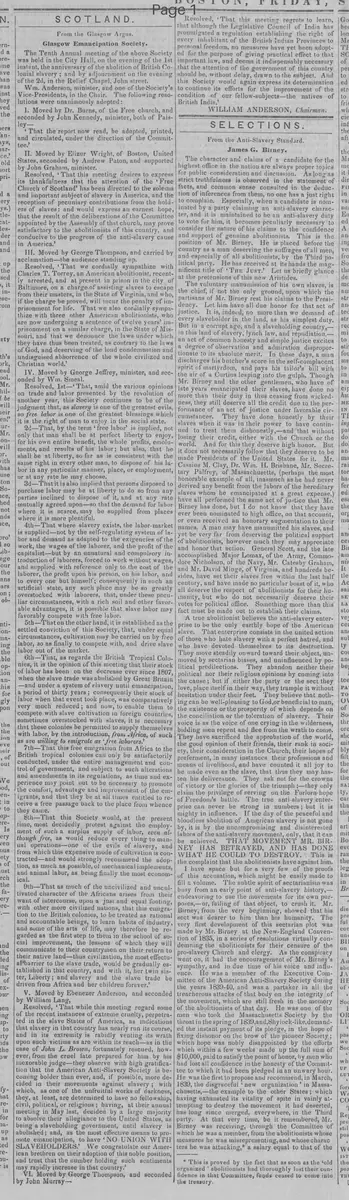
From the Glasgow Argus.
Glasgow Emancipation Society.
The Tenth Annual meeting of the above Society was held in the City Hall, on the evening of the 1st instant, the anniversary of the abolition of British Colonial slavery; and by adjournment on the evening of the 2d, in the Relief Chapel, John street. Wm. Anderson, minister, and one of the Society's Vice-Presidents, in the Chair. The following resolutions were unanimously adopted:
I. Moved by Dr. Burns, of the Free church, and seconded by John Kennedy, minister, both of Paisley—That the report now read, be adopted, printed and circulated, under the direction of the Committee.
II. Moved by Elizur Wright, of Boston, United States, seconded by Andrew Paton, and supported by John Graham, minister.
Resolved, That this meeting desires to express its thankfulness that the attention of the 'Free Church of Scotland' has been directed to the solemn and important subject of slavery in America, and the reception of pecuniary contributions from the holders of slaves: and would express an earnest hope, that the result of the deliberations of the Committee appointed by the Assembly of that church, may prove satisfactory to the abolitionists of this country, and conducive to the progress of the anti-slavery cause in America.
III. Moved by George Thompson, and carried by acclamation—the audience standing up.
Resolved, 'That we cordially sympathize with Charles T. Torrey, an American abolitionist, recently arrested, and at present in prison in the city of Baltimore, on a charge of assisting slaves to escape from their masters, in the State of Virginia, and who, if the charge be proved, will incur the penalty of imprisonment for life. That we also cordially sympathize with three other American abolitionists, who are now undergoing a sentence of twelve years' imprisonment on a similar charge, in the State of Missouri, and that we denounce the laws under which they have thus been treated, as contrary to the laws of God, and deserving of the loud condemnation and undisguised abhorrence of the whole civilized and Christian world.'
IV. Moved by George Jeffrey, minister, and seconded by Wm. Smeal.
Resolved, 1st—'That, amid the various opinions on trade and labor presented by the revolution of another year, this Society continues to be of the judgment that, as slavery is one of the greatest evils so free labor is one of the greatest blessings which it is the right of man to enjoy in the social state.
2d—That, by the term 'free labor' is implied, not only that man shall be at perfect liberty to enjoy, for his own entire benefit, the whole profits, emoluments, and results of his labor; but also, that he shall be at liberty, so far as is consistent with the same right in every other man, to dispose of his labor in any particular manner, place, or employment, or at any rate he may choose.
3d—That it is also implied that persons disposed to purchase labor may be at liberty to do so from any parties inclined to dispose of it, and at any rate mutually agreed upon—so that the demand for labor where it is scarce, may be supplied from places where it is more plentiful.
4th—That where slavery exists, the labor-market is supplied—not by the self-regulating system of labor and demand as adapted to the exigencies of the work, the wages of the laborer, and the profit of the capitalist—but by an unnatural and compulsory introduction of laborers, forced to work without wages, and supplied with reference only to the cost of the laborer, the profit upon his person, on his labor, and to every one but himself; consequently in such an artificial state, any such place may be so greatly overstocked with laborers, that, under these peculiar circumstances, with a rich soil and other favorable advantages, it is possible that slave labor may favorably compete with free labor.
5th—That on the other hand, it is established as the settled conviction of this Society, that, under equal circumstances, cultivation may be carried on by free labor, so as finally to compete with, and drive slave labor out of the market.
6th—That, as regards the British Tropical Colonies, it is the opinion of this meeting that their stock of labor has been on the decrease ever since 1807, when the slave trade was abolished by Great Britain—and under a system of slavery until emancipation, a period of thirty years; consequently their stock of labor when that event took place, was comparatively very much reduced; and now, to enable them to compete with slave cultivation in foreign countries, sometimes overstocked with slaves, it is necessary that these colonies be permitted to supply themselves with labor, by the introduction, from Africa, of such as are willing to emigrate as 'free laborers.'
7th—That this free emigration from Africa to the British tropical colonies can only be satisfactorily conducted, under the entire management and control of government, and subject to such alterations and amendments in its regulations, as time and experience may point out to be necessary to promote the comfort, advantage and improvement of the emigrants, and that they be at all times entitled to receive a free passage back to the place from whence they came.
8th—That this Society would, at the present time, most decidedly protest against the employment of such a surplus supply of labor, even although free, as would reduce every thing to manual operations—one of the evils of slavery, and from which this expensive mode of cultivation is contracted—and would strongly recommend the adoption, as much as possible, of mechanical implements, and animal labor, as being finally the most economical.
9th—That as much of the uncivilized and uncultivated character of the Africans arises from their want of intercourse, upon a just and equal footing, with other more civilized nations, that this emigration to the British colonies, to be treated as rational and accountable beings, to learn habits of industry, and some of the arts of life, may therefore be regarded as the first step to them in the school of social improvement, the lessons of which they will communicate to their countrymen on their return to their native land—thus civilization, the most effectual barrier to the slave trade, would be gradually established in that country, and with it, her twin sister, Liberty; and slavery and the slave trade be driven from Africa and her children forever.
V. Moved by Ebenezer Anderson, and seconded by William Lang.
Resolved, That while this meeting regard some of the recent instances of extreme cruelty, perpetrated in the slave States of America, as indications that slavery in that country has nearly run its course, and in its extremity is rabidly venting its wrath upon such victims as are within its reach—as in the case of John L. Brown, fortunately rescued, however, from the cruel fate prepared for him by his inexorable judge—they observe with high gratification that the American Anti-Slavery Society is becoming bolder than ever, and, if possible, more decided in their movements against slavery; with which, as one of the unfruitful works of darkness, they, at least, are determined to have no fellowship, civil, political, or religious; having, at their annual meeting in May last, decided by a large majority to absolve their allegiance to the United States, as being a slaveholding government, until slavery is abolished; and, as the most effective means to promote emancipation, to have 'NO UNION WITH SLAVEHOLDERS.' We congratulate our American brethren on their adoption of this noble position, and trust that the number holding such sentiments may rapidly increase in that country.
VI. Moved by George Thompson, and seconded by John Murray—
Resolved, 'That this meeting regrets to learn, that although the Legislative Council of India has promulgated a regulation establishing the right of every inhabitant of the British Indian Provinces to personal freedom, no measures have yet been adopted for the purpose of giving practical effect to that important law, and deems it indispensably necessary that the attention of the government of this country should be, without delay, drawn to the subject. And this Society would again express its determination to continue its efforts for the improvement of the condition of our fellow-subjects—the natives of British India.'
WILLIAM ANDERSON, Chairman.
What sub-type of article is it?
What keywords are associated?
What entities or persons were involved?
Where did it happen?
Foreign News Details
Primary Location
United States
Event Date
Evening Of The 1st Instant, And By Adjournment On The Evening Of The 2d
Key Persons
Outcome
resolutions adopted supporting american abolitionists, advocating free labor and african emigration to british colonies, and urging implementation of indian freedom laws; sympathy expressed for imprisoned abolitionists facing life sentences or 12 years imprisonment.
Event Details
The Glasgow Emancipation Society's tenth annual meeting adopted six resolutions: adopting the report; thanking the Free Church of Scotland for addressing American slavery; sympathizing with imprisoned American abolitionists Charles T. Torrey and others, denouncing slave laws; affirming free labor principles and recommending African emigration to British tropical colonies under government control; noting American anti-slavery progress and 'No Union with Slaveholders' stance; regretting lack of implementation of Indian personal freedom law and committing to efforts for Indian natives.