Thank you for visiting SNEWPapers!
Sign up free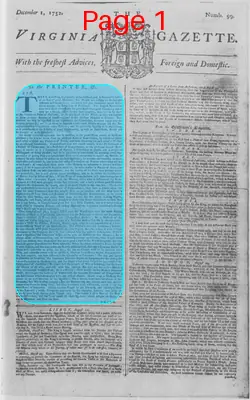
Letter to Editor
December 1, 1752
The Virginia Gazette
Richmond, Williamsburg, Richmond County, Virginia
What is this article about?
This letter advocates for the cultivation of good manners and complaisance in English society, arguing it fosters social harmony more than intellectual prowess alone. It contrasts the erudite but rude Cleora with the amiable, unlearned Teraminta, emphasizing politeness's importance, especially for women.
Clipping
OCR Quality
98%
Excellent
Full Text
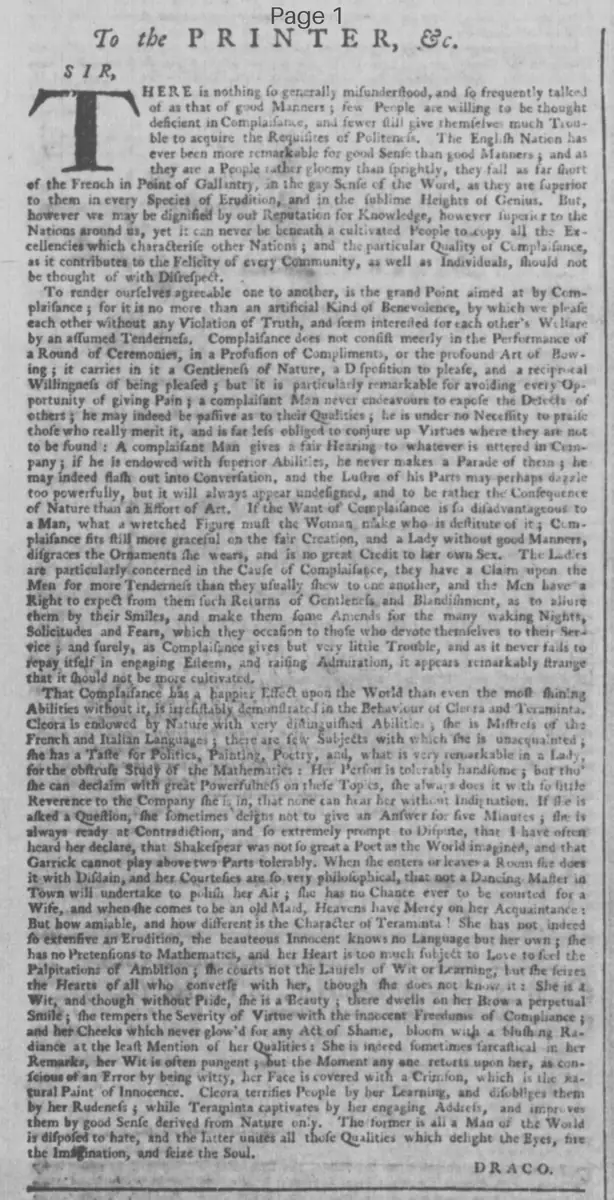
To the PRINTER, &c.
SIR,
HERE is nothing so generally misunderstood, and so frequently talked of as that of good Manners; few People are willing to be thought deficient in Complaisance, and fewer still give themselves much Trouble to acquire the Requisites of Politeness. The English Nation has ever been more remarkable for good Sense than good Manners; and as they are a People rather gloomy than sprightly, they fall as far short of the French in Point of Gallantry, in the gay Sense of the Word, as they are superior to them in every Species of Erudition, and in the sublime Heights of Genius. But, however we may be dignified by our Reputation for Knowledge, however superior to the Nations around us, yet it can never be beneath a cultivated People to copy all those Excellencies which characterize other Nations; and the particular Quality of Complaisance, as it contributes to the Felicity of every Community, as well as Individuals, should not be thought of with Disrespect.
To render ourselves agreeable one to another, is the grand Point aimed at by Complaisance; for it is no more than an artificial Kind of Benevolence, by which we please each other without any Violation of Truth, and become interested for each other's Welfare by an assumed Tenderness. Complaisance does not consist merely in the Performance of a Round of Ceremonies, in a Profusion of Compliments, or the profound Art of Bowing; it carries in it a Gentleness of Nature, a Disposition to please, and a reciprocal Willingness of being pleased; but it is particularly remarkable for avoiding every Opportunity of giving Pain; a complaisant Man never endeavours to expose the Defects of others; he may indeed be passive as to their Qualities; he is under no Necessity to praise those who really merit it, and is far less obliged to conjure up Virtues where they are not to be found: A complaisant Man gives a fair Hearing to whatever is uttered in Company; if he is endowed with superior Abilities, he never makes a Parade of them; he may indeed flash out into Conversation, and the Lustre of his Parts may perhaps dazzle too powerfully, but it will always appear undesigned, and to be rather the Consequence of Nature than an Effort of Art. If the Want of Complaisance is so disadvantageous to a Man, what a wretched Figure must the Woman make who is destitute of it; Complaisance sits still more graceful on the fair Creation, and a Lady without good Manners, disgraces the Ornaments she wears, and is no great Credit to her own Sex. The Ladies are particularly concerned in the Cause of Complaisance, they have a Claim upon the Men for more Tenderness than they usually shew to one another, and the Men have a Right to expect from them such Returns of Gentleness and Blandishment, as to allure them by their Smiles, and make them some Amends for the many waking Nights, Solicitudes and Fears, which they occasion to those who devote themselves to their Service: and surely, as Complaisance gives but very little Trouble, and as it never fails to repay itself in engaging Esteem, and raising Admiration, it appears remarkably strange that it should not be more cultivated.
That Complaisance has a happier Effect upon the World than even the most shining Abilities without it, is irresistibly demonstrated in the Behaviour of Cleora and Teraminta. Cleora is endowed by Nature with very distinguished Abilities; she is Mistress of the French and Italian Languages; there are few Subjects with which She is unacquainted; She has a Taste for Politics, Painting, Poetry, and, what is very remarkable in a Lady, for the abstruse Study of the Mathematics: Her Person is tolerably handsome; but tho' she can declaim with great Powerfulness on these Topics, she always does it with so little Reverence to the Company she is in, that none can hear her without Indignation. If she is asked a Question, she sometimes deigns not to give an Answer for five Minutes; she is always ready at Contradiction, and so extremely prompt to Dispute, that I have often heard her declare, that Shakespear was not so great a Poet as the World imagined, and that Garrick cannot play above two Parts tolerably. When she enters or leaves a Room she does it with Disdain, and her Courtesies are so very philosophical, that not a Dancing Master in Town will undertake to polish her Air; she has no Chance ever to be courted for a Wife, and when she comes to be an old Maid, Heavens have Mercy on her Acquaintance: But how amiable, and how different is the Character of Teraminta! She has not indeed so extensive an Erudition, the beauteous Innocent knows no Language but her own; She has no Pretensions to Mathematics, and her Heart is too much subject to Love to feel the Palpitations of Ambition; she courts not the Laurels of Wit or Learning, but she seizes the Hearts of all who converse with her, though she does not know it: She is a Wit, and though without Pride, she is a Beauty; there dwells on her Brow a perpetual Smile; she tempers the Severity of Virtue with the innocent Freedom of Compliance; and her Cheeks which never glow'd for any Act of Shame, blush with a blushing Radiance at the least Mention of her Qualities: She is indeed sometimes satirical in her Remarks, her Wit is often pungent; but the Moment any one retorts upon her, as conscious of an Error by being witty, her Face is covered with a Crimson, which is the natural Paint of Innocence. Cleora terrifies People by her Learning, and disobliges them by her Rudeness; while Teraminta captivates by her engaging Address, and improves them by good Sense derived from Nature only. The former is all a Man of the World is disposed to hate, and the latter unites all those Qualities which delight the Eyes, fire the Imagination, and seize the Soul.
DRACO.
SIR,
HERE is nothing so generally misunderstood, and so frequently talked of as that of good Manners; few People are willing to be thought deficient in Complaisance, and fewer still give themselves much Trouble to acquire the Requisites of Politeness. The English Nation has ever been more remarkable for good Sense than good Manners; and as they are a People rather gloomy than sprightly, they fall as far short of the French in Point of Gallantry, in the gay Sense of the Word, as they are superior to them in every Species of Erudition, and in the sublime Heights of Genius. But, however we may be dignified by our Reputation for Knowledge, however superior to the Nations around us, yet it can never be beneath a cultivated People to copy all those Excellencies which characterize other Nations; and the particular Quality of Complaisance, as it contributes to the Felicity of every Community, as well as Individuals, should not be thought of with Disrespect.
To render ourselves agreeable one to another, is the grand Point aimed at by Complaisance; for it is no more than an artificial Kind of Benevolence, by which we please each other without any Violation of Truth, and become interested for each other's Welfare by an assumed Tenderness. Complaisance does not consist merely in the Performance of a Round of Ceremonies, in a Profusion of Compliments, or the profound Art of Bowing; it carries in it a Gentleness of Nature, a Disposition to please, and a reciprocal Willingness of being pleased; but it is particularly remarkable for avoiding every Opportunity of giving Pain; a complaisant Man never endeavours to expose the Defects of others; he may indeed be passive as to their Qualities; he is under no Necessity to praise those who really merit it, and is far less obliged to conjure up Virtues where they are not to be found: A complaisant Man gives a fair Hearing to whatever is uttered in Company; if he is endowed with superior Abilities, he never makes a Parade of them; he may indeed flash out into Conversation, and the Lustre of his Parts may perhaps dazzle too powerfully, but it will always appear undesigned, and to be rather the Consequence of Nature than an Effort of Art. If the Want of Complaisance is so disadvantageous to a Man, what a wretched Figure must the Woman make who is destitute of it; Complaisance sits still more graceful on the fair Creation, and a Lady without good Manners, disgraces the Ornaments she wears, and is no great Credit to her own Sex. The Ladies are particularly concerned in the Cause of Complaisance, they have a Claim upon the Men for more Tenderness than they usually shew to one another, and the Men have a Right to expect from them such Returns of Gentleness and Blandishment, as to allure them by their Smiles, and make them some Amends for the many waking Nights, Solicitudes and Fears, which they occasion to those who devote themselves to their Service: and surely, as Complaisance gives but very little Trouble, and as it never fails to repay itself in engaging Esteem, and raising Admiration, it appears remarkably strange that it should not be more cultivated.
That Complaisance has a happier Effect upon the World than even the most shining Abilities without it, is irresistibly demonstrated in the Behaviour of Cleora and Teraminta. Cleora is endowed by Nature with very distinguished Abilities; she is Mistress of the French and Italian Languages; there are few Subjects with which She is unacquainted; She has a Taste for Politics, Painting, Poetry, and, what is very remarkable in a Lady, for the abstruse Study of the Mathematics: Her Person is tolerably handsome; but tho' she can declaim with great Powerfulness on these Topics, she always does it with so little Reverence to the Company she is in, that none can hear her without Indignation. If she is asked a Question, she sometimes deigns not to give an Answer for five Minutes; she is always ready at Contradiction, and so extremely prompt to Dispute, that I have often heard her declare, that Shakespear was not so great a Poet as the World imagined, and that Garrick cannot play above two Parts tolerably. When she enters or leaves a Room she does it with Disdain, and her Courtesies are so very philosophical, that not a Dancing Master in Town will undertake to polish her Air; she has no Chance ever to be courted for a Wife, and when she comes to be an old Maid, Heavens have Mercy on her Acquaintance: But how amiable, and how different is the Character of Teraminta! She has not indeed so extensive an Erudition, the beauteous Innocent knows no Language but her own; She has no Pretensions to Mathematics, and her Heart is too much subject to Love to feel the Palpitations of Ambition; she courts not the Laurels of Wit or Learning, but she seizes the Hearts of all who converse with her, though she does not know it: She is a Wit, and though without Pride, she is a Beauty; there dwells on her Brow a perpetual Smile; she tempers the Severity of Virtue with the innocent Freedom of Compliance; and her Cheeks which never glow'd for any Act of Shame, blush with a blushing Radiance at the least Mention of her Qualities: She is indeed sometimes satirical in her Remarks, her Wit is often pungent; but the Moment any one retorts upon her, as conscious of an Error by being witty, her Face is covered with a Crimson, which is the natural Paint of Innocence. Cleora terrifies People by her Learning, and disobliges them by her Rudeness; while Teraminta captivates by her engaging Address, and improves them by good Sense derived from Nature only. The former is all a Man of the World is disposed to hate, and the latter unites all those Qualities which delight the Eyes, fire the Imagination, and seize the Soul.
DRACO.
What sub-type of article is it?
Social Critique
Persuasive
Reflective
What themes does it cover?
Social Issues
Morality
What keywords are associated?
Good Manners
Complaisance
Social Politeness
Women's Roles
English Society
Intellectual Vs Amiable
What entities or persons were involved?
Draco.
The Printer
Letter to Editor Details
Author
Draco.
Recipient
The Printer
Main Argument
complaisance, or good manners, is essential for social harmony and personal appeal, surpassing the value of intellectual abilities alone, particularly for women, as illustrated by the contrasting characters of the learned but rude cleora and the amiable teraminta.
Notable Details
Contrasts English Good Sense With French Gallantry
References To Shakespeare And Garrick
Examples Of Cleora's Rudeness And Teraminta's Charm