Thank you for visiting SNEWPapers!
Sign up free
The Daily Herald
New Haven, New Haven County, Connecticut
What is this article about?
On the night of November 18 at Yale College, a spectacular auroral display illuminated the northern sky, featuring crimson columns, luminous arches, undulatory flashes, and shooting stars. Magnetic disturbances were noted, with the needle deflecting significantly, and temperatures dropped to 31°F with frost.
Clipping
OCR Quality
Full Text
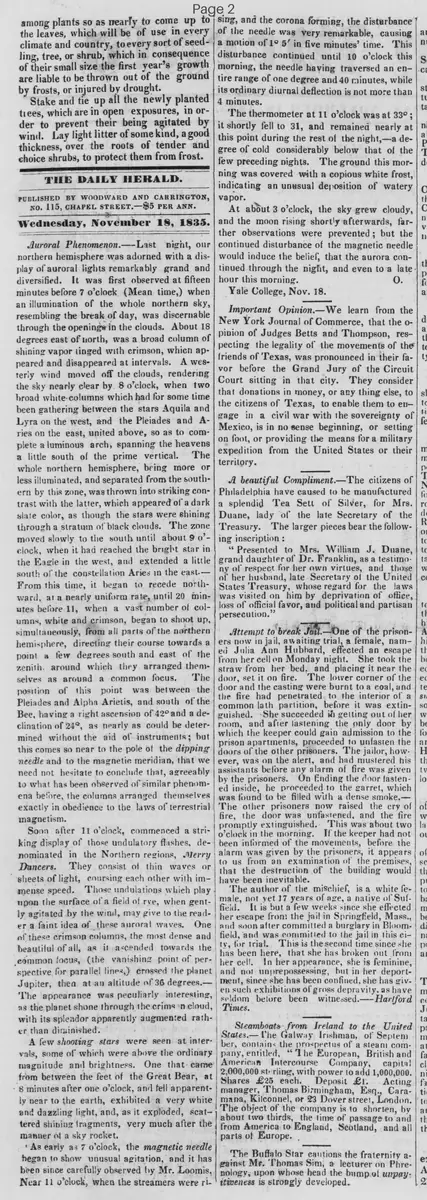
The whole northern hemisphere, being more or less illuminated, and separated from the southern by this zone, was thrown into striking contrast with the latter, which appeared of a dark slate color, as though the stars were shining through a stratum of black clouds. The zone moved slowly to the south until about 9 o'clock, when it had reached the bright star in the Eagle in the west, and extended a little south of the constellation Aries in the east. From this time, it began to recede northward, at a nearly uniform rate, until 20 minutes before 11, when a vast number of columns, white and crimson, began to shoot up, simultaneously, from all parts of the northern hemisphere, directing their course towards a point a few degrees south and east of the zenith, around which they arranged themselves as around a common focus. The position of this point was between the Pleiades and Alpha Arietis, and south of the Bee, having a right ascension of 42° and a declination of 24°, as nearly as could be determined without the aid of instruments; but this comes so near to the pole of the dipping needle and to the magnetic meridian, that we need not hesitate to conclude that, agreeably to what has been observed of similar phenomena before, the columns arranged themselves exactly in obedience to the laws of terrestrial magnetism.
Soon after 11 o'clock, commenced a striking display of those undulatory flashes, denominated in the Northern regions, Merry Dancers. They consist of thin waves or sheets of light, coursing each other with immense speed. Those undulations which play upon the surface of a field of rye, when gently agitated by the wind, may give to the reader a faint idea of these auroral waves. One of these crimson columns, the most dense and beautiful of all, as it ascended towards the common focus, (the vanishing point of perspective for parallel lines,) crossed the planet Jupiter, then at an altitude of 36 degrees. The appearance was peculiarly interesting, as the planet shone through the crimson cloud, with its splendor apparently augmented rather than diminished.
A few shooting stars were seen at intervals, some of which were above the ordinary magnitude and brightness. One that came from between the feet of the Great Bear, at 8 minutes after one o'clock, and fell apparently near to the earth, exhibited a very white and dazzling light, and, as it exploded, scattered shining fragments, very much after the manner of a sky rocket.
As early as 7 o'clock, the magnetic needle began to show unusual agitation, and it has been since carefully observed by Mr. Loomis. Near 11 o'clock, when the streamers were rising, and the corona forming, the disturbance of the needle was very remarkable, causing a motion of 1° 5' in five minutes' time. This disturbance continued until 10 o'clock this morning, the needle having traversed an entire range of one degree and 40 minutes, while its ordinary diurnal deflection is not more than 4 minutes.
The thermometer at 11 o'clock was at 33°; it shortly fell to 31, and remained nearly at this point during the rest of the night,—a degree of cold considerably below that of the few preceding nights. The ground this morning was covered with a copious white frost, indicating an unusual deposition of watery vapor.
At about 3 o'clock, the sky grew cloudy, and the moon rising shortly afterwards, further observations were prevented; but the continued disturbance of the magnetic needle would induce the belief, that the aurora continued through the night, and even to a late hour this morning.
Yale College, Nov. 18.
What sub-type of article is it?
What keywords are associated?
What entities or persons were involved?
Where did it happen?
Domestic News Details
Primary Location
Yale College
Event Date
Nov. 18
Key Persons
Outcome
no casualties; magnetic needle disturbance continued until 10 o'clock morning; temperature fell to 31° with frost.
Event Details
A grand display of auroral lights observed from 6:45 PM to 3 AM, including crimson columns, luminous arch, undulatory flashes, shooting stars, and magnetic agitation.