Thank you for visiting SNEWPapers!
Sign up free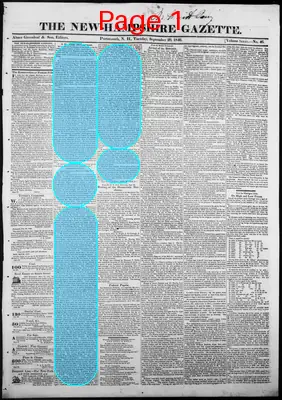
The New Hampshire Gazette
Portsmouth, Rockingham County, New Hampshire
What is this article about?
Rev. Abel Brown Jr., a Baptist minister in Northampton, Massachusetts, exposes in a letter the Whig party's deceptive efforts to win Abolitionist votes for Gen. Wm. H. Harrison in the 1840 election by misrepresenting his anti-slavery stance. He describes facing slander, threats, and abuse from Whigs for revealing these tactics and rebuking their immoral political activities.
Clipping
OCR Quality
Full Text
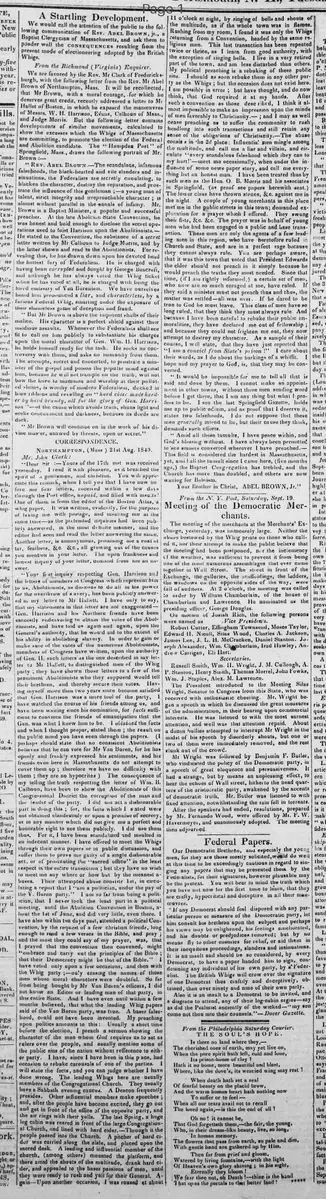
We would call the attention of the public to the following communication of Rev. ABEL BROWN, jr., a Baptist Clergyman of Massachusetts, and ask them to ponder well the consequences resulting from the present mode of electioneering adopted by the British Whigs.
From the Richmond (Virginia) Enquirer.
We are favored by the Rev. Mr Clark of Fredericksburg, with the following letter from the Rev. Mr Abel Brown of Northampton, Mass. It will be recollected, that Mr Brown, with a moral courage, for which he deserves great credit, recently addressed a letter to Mr Hallet of Boston, in which he exposed the manoeuvres of Messrs. W. H. Harrison, Evans, Calhoun of Mass., and Judge Morris. But the following letter contains developments of similar movements, calculated to show the excesses which the Whigs of Massachusetts are committing, to promote the election of the Federal and Abolition candidate. The "Hampden Post" of Springfield, Mass., draws the following portrait of Mr. Brown :-
"Rev. ABEL BROWN.-The scandalous, infamous falsehoods, the black-hearted and vile slanders and insinuations, the Federalists are secretly circulating, to blacken the character, destroy the reputation, and prostrate the influence of this gentleman ;-a young man of talent, strict integrity and irreproachable character ; is almost without parallel in the annals of infamy. Mr. Brown is a Baptist Minister, a popular and successful preacher. At the late Abolition State Convention, he was honest and bold enough to disclose the secret operations used to foist Harrison upon the Abolitionists. He stated to the Convention, the substance of a secret letter written by Mr Calhoun to Judge Morris, and by the latter shown and read to the Abolitionists. For revealing this, he has drawn down upon his devoted head the hottest fury of Federalism. He is charged with having been corrupted and bought by George Bancroft, and although he has always voted the Whig ticket when he has voted at all, he is charged with being the bribed emissary of Van Burenism. We have ourselves heard him pronounced a liar, and characterless, by a furious Federal Whig, smarting under the exposure of their shameless game of deception and fraud.
But Mr Brown is above the impotent shafts of their malice. His character is a perfect shield against their insidious assaults. Whenever the Federalists shall see fit to call on him publicly to substantiate his charges upon the moral character of Gen. Wm. H. Harrison, he holds himself ready for the task. He seeks no controversy with them, and asks no immunity from them. The attempts, secret and concerted, to prostrate a minister of the gospel and poison the popular mind against him, because he will not trample on the truth, will not bow the knee to mammon and worship at their polluted shrine, is worthy of modern Federalism, decked in blue ribbons and revelling on "hard cider made harder by hard brandy, all for the glory of Gen. Harrison"-of the cause which avoids truth, shuns light and seeks concealment and darkness, because its deeds are dark.
"Mr Brown will continue on in the work of his divine master, unawed by threats, open or secret."
CORRESPONDENCE,
NORTHAMPTON, (Mass) 21st Aug. 1840.
Mr. John Clark:
…Dear sir :-Yours of the 17th inst was received yesterday. I read it with pleasure, as it breathed the spirit of a gentleman, and christian. You will appreciate this remark, when I tell you that I have now before me four letters, received within a few days through the Post Office, unpaid, and filled with insults. One of them is from the editor of the Boston Atlas, a whig paper. It was written, evidently, for the purpose of taxing me with postage, and insulting me at the same time-as the pretended inquiries had been publicly answered, in the most definite manner, and the editor had seen and read the letter answering the same. Another letter, is anonymous, promising one a coat of tar, feathers, &c. &c., all growing out of the causes you mention in your letter. The open frankness and honest inquiry of your letter, demand from me an answer.
…Your first inquiry respecting Gen. Harrison and the letters of members of Congress which represent him to us, Abolitionists, as desirous to do all in his power for the overthrow of slavery, has been publicly answered in my letter to Mr Hallet. I have only to say, that my statements in that letter are not exaggerated- Gen. Harrison and his Northern friends have been earnestly endeavoring to obtain the votes of the Abolitionists, and have told us again and again, upon the General's authority, that he would aid to the extent of his ability in abolishing slavery. In order to gain or make sure of the votes of the numerous Abolitionists, members of Congress have written, upon the authority of Gen. H. such letters as the one described in my letter to Mr Hallet, to distinguished men of the Whig party ; they have shown those letters to a few of the prominent Abolitionists who they supposed would tell their brethren, and thereby secure their votes. Having myself more than two years since become satisfied that Gen. Harrison was a mere tool of the party, I have watched the course of his friends among us, and have been waiting since his nomination, for facts sufficient to convince the friends of emancipation that the Gen. was what I knew him to be. I obtained the facts and when I thought proper, stated them ; the result on the public mind you have seen through the papers. (I perhaps should state that no consistent Abolitionists believes that he can vote for Mr Van Buren, for he has openly and frankly expressed his sentiments, and his friends even here in Massachusetts do not attempt to cover them up ; therefore we have no difficulty with them ; they are no hypocrites) The consequence of my telling the truth respecting the letter of Win. B. Calhoun, have been to show the Abolitionists of this Congressional District the corruption of the man and the leader of the party. I did not act a dishonorable part in doing this ; for, the facts which I stated were not obtained clandestinely or upon a promise of secrecy, or in any manner which did not give me a perfect and honorable right to use them publicly. I did use them thus. For it, I have been scandalized and insulted in an indecent manner. I have offered to meet the Whigs through their own papers or in public discussion, and suffer them to prove me guilty of a single dishonorable act. or of prostituting the “sacred office” in the least respect in the entire transaction ; but they have no wish to meet me any where or how but by the meanest abuses. Their attempted abuse consists 1st, in circulating a report that I am a politician, under the pay of the V. Buren party.” I am so far from being a politician, that I never took the least part in a political meeting, until the Abolition Convention in Boston, about the 1st of June, and did very little, even there. I have also within ten days past, attended a political Convention, by the request of a few christian friends, long enough to read a few verses in the Bible, and pray ; and the most they could say of my prayer, was, that I prayed that the convention then convened, might "embrace and carry out the principles of the Bible; that their Democracy might be that of the Bible."I have voted only upon a few occasions, and then with the Whig party ;-only erasing the names of those men whose moral characters were doubtful. So far from being bought by Mr Van Buren's officers, I did not know an Editor or leading man of that party, in this entire State. And I have even until within a few months believed, that what the leading Whig papers said of the Van Buren party, was true. A baser falsehood, could not have been invented. My preaching upon politics amounts to this: Usually a short time before the election, I preach a sermon showing the character of the men whom God requires us to set as rulers over the people, and usually mention some of the public sins of the nation without reference to either party. I have, since I have been in this place, had occasion to rebuke carousals of one of the parties. I will state the facts, and you can judge whether I have done wrong. The leading Whigs here are usually members of the Congregational Church. They usually have a Sabbath evening caucus. A Deacon frequently presides. Other influential members make speeches ; and, after the people have become excited, they go out and get in front of the office of the opposite party, and the air rings with their yells. The last Spring, a huge log cabin was reared in front of the large Congregational Church, and lined with hard cider.-Through it the people passed into the Church. A pitcher of hard cider was carried along the aisle, and placed upon the sacred desk. A leading and influential member of the church, (among others) mounted the platform, and there amid the shouts of the multitude, drank hard cider, and appealed to the baser passions of men, until they were ready to rush and yell for their General. Again-Upon another occasion, I was roused at about 11 o'clock at night, by ringing of bells and shouts of the multitude, as if the whole town was in flames. Rushing from my room, I found it was only the Whigs returning from a Convention, headed by the same religious men. This last transaction has been repeated twice or thrice, as I learn from good authority, with the exception of ringing bells. I live in a very retired part of the town, and am less disturbed than others. My political preaching is a rebuking of these public sins. I should as soon rebuke them in any other party as the Whigs ; but the occasion does not exist here. I am possibly in error ; but have thought, and do now think, that God required it at my hands. After such a convention as those described, I think it almost impossible to make an impression upon the minds of men favorably to Christianity.- ; and I may as well cease preaching as to suffer the community to rush headlong into such transactions and still retain any sense of the obligations of Christianity.-The abuse consists in the 2d place: Influential men mingle among the multitude, and call me a liar and villain, and circulate "every scandalous falsehood which they can to my hurt!'-meet me occasionally, when under the influence of some news paper story, and call me everything but an honest man. I have been treated thus by such men as the Hon. O. B. Morris and his associates in Springfield, (as proof see papers herewith sent.) The lower class have thrown stones, &c. against me in the night. A couple of young merchants in this place met me in the public streets in this town; demanded explanation for a prayer which I offered. They swung their fists, &c. &c. The prayer was in behalf of young men who had been engaged in a public and base transaction. These men are only the agents of a few leading men in this region, who have heretofore ruled in Church and State, and are in a perfect rage because they cannot always rule. You are perhaps aware, that it was this town that voted that President Edwards the elder should not preach in it simply because he would preach the truths they most needed. Since that time, (if I am rightly informed,) a certain set of men, who now are so much enraged at me, have ruled. If they said a minister must not preach thus and thus, the matter was settled-all was over. If he dared to be true to God he must leave. This class of men have so long ruled, that they think they must always rule. And because I have been careful to rebuke their public immoralities, they have declared me out of fellowship ; and because they could not frighten me out, they now attempt to destroy my character. As a sample of their course, I will state, that they have just reported that "I am a convict from State's prison!" I care about their words, as I do about the barkings of a whiffit. I hope and my prayer to God, is, that they may be converted.
" It would be impossible for me to tell all that is said and done by them. I cannot make an appointment in other towns, without these men sending word before I get there, that I am any thing but what I profess to be. I see the last Springfield Gazette, holds me up to public odium, and as proof that I deserve it, states two falsehoods, I do not suppose that these men generally intend to lie, but their cause they think, demands such efforts.
" Amid all these tumults, I have peace within, and God's blessing without. I have always been permitted to see sinners converted wherever I have preached.- This field is considered the hardest in Massachusetts, yet, amid all the tumult since I came here, (five months ago,) the Baptist Congregation has trebled, and the Church has more than doubled, and others are now waiting for Baptism.
Your Brother in Christ, ABEL BROWN, Jr."
What sub-type of article is it?
What themes does it cover?
What keywords are associated?
What entities or persons were involved?
Where did it happen?
Story Details
Key Persons
Location
Northampton, Massachusetts
Event Date
August 21, 1840
Story Details
Rev. Abel Brown Jr. writes a letter exposing Whig politicians' deceptive letters claiming Gen. Harrison's support for abolishing slavery to gain Abolitionist votes in the 1840 election. He describes receiving insulting letters, facing slander as a Van Buren bribe, physical threats, and church members' immoral political activities, while defending his integrity and continued ministry success.