Thank you for visiting SNEWPapers!
Sign up free
Gazette Of The United States And Daily Evening Advertiser
Philadelphia, Philadelphia County, Pennsylvania
What is this article about?
In the U.S. House of Representatives on November 25, 1794, debate continued on Mr. Fitzsimons's motion condemning self-created Democratic societies for inciting opposition to the government and excise laws, linked to western insurrections. Speakers including Sedgwick and Rutherford argued for and against. On September 27, amendments were debated and voted on, with the motion ultimately lost.
Clipping
OCR Quality
Full Text
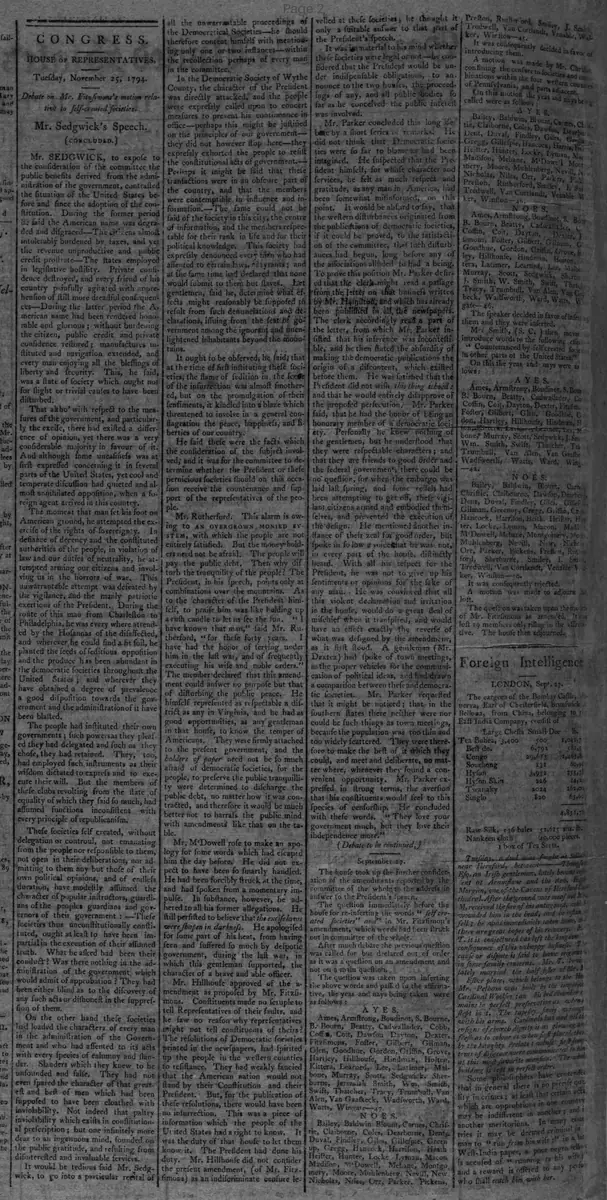
HOUSE OF REPRESENTATIVES
Tuesday, November 25, 1794.
Debate on Mr. Fitzsimons's motion relative
to self-created societies.
Mr. Sedgwick's Speech.
(CONCLUDED.)
Mr. SEDGWICK, to expose to
the consideration of the committee the
public benefits derived from the administration of the government, contrasted
the situation of the United States before
and since the adoption of the constitution. During the former period
He said the American name was degraded
and disgraced—The citizens almost
intolerably burdened by taxes, and yet
the revenue unproductive and public
credit prostrate—The states employed
in legislative hostility. Private confidence
destroyed, and every friend of his
country painfully agitated with apprehension of still more dreadful consequences—During the latter period the American name had been rendered honorable
and glorious; without burdening
the citizen, public credit and private
confidence restored; manufactures instituted and navigation extended, and
every man enjoying all the blessings of
liberty and security. This, he said,
was a state of society which ought not
for slight or trivial causes to have been
disturbed.
That altho' with respect to the measures of the government, and particularly the excise, there had existed a difference of opinion, yet there was a very
considerable majority in favour of it.
And although some uneasiness was at
first expressed concerning it in several
parts of the United States, yet cool and
temperate discussion had quieted and almost annihilated opposition, when a foreign agent arrived in this country.
The moment that man set his foot on
American ground, he attempted the exercise of the rights of sovereignty. In
defiance of decency and the constituted
authorities of the people, in violation of
law and our duties of neutrality, he attempted arming our citizens and involving us in the horrors of war. This
unwarrantable attempt was defeated by
the vigilance, and the manly patriotic
exertions of the President. During the
route of this man from Charleston to
Philadelphia, he was every where attended by the Hosannas of the disaffected,
and wherever he could find a fit soil, he
planted the seeds of seditious opposition
and the produce has been abundant in
the democratic societies throughout the
United States; and wherever they
have obtained a degree of prevalence
a good disposition towards the government and the administration of it have
been blasted.
The people had instituted their own
governments; such powers as they pleased they had delegated and such as they
chose, they had retained. They, too,
had employed such instruments as their
wisdom dictated to express and to execute their will. But the members of
these clubs revolting from the state of
equality of which they said so much, had
assumed functions inconsistent with
every principle of republicanism.
These societies self created, without
delegation or controul, not emanating
from the people nor responsible to them,
not open in their deliberations, nor admitting to them any but those of theirown political opinions, and of endless
duration, have modestly assumed the
character of popular instructors, guardians of the peoples guardians and gov.
ernors of their government: These
societies thus unconstitutionally constituted, ought at least to have been impartial in the execution of their assumed
truth. What he asked had been their
conduct? Was there nothing in the administration of the government which
would admit of approbation? They had
been either blind as to the discovery of
any such acts or dishonest in the suppression of them.
On the other hand these societies
had loaded the characters of every man
in the administration of the Government
and who had assented to its acts
with every species of calumny and slander. Slanders which they knew to be
unfounded and false. They had not
even spared the character of that greatest and best of men which had been
supposed to have been cloathed with
inviolability. Not indeed that paltry
inviolability which exists in constitutional prescription; but one infinitely more
dear to an ingenuous mind, founded on
the public gratitude, and resulting from
disinterested and invaluable services.
It would be tedious said Mr. Sedgwick, to go into a particular recital of
all the unwarrantable proceedings of
the Democratical Societies—he should
therefore content himself with mentioning only one or two instances—within
the recollection perhaps of every man
in the committee.
In the Democratic Society of Wythe
County, the character of the President
was directly attacked, and the people
were expressly called upon to concert
measures to prevent his continuance in
office—perhaps this might be justified
on the principles of our government—they did not however stop here—they
expressly exhorted the people to resist
the constitutional acts of government.
Perhaps it might be said that these
transactions were in an obscure part of
the country, and that the members
were contemptible in influence and information.—The same could not be
said of the society in this city, the centre
of information, and the members respectable for their rank in life and for their
political knowledge. This society had
expressly denounced every man who had
assented to certain laws, tyrants; and
at the same time had declared that none
would submit to them but slaves. Let
gentlemen, said he, determine what effects might reasonably be supposed to
result from such denunciations and declarations, issuing from the seat of government among the ignorant and unenlightened inhabitants beyond the mountains.
It ought to be observed; he said; that
at the time of first instituting these societies, the flame of sedition in the scene
of the insurrection was almost smothered, but on the promulgation of their
sentiments, it kindled into a blaze which
threatened to involve in a general conflagration the peace, happiness, and liberties of our country.
He said these were the facts which
the consideration of the subject involved, and it was for the committee to determine whether the President or these
pernicious societies should on this occasion receive the countenance and support of the representatives of the people.
Mr. Rutherford: This alarm is owing
TO AN OVERGROWN MONIED SYSTEM,
with which the people are not
entirely satisfied. But the money holders need not be afraid. The people will
pay the public debt. Then why disturb the tranquility of the people? The
President, in his speech, points only at
combinations over the mountains. As
to the character of the President himself, to praise him was like holding up
a rush candle to let us see the sun. "I
have known that man," said Mr. Rutherford, "for these forty years. I
have had the honor of serving under
him in the last war, and of frequently
executing his wise and noble orders."
The member declared that this amendment could answer no purpose but that
of disturbing the public peace. He
himself represented as respectable a district as any in Virginia, and he had as
good opportunities, as any gentleman
in that house, to know the temper of
Americans. They were firmly attached
to the present government, and the
holders of paper need not be so much
afraid of democratic societies, for the
people, to preserve the public tranquility were determined to discharge the
public debt, no matter how it was contracted, and therefore it would be much
better not to harass the public mind
with amendments like that on the table.
Mr. M'Dowell rose to make an apology for some words which had escaped
him the day before. He did not expect to have been so smartly handled.
He had been forcibly struck at the time,
and had spoken from a momentary impulse. In substance, however, he adhered to all his former allegations. He
still persisted to believe that the excise laws were hatched in darkness. He apologized for some part of his heat, from having
seen and suffered so much by despotic
government, during the last war, in
which this gentleman supported, the
character of a brave and able officer.
Mr. Hillhouse approved of the amendment as proposed by Mr. Fitzsimons. Constituents made no scruple to
tell Representatives of their faults. and
he saw no reason why representatives
might not tell constituents of theirs?
The resolutions of Democratic societies
printed in the newspapers, had spirited
up the people in the western counties
to resistance. They had weakly fancied
that the American nation would not
stand by their Constitution and their
President. But, for the publication of
these resolutions, there would have been
no insurrection. This was a piece of
information which the people of the
United States had a right to know. It
was the duty of that house to let them
know it. The President had done his
duty. Mr. Hillhouse did not consider
the present amendment, (of Mr. Fitz.
mons) as an indiscriminate censure levelled at these societies; he thought it
only a suitable answer to that part of
the President's speech.
It was immaterial to his mind whether
these societies were legal or not—he considered that the President would be under indispensible obligations, to announce to the two houses, the proceedings of any, and all public bodies so
far as he conceived the public interest
was involved.
Mr. Parker concluded this long debate by a short series of remarks. He
did not think that Democratic societies were so far to blame as had been
imagined. He suspected that the President himself, for whose character and
services, he felt as much respect and
gratitude, as any man in America, had
been somewhat misinformed, on this
point. It would be absurd to say, that
the western disturbances originated from the publications of democratic societies, if it could be proved, to the satisfaction of the committee, that such disturbances had begun, long before any of the associations alluded to had a being.
To prove this position Mr. Parker desired that the clerk might read a passage from the letter on that business written by Mr. Hamilton; and which has already been published in all the newspapers.
The clerk accordingly read a part of
the letter. from which Mr. Parker inferred that his inference was incontestable; said he then stated the absurdity of
making the democratic publications the
origin of a discontent, which existed
before them. He was satisfied that the
President did not wish this thing echoed.
and that he would entirely disapprove of
the proposed persecution. Mr. Parker
said, that he had the honor of being an
honorary member of a democratic society. Personally he knew nothing of
the gentlemen, but he understood that
they were respectable characters; and
that they are friends to good order and
the federal government:, there could be
no question, for when the embargo, was
laid last spring, and some vessels had
been attempting to get off, these vigilant citizens armed and embodied themselves, and prevented the execution of
the design. He mentioned another instance of their zeal for good order, but
spoke in so low a voice that he was not,
in every part of the house, distinctly
heard. With all his respect for the
President, he was not to give up his
sentiments or opinions for the sake of
any man. He was convinced that all
this violent declamation and irritation
in the house, would do a great deal of
mischief when it transpired, and would
have an effect exactly the reverse of
what was designed by the amendment.
as it first stood. A gentleman (Mr.
Dexter) had spoke of town meetings,
as the proper vehicles for the communication of political ideas, and had drawn
a comparison between these and democratic societies. Mr. Parker requested
that it might be noticed; that in the
southern states there neither were nor
could be such things as town meetings,
because the population was too thin and
too widely scattered. They were therefore to make the best of it which they
could, and meet and deliberate, no matter where; whenever they found a convenient opportunity. Mr. Parker expressed in strong terms, the aversion
that his constituents would feel to this
species of censorship. He concluded
with these words. "They love your
government much, but they love their
independence more."
(Debate to be continued.)
September 27.
The house took up the further consideration of the amendments reported by the
committee of the whole to the address in
answer to the President's speech.
The question immediately before the
house for re-inserting the words "self-created societies" and "in Mr. Fitzsimons's
amendment, which words had been struck
out in committee of the whole.
After much debate the previous question was called for but declared out of order as it was a question on an amendment and
not on a main question.
The question was taken upon inserting
the above words and passed in the affirmative, the yeas and nays being taken were
as follows:
AYES.
Ames, Armstrong, Boudinot, S. Bourne,
B. Bourne, Beatty, Cadwallader, Cobb,
Coffin, Coit, Dayton, Dexter,
Fitzsimons, Foster, Gilbert, Gilman,
Glenn, Goodhue, Gordon, Griffin, Grove,
Hartley, Hillhouse, Hindman, Holten,
Kittera, Learned, Lee, Latimer, Malbone, Murray, Scott, Sedgwick, Sherburne, Jeremiah Smith, Wm. Smith,
Swift, Thatcher, Tracy, Trumbull, Van
Alen, Van Gaasbeck, Wadsworth, Ward,
Watts, Wingate—47.
NOES.
Bailey, Baldwin Blount, Carnes, Christie, Claiborne, Coles, Dearborne, Dent,
Duval, Findley, Giles, Gillespie, Greenup, Gregg, Hancock, Harrison, Heath
Heister, Hunter, Locke Lyman, Macon
Madison, M'Dowell, Mebane, Montgomery, Moore, Muhlenberg, Nevill, New
Nicholas, Niles, Orr, Parker. Pickens,
Preston, Rutherford, Smiley, J. Smith,
Tredwell, Van Cortlandt, Venable Walker, Winton—45.
It was consequently decided in favor of
introducing them.
A motion was made by Mr. Christie
confining the censure to societies and combinations within the four western counties of Pennsylvania, and parts adjacent.
On this motion the yeas and nays being
called were as follows:
AYES.
Bailey, Baldwin, Blount, Carnes, Christie, Claiborne, Coles, Dayton, Dearborne, Dent, Duval, Findley, Giles, Gregg, Gillespie, Hancock, Harris, Heath
Heister, Hunter, Locke, Lyman, Macon, Madison, Mebane, M'Dowell, Montgomery, Moore, Muhlenberg, Nevill, Nicholas, Niles, Orr, Parker, Pickens, Preston, Rutherford, Smiley, J. Smith,
Tredwell, Van Cortlandt, Venable Walker, Winton—46.
NOES.
Ames, Armstrong, Boudinot, S. Bourne
B. Bourne, Beatty, Cadwallader, Cobb,
Coffin, Coit, Dayton, Dexter, Fitzsimons, Foster, Gilbert, Gilman, Goodhue, Gordon, Griffin, Grove, Hartley, Hillhouse, Hindman, Holten,
Kittera, Latimer, Learned, Lee, Malbone, Murray, Scott, Sedgwick, Sherburne, J. Smith, W. Smith, Swift, Thatcher, Tracy, Trumbull, Van Alen, Van Gaasbeck, Wadsworth, Ward, Watts, Wingate—46.
The speaker decided in favor of inserting them and they were inserted.
Mr. Smith, (S. C.) then moved to
introduce words to the following effect—
Countenanced by self created societies
in other parts of the United States."
On this the yeas and nays were as follows:
AYES.
Ames, Armstrong, Boudinot, S. Bourne
B. Bourne, Beatty, Cadwallader, Coffin, Coit, Dayton, Dexter, Fitzsimons
Foster: Gilbert, Glenn, Goodhue, Gordon, Hartley, Hillhouse, Hindman, Holten, Kittera, Latimer, Learned, Lee, Malbone, Murray, Scott, Sedgwick, J. Smith
Wm. Smith, Swift, Thatcher, Tracy,
Trumbull, Van Alen, Van Gaasbeck
Wadsworth Watts, Ward, Wingate—42.
NOES.
Bailey, Baldwin, Blount, Carnes, Christie. Claibourne, Dayton, Dearborne, Dent, Duval, Findley, Giles, Gillespie
Gilman, Greenup, Gregg, Griffin, Hancock, Harrison, Heath. Heister, Hunter. Locke, Lyman, Macon, Madison
M'Dowell, Mebane, Montgomery, Moore, Muhlenberg, Nevill, New, Nicholas
Orr, Parker, Pickens, Preston, Rutherford, Sherburne, Smiley, J. Smith
Tredwell, Van Cortlandt, Venable Walker, Winton—50.
It was consequently rejected.
A motion was made to adjourn and lost.
The question was taken upon the motion of Mr. Fitzsimons as amended. It was
lost 16 members only rising in the affirmative. The house then adjourned.
What sub-type of article is it?
What keywords are associated?
What entities or persons were involved?
Where did it happen?
Domestic News Details
Primary Location
Philadelphia
Event Date
Tuesday, November 25, 1794; September 27
Key Persons
Outcome
the motion of mr. fitzsimons as amended was lost, with only 16 members rising in the affirmative. various amendments on self-created societies were debated and voted on, with mixed results including 47-45 in favor of re-inserting 'self-created societies', 46-46 tie on confining to western counties (inserted), and 42-50 against countenancing by societies elsewhere.
Event Details
Debate in the House of Representatives on Mr. Fitzsimons's motion relative to self-created societies, concluding Mr. Sedgwick's speech criticizing Democratic societies for seditious opposition and inciting insurrection against excise laws and government. Counterarguments by Mr. Rutherford attributing alarm to monied system, Mr. M'Dowell apologizing but upholding views, Mr. Hillhouse supporting amendment, and Mr. Parker defending societies. Later consideration of amendments to the address in answer to the President's speech, including votes on inserting references to self-created societies.