Thank you for visiting SNEWPapers!
Sign up free
Story
July 1, 1888
Wichita Eagle
Wichita, Sedgwick County, Kansas
What is this article about?
Descriptive account of the American Western deserts as mud plains that dry into hard surfaces in summer, with salt accumulations, deceptive mirages, and towering dust columns, contrasting sandy stereotypes.
Clipping
OCR Quality
95%
Excellent
Full Text
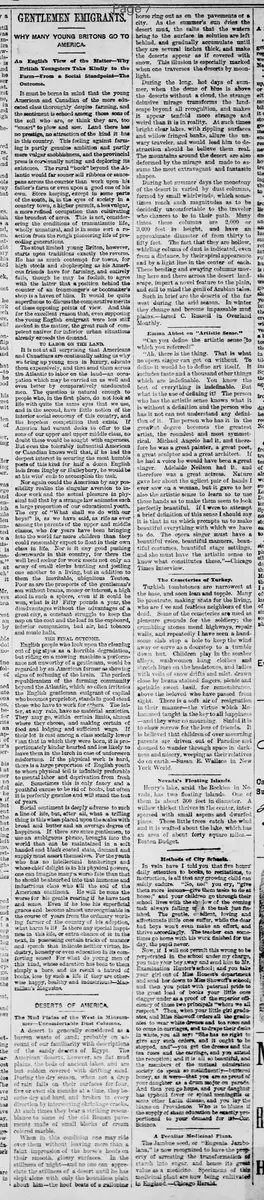
DESERTS OF AMERICA
The Mud Plains of the West in Summer-Uncomfortable Dust Columns.
A desert is generally considered as a barren waste of sand: probably on account of our familiarity with descriptions of the sandy deserts of Egypt. The American deserts, however, are flat mud plains, the beds of ancient lakes, and are but seldom covered with drifting sand.
During the dry season, when not a drop of rain falls on their surfaces for four, five or even six months at a time, they become dry and hard, and broken in every direction by intersecting shrinkage cracks. At such times they bear a striking resemblance to some of the old Roman pavements made of small blocks of cream colored marble.
When in this condition one may ride over them without leaving more than a faint impression of the horse's hoofs on their smooth, glossy surfaces. In the stillness of night and no one can appreciate the stillness of a desert until he has slept alone with only the boundless plain about him-the hoof beats of a galloping horse ring out as on the pavements of a city. As the summer's sun dries the desert mud, the salts that the waters bring to the surface in solution are left behind, and gradually accumulate until they are several inches thick, and make the deserts appear as if covered with snow. This illusion is especially marked when one traverses the deserts by moonlight.
During the long, hot days of summer, when the dome of blue is above the deserts without a cloud, the strange delusive mirage transforms the landscape beyond all recognition, and makes it appear tenfold more strange and weird than it is in reality. At such times bright clear lakes, with rippling surfaces and willow fringed banks, allure the unwary traveler, and would lead him to destruction should he believe them real. The mountains around the desert are also deformed by the mirage and made to assume the most extravagant and fantastic shapes.
During hot summer days the monotony of the desert is varied by dust columns, formed by small whirlwinds, which sometimes reach such magnitudes as to be decidedly uncomfortable to the traveler who chances to be in their path. Many times these columns are 2,000 or 3,000 feet in height, and have an approximate diameter of from thirty to fifty feet. The fact that they are hollow, whirling columns of dust is indicated, even from a distance, by their spiral appearance and by a light line in the center of each. These bending and swaying columns moving here and there across the desert landscape, impart a novel feature to the plain, and call to mind the genii of Arabian tales.
Such in brief are the deserts of the far west during the arid season. In winter they change and become impassable mud plains.-Israel C. Russell in Overland Monthly.
The Mud Plains of the West in Summer-Uncomfortable Dust Columns.
A desert is generally considered as a barren waste of sand: probably on account of our familiarity with descriptions of the sandy deserts of Egypt. The American deserts, however, are flat mud plains, the beds of ancient lakes, and are but seldom covered with drifting sand.
During the dry season, when not a drop of rain falls on their surfaces for four, five or even six months at a time, they become dry and hard, and broken in every direction by intersecting shrinkage cracks. At such times they bear a striking resemblance to some of the old Roman pavements made of small blocks of cream colored marble.
When in this condition one may ride over them without leaving more than a faint impression of the horse's hoofs on their smooth, glossy surfaces. In the stillness of night and no one can appreciate the stillness of a desert until he has slept alone with only the boundless plain about him-the hoof beats of a galloping horse ring out as on the pavements of a city. As the summer's sun dries the desert mud, the salts that the waters bring to the surface in solution are left behind, and gradually accumulate until they are several inches thick, and make the deserts appear as if covered with snow. This illusion is especially marked when one traverses the deserts by moonlight.
During the long, hot days of summer, when the dome of blue is above the deserts without a cloud, the strange delusive mirage transforms the landscape beyond all recognition, and makes it appear tenfold more strange and weird than it is in reality. At such times bright clear lakes, with rippling surfaces and willow fringed banks, allure the unwary traveler, and would lead him to destruction should he believe them real. The mountains around the desert are also deformed by the mirage and made to assume the most extravagant and fantastic shapes.
During hot summer days the monotony of the desert is varied by dust columns, formed by small whirlwinds, which sometimes reach such magnitudes as to be decidedly uncomfortable to the traveler who chances to be in their path. Many times these columns are 2,000 or 3,000 feet in height, and have an approximate diameter of from thirty to fifty feet. The fact that they are hollow, whirling columns of dust is indicated, even from a distance, by their spiral appearance and by a light line in the center of each. These bending and swaying columns moving here and there across the desert landscape, impart a novel feature to the plain, and call to mind the genii of Arabian tales.
Such in brief are the deserts of the far west during the arid season. In winter they change and become impassable mud plains.-Israel C. Russell in Overland Monthly.
What sub-type of article is it?
Curiosity
What themes does it cover?
Nature
What keywords are associated?
American Deserts
Mud Plains
Mirage
Dust Columns
Arid Season
Where did it happen?
Mud Plains Of The West, Deserts Of The Far West
Story Details
Location
Mud Plains Of The West, Deserts Of The Far West
Event Date
Summer, Arid Season
Story Details
Description of American deserts as flat mud plains that harden in summer, resembling Roman pavements, covered in salts like snow, featuring mirages of lakes and deformed mountains, and dust columns from whirlwinds.