Thank you for visiting SNEWPapers!
Sign up free
Imperial Valley Press
El Centro, Imperial County, California
What is this article about?
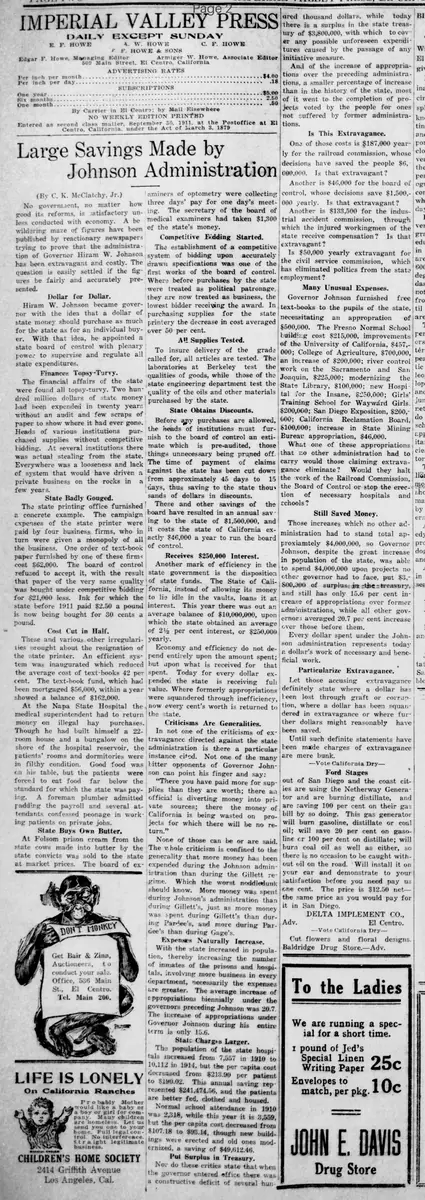
Editorial by C. K. McClatchy, Jr. defends Governor Hiram W. Johnson's California administration against accusations of extravagance, highlighting reforms like the state board of control that achieved $1,500,000 annual savings through competitive bidding, oversight, and efficiency, while increasing population and projects with lower per capita costs and a $3,800,000 surplus.
Merged-components note: Article defends Johnson administration with opinionated tone; relabeled from 'story' to 'editorial'. Image is illustrative and overlaps spatially with text.
Clipping
OCR Quality
Full Text
(By C. K. McClatchy, Jr.)
No government, no matter how good its reforms, is satisfactory unless conducted with economy.
A bewildering maze of figures have been published by reactionary newspapers trying to prove that the administration of Governor Hiram W. Johnson has been extravagant and costly. The question is easily settled if the figures be fairly and accurately presented.
Dollar for Dollar.
Hiram W. Johnson became governor with the idea that a dollar of state money should purchase as much for the state as for an individual buyer. With that idea, he appointed a state board of control with plenary power to supervise and regulate all state expenditures.
Finances Topsy-Turvy.
The financial affairs of the state were found all topsy-turvy. Two hundred million dollars of state money had been expended in twenty years without an audit and few scraps of paper to show where it had ever gone. Heads of various institutions purchased supplies without competitive bidding. At several institutions there was actual stealing from the state. Everywhere was a looseness and lack of system that would have driven a private business on the rocks in a few years.
State Badly Gouged.
The state printing office furnished a concrete example. The campaign expenses of the state printer were paid by four business firms, who in turn were given a monopoly of all the business. One order of text-book paper furnished by one of these firms cost $62,000. The board of control refused to accept it, with the result that paper of the very same quality was bought under competitive bidding for $21,000 less. Ink for which the state before 1911 paid $2.50 a pound is now being bought for 30 cents a pound.
Cost Cut in Half.
These and various other irregularities brought about the resignation of the state printer. An efficient system was inaugurated which reduced the average cost of text-books 42 per cent. The text-book fund, which had been mortgaged $56,000, within a year showed a balance of $162,000.
At the Napa State Hospital the medical superintendent had to return money on illegal hay purchases. Though he had built himself a 22-room house and a bungalow on the shore of the hospital reservoir, the patients' rooms and dormitories were in filthy condition. Good food was on his table, but the patients were forced to eat food far below the standard for which the state was paying.
A foreman plumber admitted padding the payroll and several attendants confessed peonage in working patients on private jobs.
State Buys Own Butter.
At Folsom prison cream from the state cows made into butter by the state convicts was sold to the state at market prices. The board of examiners of optometry were collecting three days' pay for one day's meeting. The secretary of the board of medical examiners had taken $1,300 of the state's money.
Competitive Bidding Started.
The establishment of a competitive system of bidding upon accurately drawn specifications was one of the first works of the board of control. Where before purchases by the state were treated as political patronage they are now treated as business, the lowest bidder receiving the award. In purchasing supplies for the state printery the decrease in cost averaged over 50 per cent.
All Supplies Tested.
To insure delivery of the grade called for, all articles are tested. The laboratories at Berkeley test the qualities of goods, while those of the state engineering department test the quality of the oils and other materials purchased by the state.
State Obtains Discounts.
Before any purchases are allowed, the heads of institutions must furnish to the board of control an estimate which is pre-audited, those things unnecessary being pruned off. The time of payment of claims against the state has been cut down from approximately 45 days to 15 days, thus saving to the state thousands of dollars in discounts.
These and other savings of the board have resulted in an annual saving to the state of $1,500,000, and it costs the state of California exactly $46,000 a year to run the board of control.
Receives $250,000 Interest.
Another mark of efficiency in the state government is the disposition of state funds. The State of California, instead of allowing its money to lie idle in the vaults, loans it at interest. This year there was out an average balance of $10,000,000, upon which the state obtained an average of 2½ per cent interest, or $250,000 yearly.
Economy and efficiency do not depend entirely upon the amount spent; but upon what is received for that spent. Today for every dollar expended the state is receiving full value. Where formerly appropriations were squandered through inefficiency, now every cent's worth is returned to the state.
Criticisms Are Generalities.
In not one of the criticisms of extravagance directed against the state administration is there a particular instance cited. Not one of the many bitter opponents of Governor Johnson can point his finger and say: "There you have paid more for supplies than they are worth; there an official is diverting money into private sources; there the money of California is being wasted on projects for which there will be no return."
None of those can be or are said. The whole criticism is confined to the generality that more money has been expended during the Johnson administration than during the Gillett regime. Which the worst noddledunk should know. More money was spent during Johnson's administration than during Gillett's, just as more money was spent during Gillett's than during Pardee's, and more during Pardee's than during Gage's.
Expenses Naturally Increase.
With the state increased in population, thereby increasing the number of inmates of the prisons and hospitals, involving more business in every department, necessarily the expenses are greater. The average increase of appropriations biennially under the governors preceding Johnson was 20.7. The increase of appropriations under Governor Johnson during his entire term is only 15.6.
State Charges Larger.
The population of the state hospitals increased from 7,557 in 1910 to 10,112 in 1914, but the per capita cost decreased from $213.90 per patient to $190.02. This annual saving represented $241,474.56, and the patients are better fed, clothed and housed.
Normal school attendance in 1910 was 2,318, while this year it is 3,559, but the per capita cost decreased from $107.18 to $93.14, though new buildings were erected and old ones modernized, a saving of $49,612.46.
Put Surplus in Treasury.
Nor do these critics state that when the governor entered office there was a constructive deficit of several hundred thousand dollars, while today there is a surplus in the state treasury of $3,800,000, with which to cover any possible unforeseen expenditures caused by the passage of any initiative measure.
And of the increase of appropriations over the preceding administrations, a smaller percentage of increase than in the history of the state, most of it went to the completion of projects voted by the people for ones not suffered by former administrations.
Is This Extravagance.
One of those costs is $187,000 yearly for the railroad commission, whose decisions have saved the people $6,000,000. Is that extravagant?
Another is $46,000 for the board of control, whose decisions save $1,500,000 yearly. Is that extravagant?
Another is $133,500 for the industrial accident commission, through which the injured workingmen of the state receive compensation? Is that extravagant?
Is $50,000 yearly extravagant for the civil service commission, which has eliminated politics from the state employment?
Many Unusual Expenses.
Governor Johnson furnished free text-books to the pupils of the state, necessitating an appropriation of $500,000. The Fresno Normal School building cost $215,000; improvements of the University of California, $457,000; College of Agriculture, $700,000, an increase of $200,000; river control work on the Sacramento and San Joaquin, $225,000; modernizing the State Library, $100,000; new Hospital for the Insane, $250,000; Girls Training School for Wayward Girls $200,000; San Diego Exposition, $200,000; California Reclamation Board, $100,000; increase in State Mining Bureau appropriation, $46,000.
What one of these appropriations that no other administration had to carry would those claiming extravagance eliminate? Would they halt the work of the Railroad Commission, the Board of Control or stop the erection of necessary hospitals and schools?
Still Saved Money.
Those increases which no other administration had to stand total approximately $4,000,000, so Governor Johnson, despite the great increase in population of the state, was able to spend $4,000,000 upon projects no other governor had to face, put $3,800,000 of surplus in the treasury, and still has only 15.6 per cent increase of appropriations over former administrations, while all other governors averaged 20.7 per cent increase over those before them.
Every dollar spent under the Johnson administration represents today a dollar's work of necessary and beneficial work.
Particularize Extravagance.
Let those accusing extravagance definitely state where a dollar has been lost through graft or corruption, where a dollar has been squandered in extravagance or where further dollars might reasonably have been saved.
Until such definite statements have been made charges of extravagance are mere bunk.
What sub-type of article is it?
What keywords are associated?
What entities or persons were involved?
Editorial Details
Primary Topic
Defense Of Johnson Administration's Fiscal Efficiency And Savings
Stance / Tone
Strongly Supportive Of Governor Johnson's Economic Reforms And Anti Extravagance Measures
Key Figures
Key Arguments