Thank you for visiting SNEWPapers!
Sign up free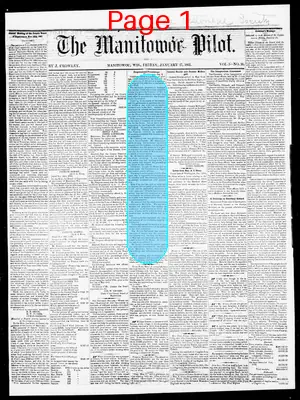
The Manitowoc Pilot
Manitowoc, Manitowoc County, Wisconsin
What is this article about?
On January 6 in Washington, Rep. Conkling raised a privilege question in the House, demanding further response from the Secretary of War on responsibility for the Ball's Bluff disaster. Debate featured sharp criticism of military setbacks, opposition citing constitutional limits and confidence in Gen. McClellan, and defenses of civilian oversight.
Clipping
OCR Quality
Full Text
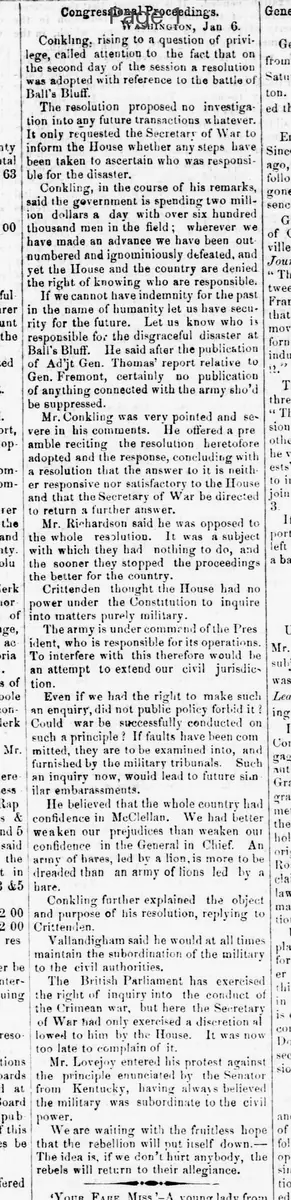
Conkling, rising to a question of privilege, called attention to the fact that on the second day of the session a resolution was adopted with reference to the battle of Ball's Bluff.
The resolution proposed no investigation into any future transactions whatever. It only requested the Secretary of War to inform the House whether any steps have been taken to ascertain who was responsible for the disaster.
Conkling, in the course of his remarks, said the government is spending two million dollars a day with over six hundred thousand men in the field; wherever we have made an advance we have been outnumbered and ignominiously defeated, and yet the House and the country are denied the right of knowing who are responsible.
If we cannot have indemnity for the past in the name of humanity let us have security for the future. Let us know who is responsible for the disgraceful disaster at Ball's Bluff. He said after the publication of Ad'jt Gen. Thomas' report relative to Gen. Fremont, certainly no publication of anything connected with the army should be suppressed.
Mr. Conkling was very pointed and severe in his comments. He offered a preamble reciting the resolution heretofore adopted and the response, concluding with a resolution that the answer to it is neither responsive nor satisfactory to the House and that the Secretary of War be directed to return a further answer.
Mr. Richardson said he was opposed to the whole resolution. It was a subject with which they had nothing to do, and the sooner they stopped the proceedings the better for the country.
Crittenden thought the House had no power under the Constitution to inquire into matters purely military.
The army is under command of the President, who is responsible for its operations. To interfere with this therefore would be an attempt to extend our civil jurisdiction.
Even if we had the right to make such an enquiry, did not public policy forbid it? Could war be successfully conducted on such a principle? If faults have been committed, they are to be examined into, and punished by the military tribunals. Such an inquiry now, would lead to future similar embarrassments.
He believed that the whole country had confidence in McClellan. We had better weaken our prejudices than weaken our confidence in the General in Chief. An army of hares, led by a lion, is more to be dreaded than an army of lions led by a hare.
Conkling further explained the object and purpose of his resolution, replying to Crittenden.
Vallandigham said he would at all times maintain the subordination of the military to the civil authorities.
The British Parliament has exercised the right of inquiry into the conduct of the Crimean war, but here the Secretary of War had only exercised a discretion allowed to him by the House. It was now too late to complain of it.
Mr. Lovejoy entered his protest against the principle enunciated by the Senator from Kentucky, having always believed the military was subordinate to the civil power.
We are waiting with the fruitless hope that the rebellion will put itself down. The idea is, if we don't hurt anybody, the rebels will return to their allegiance.
What sub-type of article is it?
What keywords are associated?
What entities or persons were involved?
Where did it happen?
Domestic News Details
Primary Location
Washington
Event Date
Jan 6
Key Persons
Outcome
conkling offered a resolution demanding a more satisfactory response from the secretary of war; debate highlighted divisions over civilian oversight of military matters, with no final outcome reported.
Event Details
Rep. Conkling addressed the House on a resolution seeking information from the Secretary of War about responsibility for the Ball's Bluff disaster, criticizing military defeats and suppressed reports. He proposed a new resolution deeming the prior response inadequate. Opponents like Richardson and Crittenden argued against congressional interference in military affairs, emphasizing presidential command and confidence in Gen. McClellan. Vallandigham and Lovejoy defended civilian authority over the military.