Thank you for visiting SNEWPapers!
Sign up free
The Virginia Gazette
Richmond, Williamsburg, Richmond County, Virginia
What is this article about?
Continuation of satirical critique of the 'Virginia Pindar,' accusing him of using bathos to dilute and parody sublime works by Pope, Milton, and biblical texts, including blasphemous travesties of scripture and Christ's speeches.
Merged-components note: This is a continuation of the critical remarks on 'the Virginia Pindar', an opinion piece split across pages 2 and 3. The text flows from the incomplete sentence in the first part to the discussion in the second. Keeping label as editorial, changing the second part from literary.
Clippings
1 of 2
OCR Quality
Full Text
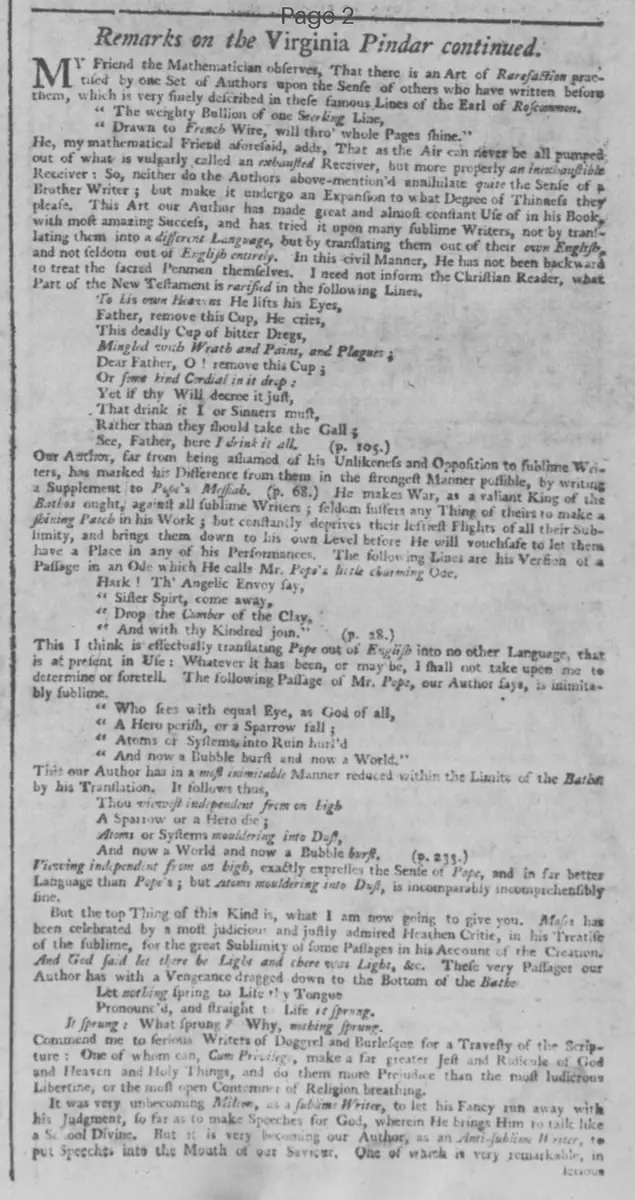
My Friend practised by one Set of Authors upon the Sense of others who have written before them, which is very finely described in these famous Lines of the Earl of Roscommon.
The weighty Bullion of one Sterling Line,
Drawn to French Wire, will thro' whole Pages shine.
He, my mathematical Friend aforesaid, adds, That as the Air can never be all pumped out of what is vulgarly called an exhausted Receiver, but more properly an inexhaustible Receiver: So, neither do the Authors above-mention'd annihilate quite the Sense of Brother Writer; but make it undergo an Expansion to what Degree of Thinness they please. This Art our Author has made great and almost constant Use of in his Book with most amazing Success, and has tried it upon many sublime Writers, not by translating them into a different Language, but by translating them out of their own English and not seldom out of English entirely. In this civil Manner, He has not been backward to treat the sacred Penmen themselves. I need not inform the Christian Reader, what Part of the New Testament is rarified in the following Lines.
To his own Heav'ns He lifts his Eyes,
Father, remove this Cup, He cries,
This deadly Cup of bitter Dregs,
Mingled with Wrath and Pains, and Plagues;
Dear Father, O! remove this Cup;
Or some kind Cordial in it drop:
Yet if thy Will decree it just,
That drink it I or Sinners must.
Rather than they should take the Gall;
See, Father, here I drink it all. (p. 105.)
Our Author, far from being ashamed of his Unlikeness and Opposition to sublime Writers, has marked his Difference from them in the strongest Manner possible, by writing a Supplement to Pope's Messiah. (p. 68.) He makes War, as a valiant King of the Bathos ought, against all sublime Writers; Seldom suffers any Thing of theirs to make a shining Patch in his Work; but constantly deprives their loftiest Flights of all their Sublimity, and brings them down to his own Level before He will vouchsafe to let them have a Place in any of his Performances. The following Lines are his Version of Passage in an Ode which He calls Mr. Pope's little charming One.
Hark! Th' Angelic Envy say,
Sister Spirit, come away,
Drop the Chamber of the Clay,
And with thy Kindred join. (p. 28.)
This I think is effectually translating Pope out of English into no other Language, that is at present in Use: Whatever it has been, or may be, I shall not take upon me to determine or foretell. The following Passage of Mr. Pope, our Author says, is inimitablely sublime.
Who sees with equal Eye, as God of all,
A Hero perish, or a Sparrow fall;
Atoms or Systems into Ruin hurl'd
And now a Bubble burst and now a World.
This our Author has in a most inimitable Manner reduced within the Limits of the Bathos by his Translation. It follows thus,
Thou view'st independent from on high
A Sparrow or a Hero die;
Atoms or Systems mouldering into Dust,
And now a World and now a Bubble burst. (p. 235.)
Viewing independent from on high, exactly expresses the Sense of Pope, and in far better Language than Pope's; but Atoms mouldering into Dust, is incomparably incomprehensibly fine.
But the top Thing of this Kind is, what I am now going to give you. Moses has been celebrated by a most judicious and justly admired Heathen Critick, in his Treatise of the sublime, for the great Sublimity of some Passages in his Account of the Creation. And God said let there be Light and there was Light, &c. These very Passages our Author has with a Vengeance dragged down to the Bottom of the Bathos
Let nothing spring to Life by Tongue
Pronounc'd, and straight to Life 'tis sprung.
It sprung: What Sprung? Why, nothing sprung.
Commend me to Serious Writers of Doggerel and Burlesque for a Travesty of the Scripture: One of whom can, Cum Privilegio, make a far greater Jest and Ridicule of God and Heaven and Holy Things, and do them more Prejudice than the most ludicrous Libertine, or the most open Contemner of Religion breathing.
It was very unbecoming Milton, as a sublime Writer, to let his Fancy run away with his Judgment, so far as to make Speeches for God, wherein He brings Him to talk like a School Divine. But it is very becoming our Author, as an Anti-sublime, or Bathos Writer, to put Speeches into the Mouth of our Saviour. One of which is very remarkable, in encounter the Devil tho' He be doubtful of the Ever cannot certainly tell, but He Serious Sadness, representing the Speaker before his Incarnation, as bravely resolved to may lose his All in this Conflict; and like a poor benighted Indian, (with Reverence be It spoken) be reduced to err on the Devil for his God. Which is, I think, the greatest Compliment that ever was paid to the Devil. He saw. and (O amazing Grace! He lov'd With Pity all his inmost Bowels mov'd, And Love omnipotent began to glow : "Shall all the human Race, He cries, Fall an eternal Sacrifice, And grace the Triumphs of the insulting Foe P What! Shall Hell's Tyranny destroy My Father's Heart, Work and Boast, And riot in malicious Joy : . To See His favourite Creature Lost 9 No I rather confounded, With Chaos surrounded, " Be Heav'n, Earth; Ocean and all as The Wheels of Nature break, The Universe to horrid Wreck, Be rended, disjointed, lost I I will o'ercome, or let God er. Wreath from the Tyrant's Hand his royal Rod Or yield him mine, and make him God : By chosen Race shall live, or I will share their D " By the Dread Life of the Divinity PoK'd by the Eternal Taxi, "I swear and ratify the solemn Decree," : (p. 81.) It was a great Piece of Judgment in our Author, to make this Speech in Verse. Under the Shelter of Rhyme he may Safely set the Undertaking of Christ for the Redemption of Mankind in a ridiculous Light : Whereas, had He done it in Prose,it might have been thought too gross an Instance of Blasphemy. If to write of One of the Persons of the Holy Trinity, in such a Strain as an Heathen Muse might with Propriety make Use of to describe Jupiter, in Fear of being dethroned by Giants and confederate Dei- ties, and reduced to the last Extremity by his Antagonists, be not suitable to our Author's ing Muse; a Name which our Author himself has given to her ; (p. 83.) and No-body, Muse as she is a Christian Muse ; yet it is, without Doubt, suitable to her as she is a rev- I hope, will hereafter dispute the Justice of her Title to it, or once imagine that he complimented her with it out of Prejudice or Partiality ; since it is no more than the she really merited.. great Personages, under it's Roof at the Same Time, and rears it's lofty Head in Meor- Llied him For an Apartment in that Palace which often contains many Kings, and other out-do the Rante of Nat Lee, or any other Writer whose poetic Rage, or Ravings, qua- The Fury of this last Speech puts me in Mind of our Author's devout Curses ; which Felds. against himself and others ; our quick-sighted Author derives a clear and unquestionable Right from thence to imprecate the most dreadful Curses, sometimes on Himself alone, sometimes on the whole Creation but Himself, on no Occasion at all, as He Says in his Preface, and on none that I can find, except to show his Talents in Poetry. For Instances do exemplify what is here said, I refer to Passages already taken Notice of, and to Some which at once show our Author's nice Skill in rhetorical Touches, and his Art to fill ahat will hereafter be quoted under different Heads. Some very affecting Repetitions, op a Verse. Too true ! too true ! my trembling Soul replies. (p.2.) Twas He, 'twas He that form'd your mortal Frame. (P. 7.) But bound with lasting Bands of Love, O let me, let me ne'er remove. (p.91.) O! why, if Thou wilt ever, ver hide Thy self, and leave them till unsatisfied. (p. 54-) O wilt thou frown, and say Depart ! Depart !---ah!where, Lord! shall I flee? (p. 104.) Yin fruitless Wuh ! its restless Wheel Of Time moves onward, onward still. : (p. 307. Jesus I we yield I do more,' me mat Will re offend Thee, as before. . : (p. 90.) "" For Thee, Sor,stre thy Jesus moaml u. Thee so ungrateful, so unkind I . . (p. 206.) There over-whelmed : the Rebel Worms Lie ever, ever, ever lost. (A long and therefore just Description of Eternity.) A chilly Pale deforms my Cheeks; And now my falling Jaws relax : And now I'm gone, I'm gone. (Id est, doubly gone.) [To be continued.]
What sub-type of article is it?
What keywords are associated?
What entities or persons were involved?
Editorial Details
Primary Topic
Critique Of Bathos And Parody In The Virginia Pindar's Writing
Stance / Tone
Strongly Critical And Mocking
Key Figures
Key Arguments