Thank you for visiting SNEWPapers!
Sign up free
Peninsula Enterprise
Accomac, Accomack County, Virginia
What is this article about?
In Washington, Commissary General Charles P. Eagan faced court martial over his response to General Miles' charges. Testimony on Jan. 28 highlighted his temporary insanity; on Jan. 30, he was convicted of unbecoming conduct and sentenced to army dismissal, with clemency recommended—only the President can intervene.
Clipping
OCR Quality
Full Text
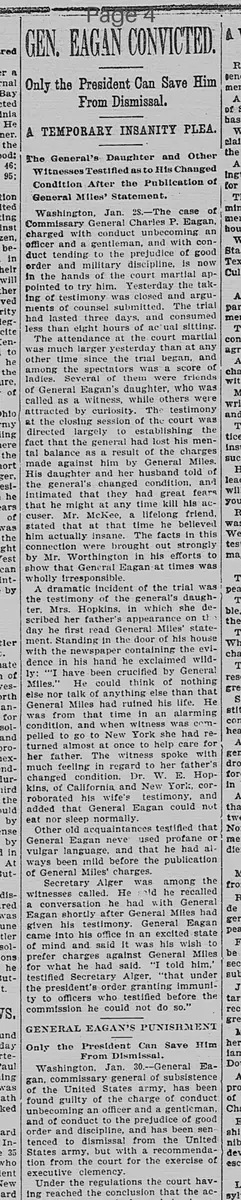
Only the President Can Save Him From Dismissal.
A TEMPORARY INSANITY PLEA.
The Generals Daughter and Other Witnesses Testified as to His Changed Condition After the Publication of General Miles' Statement.
Washington, Jan. 28.--The case of Commissary General Charles P. Eagan, charged with conduct unbecoming an officer and a gentleman, and with conduct tending to the prejudice of good order and military discipline, is now in the hands of the court martial appointed to try him. Yesterday the taking of testimony was closed and arguments of counsel submitted. The trial had lasted three days, and consumed less than eight hours of actual sitting. The attendance at the court martial was much larger yesterday than at any other time since the trial began, and among the spectators was a score of ladies. Several of them were friends of General Eagan's daughter, who was called as a witness, while others were attracted by curiosity. The testimony at the closing session of the court was directed largely to establishing the fact that the general had lost his mental balance as a result of the charges made against him by General Miles. His daughter and her husband told of the general's changed condition, and intimated that they had great fears that he might at any time kill his accuser. Mr. McKee, a lifelong friend, stated that at that time he believed him actually insane. The facts in this connection were brought out strongly by Mr. Worthington in his efforts to show that General Eagan at times was wholly irresponsible.
A dramatic incident of the trial was the testimony of the general's daughter, Mrs. Hopkins, in which she described her father's appearance on the day he first read General Miles' statement. Standing in the door of his house with the newspaper containing the evidence in his hand he exclaimed wildly: "I have been crucified by General Miles." He could think of nothing else nor talk of anything else than that General Miles had ruined his life. He was from that time in an alarming condition, and when witness was compelled to go to New York she had returned almost at once to help care for her father. The witness spoke with much feeling in regard to her father's changed condition. Dr. W. E. Hopkins, of California and New York, corroborated his wife's testimony, and added that General Eagan could not eat nor sleep normally.
Other old acquaintances testified that General Eagan never used profane or vulgar language, and that he had always been mild before the publication of General Miles' charges.
Secretary Alger was among the witnesses called. He said he recalled a conversation he had with General Eagan shortly after General Miles had given his testimony. General Eagan came into his office in an excited state of mind and said it was his wish to prefer charges against General Miles for what he had said. "I told him," testified Secretary Alger, "that under the president's order granting immunity to officers who testified before the commission he could not do so."
GENERAL EAGAN'S PUNISHMENT
Only the President Can Save Him From Dismissal.
Washington, Jan. 30.--General Eagan, commissary general of subsistence of the United States army, has been found guilty of the charge of conduct unbecoming an officer and a gentleman, and of conduct to the prejudice of good order and discipline, and has been sentenced to dismissal from the United States army, but with a recommendation from the court for the exercise of executive clemency.
Under the regulations the court having reached the conclusion that the accused was guilty had no choice in selecting a penalty, the regulations prescribing absolutely the one punishment--dismissal. Therefore, the only hope for General Eagan is in the direction of commutation, mitigation or disapproval.
What sub-type of article is it?
What keywords are associated?
What entities or persons were involved?
Where did it happen?
Domestic News Details
Primary Location
Washington
Event Date
Jan. 28 To Jan. 30
Key Persons
Outcome
found guilty of conduct unbecoming an officer and a gentleman, and conduct to the prejudice of good order and military discipline; sentenced to dismissal from the united states army, with a recommendation for executive clemency; only the president can commute, mitigate, or disapprove the sentence.
Event Details
The court martial of Commissary General Charles P. Eagan, charged with conduct unbecoming an officer and a gentleman, and conduct tending to the prejudice of good order and military discipline, closed testimony on Jan. 28 after three days. Witnesses, including his daughter Mrs. Hopkins, her husband Dr. W. E. Hopkins, lifelong friend Mr. McKee, and Secretary Alger, testified to Eagan's changed mental condition and temporary insanity following General Miles' statement publication. They described his excitement, inability to eat or sleep, and prior mild demeanor without profane language. On Jan. 30, the court found him guilty and sentenced him to dismissal, per regulations, with a clemency recommendation.