Thank you for visiting SNEWPapers!
Sign up free
Summit County Labor News
Akron, Summit County, Ohio
What is this article about?
U.S. Circuit Courts of Appeal in multiple districts have rejected the NLRB's Brown-Olds remedy, which mandates reimbursement of union dues for alleged closed-shop hiring violations. The AFL-CIO criticizes it as oppressive, and the Supreme Court may rule on related cases.
Merged-components note: Continuation of Brown-Olds remedy legal story from page 1 to page 4.
Clippings
1 of 2
OCR Quality
Full Text
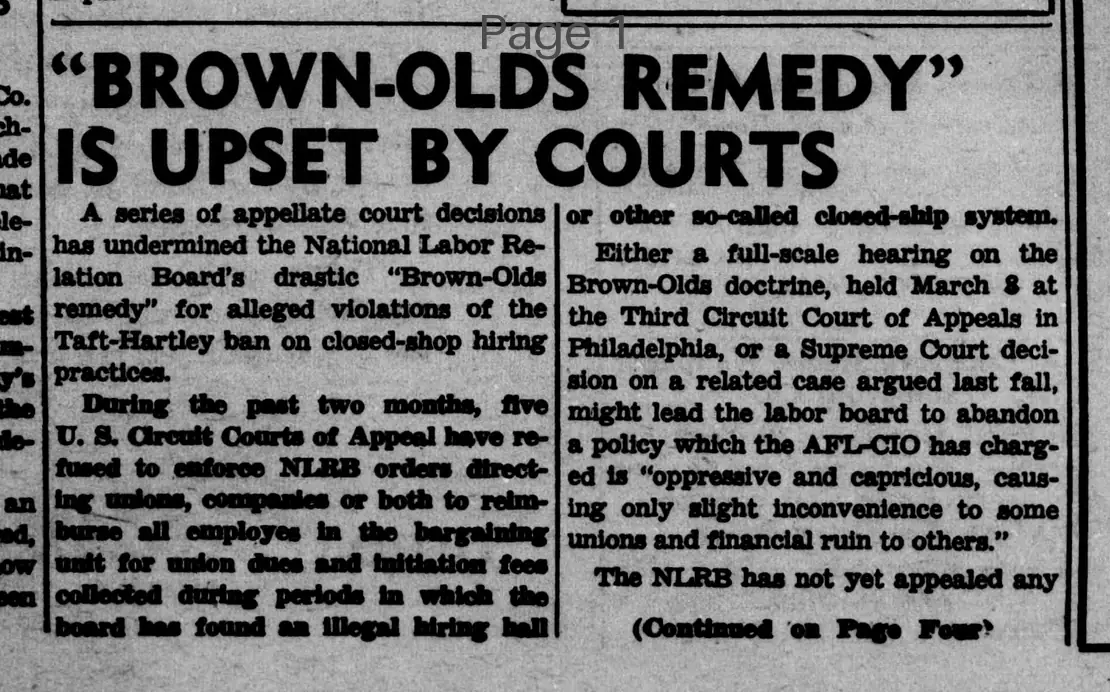
A series of appellate court decisions has undermined the National Labor Relations Board's drastic "Brown-Olds remedy" for alleged violations of the Taft-Hartley ban on closed-shop hiring practices.
During the past two months, five U. S. Circuit Courts of Appeal have refused to enforce NLRB orders directing unions, companies or both to reimburse all employees in the bargaining unit for union dues and initiation fees collected during periods in which the board has found an illegal hiring hall or other so-called closed-shop system.
Either a full-scale hearing on the Brown-Olds doctrine, held March 8 at the Third Circuit Court of Appeals in Philadelphia, or a Supreme Court decision on a related case argued last fall, might lead the labor board to abandon a policy which the AFL-CIO has charged is "oppressive and capricious, causing only slight inconvenience to some unions and financial ruin to others."
The NLRB has not yet appealed any (Continued on Page Four)
"BROWN-OLDS REMEDY" IS UPSET BY COURTS
The National Labor Relations Board plans to appeal some of its lost circuit court cases to the Supreme Court, but a spokesman said it is "reasonable to expect" that one or more of the cases would be appealed.
The precedent on which the NLRB bases its controversial doctrine is a 1956 case involving the Brown-Olds Plumbing & Heating Corp., where repayment of union dues was ordered after a finding that the company and the union in effect had a closed-shop policy.
In 1958, the labor board cited this precedent in serving notice that it would order the refunding of all union dues if hiring hall and other job referral systems operated by unions failed to provide specific, written guarantees that non-union members would be given equal consideration for jobs.
Unions and employers were allowed a grace period to bring their contracts and practices into conformity with the labor board ruling. It was the NLRB's crackdown on alleged violations after the "grace period" had expired which brought a rash of court challenges and decisions reversing the labor board.
In cases where the Brown-Olds "remedy" was the key issue, federal appellate courts in Philadelphia, New Orleans, the District of Columbia, San Francisco and New York have rejected the NLRB position. In only one of the 11 circuit courts-in Chicago-was the labor board upheld, and labor attorneys do not consider that case a clear-cut test of the Brown-Olds doctrine. That decision has been appealed to the Supreme Court.
The Third Circuit court in Philadelphia, where a three-judge panel had unanimously rejected the Brown-Olds remedy in January, reheard the case before the full seven-judge court in a legal "double-header" in which a new case involving the Brown-Olds doctrine was also argued.
Before the circuit court issues its opinion, however, there is a possibility that the Supreme Court might rule on the issue.
The case before the Supreme Court-Machinists Local 1424 and the Bryan Mfg. Co. vs. NLRB-could be decided without a ruling on the Brown-Olds issue, labor attorneys emphasize.
The AFL-CIO, however, submitted a "friend of the court" brief dealing with the Brown-Olds issue as a factor in the case.
The brief challenged the Brown-Olds "remedy" on the grounds that:
• It is based on an "unreasonable inference" that union dues and fees collected under an illegal union security or hiring hall arrangement constitute "coerced payments."
All evidence and history points out, the AFL-CIO declared, that the overwhelming majority of workers voluntarily embrace union conditions.
The "mass reimbursement" order is "not appropriate" to the situation and is an "abuse" of the NLRB's authority.
The financial burden of reimbursement "falls most heavily upon the smaller unions least able to sustain it."
Labor attorneys pointed out that in some Brown-Olds type cases, the company alone has been ordered to reimburse the employees, in other cases the union alone, and that in still other cases financial liability is imposed equally on the company and the union. The NLRB order directing reimbursement applies to whichever party happened to be named in the original charge.
The legal precedent on which the NLRB based its original Brown-Olds decision is inappropriate.
It was a Supreme Court decision in 1943 which upheld an NLRB order forcing the Virginia Electric & Power Co. to pay back dues it had collected on behalf of a company-dominated union. The court held that the employees had been coerced into joining the company union.
What sub-type of article is it?
What themes does it cover?
What keywords are associated?
What entities or persons were involved?
Where did it happen?
Story Details
Key Persons
Location
U.S. Circuit Courts Of Appeal (Philadelphia, New Orleans, District Of Columbia, San Francisco, New York, Chicago); Supreme Court
Event Date
1956 1960s, With Recent Decisions In Past Two Months And March 8 Hearing
Story Details
Appellate courts undermine NLRB's Brown-Olds remedy requiring reimbursement of union dues for closed-shop violations; AFL-CIO challenges it as oppressive; potential Supreme Court review.