Thank you for visiting SNEWPapers!
Sign up free
Editorial
September 14, 1846
Lynchburg Virginian
Lynchburg, Virginia
What is this article about?
The 1846 editorial from The Lynchburg Virginian reflects on U.S. progress since 1806, exceeding constitutional framers' visions, with advancements in printing, press influence, transportation via steam and rails, and the revolutionary magnetic telegraph.
Clipping
OCR Quality
75%
Good
Full Text
The Lynchburg Virginian.
MONDAY MORNING, SEPT. 14, 1846.
FORTY YEARS AGO.
As a nation we have been justly accused of glorying, not so much in the past as to the future—priding ourselves less upon the achievements of our forefathers than of our posterity. We have much to boast of in the past, and we are too nearly connected by blood with John Bull not to dwell upon anything which may minister to our vanity. We certainly do indulge in magnificent anticipations; and yet, strange to say, the course of events always brings about a reality even more magnificent.—
The august assemblage of patriots which met, in 1787, to frame the Federal Constitution were sensible alive to the future growth of their country—but we may look in vain, in the debates, for any expression which fell from the most sanguine, to indicate the faintest conception of the strength and power to be attained by the nation within the first fifty years of its existence. No one in that day had an idea of the future growth of the West—a great extension of the empire in that direction was not dreamed of. The Mississippi seems to have been regarded as the natural boundary. Had any one talked of a Republic, washed by the Atlantic and the Pacific, he would have been considered a candidate for the lunatic hospital. The Abbé Raynal had demonstrated that North America was incapable of sustaining a population exceeding ten millions, and, as the dictum of a philosopher was then rarely questioned, we doubt whether any members suffered their imaginations to contemplate the government of a greater number of people by the Constitution they were forming. We do not know how far the sages of that body feared the policy, suggested by his minister, the Count de Vergennes, upon Louis XVI.: that France should cultivate friendly relations with the Indians, as a nation which might serve as a counterpoise to the growth and to the power of the United States—but certain it is, the Indian Tribes were great bugbears, and there was but a timid hope indulged of not stemming his reaching the Mississippi.
We could dwell with much pleasure upon what were, at the moment, considered visions of a heated fancy, as some member, accidentally, or by way of argument, portrayed the destinies of the country—and show that the most enthusiastic of these anticipations have already been more than realized.
But we take pen in hand for a humbler purpose—
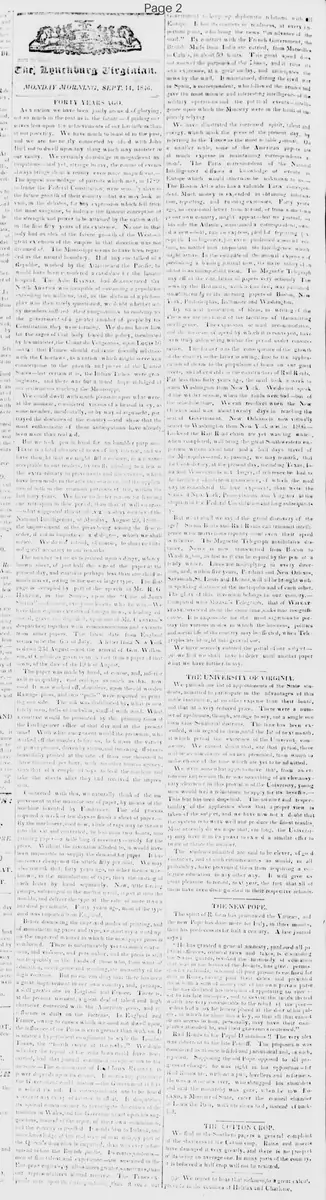
Here is at hand the choice of news if any miles, who would have thought that we might fill a column, in a manner acceptable to our readers, by briefly alluding to a few of the extraordinary improvements and discoveries, which have been made in the arts and sciences, and the application of both to the common purposes of life, within the last forty years. We have no better reason for hailing our retrospect to this period, than that it was braced—what suggested this article—a stray number of the National Intelligencer, of Monday, August 23, 1806. The improvement of the press being among the first in order, if not most important, we shall notice it. We do not intend, of course, to observe chronological accuracy in our remarks. The number before us is printed upon a dingy, whitish brown sheet, of just half the size of the paper at the present day, and contains perhaps less than one third as much matter, owing to the use of larger type. The first page is occupied by part of the speech of Mr. R. G. Harper, in the Senate, on the "Case of John Randolph"—for some hows while—We have then a good specimen of foreign news, a leading editor's critique upon Mr. Canning's despatches; together with comments and extracts from other papers. The latest date from England seems to be the 6th of July. A letter from N. York is dated 23d August—and the arrival of Gen. Wilkinson, at Carlisle is given in a reprint from a paper of that town, of the date of the 10th of August. The paper was made by hand, of course, and, inferior as it is in quality, cost perhaps as much as half now used. It was worked off, doubtless, upon the old wooden Ramage press, and two "pulls" were required in printing one side. The ink was distributed by, what is now rarely seen, balls of buckskin, stuffed with wool. What a contrast! would be presented by the printing room of the Intelligencer office of that day and at the present time! With what amazement would the pressman, who worked off the number before us, look upon the variety of power presses, driven by steam, and throwing off sheets beautifully printed at the rate of from one thousand to three thousand per hour, with no other human agencies than that of a couple of boys to feed the machine and take the sheets after they had received the impression. Connected with this, we naturally think of the improvement in the manufacture of paper, by means of the machine invented by Fourdrinier. The old process required a week or ten days to finish a sheet of paper,— By the machinery, used now, a bale of rags may be thrown into the vat and converted, in less than two hours, into printing paper—a whole long it necessary—ready for the press. Without the invention alluded to, it would have been impossible to supply the demand for paper. It has likewise cheapened the article fifty per cent. We may also remark that, forty years ago, no other means were known, in the manufacture of type, than the casting of each letter by hand separately. Now, little forcing pumps, submerged in the heated metal, inject it into the moulds, and deliver the type at the rate of more than a hundred per minute. Forty years ago, most of the type used was imported from England. Before dismissing the improved modes of printing, and of manufacturing paper and type, we must say a word upon the improved manner in which the newspaper press is conducted. There is unfortunately yet too much earliness, and violence, and personality, and the press is still too frequently in the hands of those who, from want of education, intelligence and breeding, are unworthy of the high vocation. But no one can deny that there has been a great improvement in our own country, and, perhaps, a still greater one in England and France. There is, at the present moment, a great deal of talent and high character connected with the American press, and its influence is daily on the increase. In England and France, owing to causes which we need not dwell upon, the influence of the Press is even greater than with us. It is scarcely a hyperbolical compliment to style the London Times, the "fourth estate of the realm." We doubt whether the repeal of the corn laws could have been carried, had that journal continued its opposition to the measure—The Chronicle of John Russell in power daunted his users. Its many patrons the Government cmil aw—the Government is in its sclutr's aid. Its correspondents are to be found serving at forty offers is it. It despatches is sleepless emmisary to investigate the causes of the troubles in Wales, and the Government acts upon his suggestions, instead of the report of their own commission, and the country is profited. It sends him to Ireland, and makes khald ge of the real state of that may port o the Queen's domain is imparted, than was ever for spread telote the British pusle. Its correspondents— men of fine talent and experience —are sustained in the European eyias, y allowances greater sunettms, than cor reptsnatives alroad recrive. The Times ix yes mp upon ite creyndant, than it cuss our G xerrment ts heep "p dipbonate nlatons wuth all Eatage. I has its ovurers in te aduess, at every i n. pertant point, "he brng the heus "in advance of the wai." By e ntract with the Frnch Guverntent, the Brattsh Mals frod Iud ia ate catrted, from Marseilles io Cala s, in ab ut 5o h urs. Tus great speel ds yot ausuit the purpuses of the I tmts, and it runs is oan exptesses, at a great onlay, and antteljates the news by the nal. It maintaned, during the civid war in Spain, a cortespondent, who lollov ed the arutes and gave the must minute and interesting intelligence of the nilitary operattets and the pol t al events-intell. gence upon w hiclh the Ministry were in the hablt ot im- plteuly relytag We nave il'ustrated the juereased spirit, talent and rnergy, watch muk the press of the present day, by releting to the I umes as the tust io table jurhal, On a sualler scale, solle of the Ameriean pap ts are at much expetise in maintaintng cottespondents a broad. Ihe Pars currespotdent of the Nattunal Inte llige heer d fluses a kuowledge of events in Eorope which would otherwise be wakn rwn to us — TheBuston Arl s also has a valuable Fars cottesjon de nt. Muct. money is exyr uded in abtintng inlutaa. ton, reporting. aad tuining expresses. Fory years g, an cea-lonal letter troth al poad, or trom s me i wa out oun esuntry, migt appeat-but no jmurnal, on his side the Atlantle, naimtamed a correspo udeni, own- d a bews-bnat, run aniaj ress, jaid tor rep rng ( "pt th Imlngrer,) even puolished a seenl ea ton, to tatter bow topoutant the lole hige tee which sntght arrive. Ia the esti nate of the anoual expehs s uf puolish ng a hadng j uinal tow, the ma re salaty of .n ed tor isan unimportant nen. The Maghete Trlegraph nay aì et the cre lauton of papets very setously. The aws by the Batin ilt, wesk o tre las, was pashed stnul the out ty in the m rutng pape rs ot- Buston, N.w Yth, Pnl deyhia, Daltuote abd Washin ton. By ha uial asoeration of ideas, in wrng if the I'n s we are rei i tid of the laclues of tanstiling iit grme. I he espatston of nad aeconatodaln, and the lcreas i saed by wh ch i iseoveyo, have eon truly asth st ing wi'nn tihe puraod utder cousides rathp. Ihe Iorotr was the cous quenee oi the growth a the coun'ry -the later is owihg, hrst to the applea- caliun ot sitan to the propulston o beats on eur great rivers, aniaterwardsotheeoisrd toiofRu Rmds. Far less than forty years aga, the mail tork a wech to tach Washngton Irom New Ytk. Wedo not speak ot the wi.itr seasull, when the roads werc bad -but of The schrdile thare. We can recollect when the New Orleans mail was about twenty days in reachmg the st at o Govermment. New Orlrans is muw virtually hearer wo Washington than New Yik was in Isoo.- Laushsot the Rat R ad chain are yet wan thg whle when conpleted, will brng he great Souibwestern en.- perum wltnln ahut tour and a half days travel of the Meiropulis-and, i passing, we may reabarh, that teC ont drey,at the present dav, mncluding Texas, lo. wa and Wisetslo is ht Irger, it relerehee be had to he lacilithes diutereanntneathr,'t whch the mand tay Le coisdiderd th tue txmrl, than were the wats ANe Yrk,Penkylvaa ana Vrgna athe ahoplt n od t e Fed ral Cor stitutonand lotg subsequente 1. But wat slall we say f the grand discovery of the ag? Seam Dats anu Ra I Roads cad transait intellt gruce wnh mirveions rapidity —out even ther speed is rolatve Ih Maguetie Telegraph aunihilatrs dis- tanee, News Is muw trans'nitied from Bos'on to Wash n ton, as tast as it can be eopled by the pe n ot a ready wrlr. Iues are muluplytg m every due ton, and, within five years, P. rland and New Orlans, Savanuah,St. Louis and De roit,will ail be bronght with- in sp akig d stanee of the u tropolis aad of each other. I'he glry t this mhvinilon belongs to our eonhiry.- t ompated wnn Mokse's Telegraph, that of Whear srone uver'ed ab u the saue ume,suks mlo msignifi she. It is hhposssle lor the most siaelous to por- tray the varlous in d s in whieh the business, polines and soelal hfe ot the cou'try miy besfiected, whea Telt. gruphs ate brought lhto geieral use, We have searcely entered the portal ofonr sryet- w we fi d we shall have to deler untt atother papet wnat we have further to say.
MONDAY MORNING, SEPT. 14, 1846.
FORTY YEARS AGO.
As a nation we have been justly accused of glorying, not so much in the past as to the future—priding ourselves less upon the achievements of our forefathers than of our posterity. We have much to boast of in the past, and we are too nearly connected by blood with John Bull not to dwell upon anything which may minister to our vanity. We certainly do indulge in magnificent anticipations; and yet, strange to say, the course of events always brings about a reality even more magnificent.—
The august assemblage of patriots which met, in 1787, to frame the Federal Constitution were sensible alive to the future growth of their country—but we may look in vain, in the debates, for any expression which fell from the most sanguine, to indicate the faintest conception of the strength and power to be attained by the nation within the first fifty years of its existence. No one in that day had an idea of the future growth of the West—a great extension of the empire in that direction was not dreamed of. The Mississippi seems to have been regarded as the natural boundary. Had any one talked of a Republic, washed by the Atlantic and the Pacific, he would have been considered a candidate for the lunatic hospital. The Abbé Raynal had demonstrated that North America was incapable of sustaining a population exceeding ten millions, and, as the dictum of a philosopher was then rarely questioned, we doubt whether any members suffered their imaginations to contemplate the government of a greater number of people by the Constitution they were forming. We do not know how far the sages of that body feared the policy, suggested by his minister, the Count de Vergennes, upon Louis XVI.: that France should cultivate friendly relations with the Indians, as a nation which might serve as a counterpoise to the growth and to the power of the United States—but certain it is, the Indian Tribes were great bugbears, and there was but a timid hope indulged of not stemming his reaching the Mississippi.
We could dwell with much pleasure upon what were, at the moment, considered visions of a heated fancy, as some member, accidentally, or by way of argument, portrayed the destinies of the country—and show that the most enthusiastic of these anticipations have already been more than realized.
But we take pen in hand for a humbler purpose—
Here is at hand the choice of news if any miles, who would have thought that we might fill a column, in a manner acceptable to our readers, by briefly alluding to a few of the extraordinary improvements and discoveries, which have been made in the arts and sciences, and the application of both to the common purposes of life, within the last forty years. We have no better reason for hailing our retrospect to this period, than that it was braced—what suggested this article—a stray number of the National Intelligencer, of Monday, August 23, 1806. The improvement of the press being among the first in order, if not most important, we shall notice it. We do not intend, of course, to observe chronological accuracy in our remarks. The number before us is printed upon a dingy, whitish brown sheet, of just half the size of the paper at the present day, and contains perhaps less than one third as much matter, owing to the use of larger type. The first page is occupied by part of the speech of Mr. R. G. Harper, in the Senate, on the "Case of John Randolph"—for some hows while—We have then a good specimen of foreign news, a leading editor's critique upon Mr. Canning's despatches; together with comments and extracts from other papers. The latest date from England seems to be the 6th of July. A letter from N. York is dated 23d August—and the arrival of Gen. Wilkinson, at Carlisle is given in a reprint from a paper of that town, of the date of the 10th of August. The paper was made by hand, of course, and, inferior as it is in quality, cost perhaps as much as half now used. It was worked off, doubtless, upon the old wooden Ramage press, and two "pulls" were required in printing one side. The ink was distributed by, what is now rarely seen, balls of buckskin, stuffed with wool. What a contrast! would be presented by the printing room of the Intelligencer office of that day and at the present time! With what amazement would the pressman, who worked off the number before us, look upon the variety of power presses, driven by steam, and throwing off sheets beautifully printed at the rate of from one thousand to three thousand per hour, with no other human agencies than that of a couple of boys to feed the machine and take the sheets after they had received the impression. Connected with this, we naturally think of the improvement in the manufacture of paper, by means of the machine invented by Fourdrinier. The old process required a week or ten days to finish a sheet of paper,— By the machinery, used now, a bale of rags may be thrown into the vat and converted, in less than two hours, into printing paper—a whole long it necessary—ready for the press. Without the invention alluded to, it would have been impossible to supply the demand for paper. It has likewise cheapened the article fifty per cent. We may also remark that, forty years ago, no other means were known, in the manufacture of type, than the casting of each letter by hand separately. Now, little forcing pumps, submerged in the heated metal, inject it into the moulds, and deliver the type at the rate of more than a hundred per minute. Forty years ago, most of the type used was imported from England. Before dismissing the improved modes of printing, and of manufacturing paper and type, we must say a word upon the improved manner in which the newspaper press is conducted. There is unfortunately yet too much earliness, and violence, and personality, and the press is still too frequently in the hands of those who, from want of education, intelligence and breeding, are unworthy of the high vocation. But no one can deny that there has been a great improvement in our own country, and, perhaps, a still greater one in England and France. There is, at the present moment, a great deal of talent and high character connected with the American press, and its influence is daily on the increase. In England and France, owing to causes which we need not dwell upon, the influence of the Press is even greater than with us. It is scarcely a hyperbolical compliment to style the London Times, the "fourth estate of the realm." We doubt whether the repeal of the corn laws could have been carried, had that journal continued its opposition to the measure—The Chronicle of John Russell in power daunted his users. Its many patrons the Government cmil aw—the Government is in its sclutr's aid. Its correspondents are to be found serving at forty offers is it. It despatches is sleepless emmisary to investigate the causes of the troubles in Wales, and the Government acts upon his suggestions, instead of the report of their own commission, and the country is profited. It sends him to Ireland, and makes khald ge of the real state of that may port o the Queen's domain is imparted, than was ever for spread telote the British pusle. Its correspondents— men of fine talent and experience —are sustained in the European eyias, y allowances greater sunettms, than cor reptsnatives alroad recrive. The Times ix yes mp upon ite creyndant, than it cuss our G xerrment ts heep "p dipbonate nlatons wuth all Eatage. I has its ovurers in te aduess, at every i n. pertant point, "he brng the heus "in advance of the wai." By e ntract with the Frnch Guverntent, the Brattsh Mals frod Iud ia ate catrted, from Marseilles io Cala s, in ab ut 5o h urs. Tus great speel ds yot ausuit the purpuses of the I tmts, and it runs is oan exptesses, at a great onlay, and antteljates the news by the nal. It maintaned, during the civid war in Spain, a cortespondent, who lollov ed the arutes and gave the must minute and interesting intelligence of the nilitary operattets and the pol t al events-intell. gence upon w hiclh the Ministry were in the hablt ot im- plteuly relytag We nave il'ustrated the juereased spirit, talent and rnergy, watch muk the press of the present day, by releting to the I umes as the tust io table jurhal, On a sualler scale, solle of the Ameriean pap ts are at much expetise in maintaintng cottespondents a broad. Ihe Pars currespotdent of the Nattunal Inte llige heer d fluses a kuowledge of events in Eorope which would otherwise be wakn rwn to us — TheBuston Arl s also has a valuable Fars cottesjon de nt. Muct. money is exyr uded in abtintng inlutaa. ton, reporting. aad tuining expresses. Fory years g, an cea-lonal letter troth al poad, or trom s me i wa out oun esuntry, migt appeat-but no jmurnal, on his side the Atlantle, naimtamed a correspo udeni, own- d a bews-bnat, run aniaj ress, jaid tor rep rng ( "pt th Imlngrer,) even puolished a seenl ea ton, to tatter bow topoutant the lole hige tee which sntght arrive. Ia the esti nate of the anoual expehs s uf puolish ng a hadng j uinal tow, the ma re salaty of .n ed tor isan unimportant nen. The Maghete Trlegraph nay aì et the cre lauton of papets very setously. The aws by the Batin ilt, wesk o tre las, was pashed stnul the out ty in the m rutng pape rs ot- Buston, N.w Yth, Pnl deyhia, Daltuote abd Washin ton. By ha uial asoeration of ideas, in wrng if the I'n s we are rei i tid of the laclues of tanstiling iit grme. I he espatston of nad aeconatodaln, and the lcreas i saed by wh ch i iseoveyo, have eon truly asth st ing wi'nn tihe puraod utder cousides rathp. Ihe Iorotr was the cous quenee oi the growth a the coun'ry -the later is owihg, hrst to the applea- caliun ot sitan to the propulston o beats on eur great rivers, aniaterwardsotheeoisrd toiofRu Rmds. Far less than forty years aga, the mail tork a wech to tach Washngton Irom New Ytk. Wedo not speak ot the wi.itr seasull, when the roads werc bad -but of The schrdile thare. We can recollect when the New Orleans mail was about twenty days in reachmg the st at o Govermment. New Orlrans is muw virtually hearer wo Washington than New Yik was in Isoo.- Laushsot the Rat R ad chain are yet wan thg whle when conpleted, will brng he great Souibwestern en.- perum wltnln ahut tour and a half days travel of the Meiropulis-and, i passing, we may reabarh, that teC ont drey,at the present dav, mncluding Texas, lo. wa and Wisetslo is ht Irger, it relerehee be had to he lacilithes diutereanntneathr,'t whch the mand tay Le coisdiderd th tue txmrl, than were the wats ANe Yrk,Penkylvaa ana Vrgna athe ahoplt n od t e Fed ral Cor stitutonand lotg subsequente 1. But wat slall we say f the grand discovery of the ag? Seam Dats anu Ra I Roads cad transait intellt gruce wnh mirveions rapidity —out even ther speed is rolatve Ih Maguetie Telegraph aunihilatrs dis- tanee, News Is muw trans'nitied from Bos'on to Wash n ton, as tast as it can be eopled by the pe n ot a ready wrlr. Iues are muluplytg m every due ton, and, within five years, P. rland and New Orlans, Savanuah,St. Louis and De roit,will ail be bronght with- in sp akig d stanee of the u tropolis aad of each other. I'he glry t this mhvinilon belongs to our eonhiry.- t ompated wnn Mokse's Telegraph, that of Whear srone uver'ed ab u the saue ume,suks mlo msignifi she. It is hhposssle lor the most siaelous to por- tray the varlous in d s in whieh the business, polines and soelal hfe ot the cou'try miy besfiected, whea Telt. gruphs ate brought lhto geieral use, We have searcely entered the portal ofonr sryet- w we fi d we shall have to deler untt atother papet wnat we have further to say.
What sub-type of article is it?
Social Reform
Infrastructure
What keywords are associated?
National Progress
Press Improvements
Printing Technology
Paper Manufacturing
Telegraph Invention
Railroads
Steam Power
Societal Advancement
Historical Reflection
American Expansion
What entities or persons were involved?
Framers Of The Federal Constitution
Abbé Raynal
Count De Vergennes
Louis Xvi
Indian Tribes
Mr. R. G. Harper
Mr. Canning
Gen. Wilkinson
Fourdrinier
Morse
Wheatstone
London Times
National Intelligencer
Editorial Details
Primary Topic
Reflections On Technological And Societal Progress Over Forty Years
Stance / Tone
Optimistic Historical Reflection
Key Figures
Framers Of The Federal Constitution
Abbé Raynal
Count De Vergennes
Louis Xvi
Indian Tribes
Mr. R. G. Harper
Mr. Canning
Gen. Wilkinson
Fourdrinier
Morse
Wheatstone
London Times
National Intelligencer
Key Arguments
America's Growth Has Exceeded The Framers' Most Sanguine Expectations
The West's Expansion Was Not Anticipated, With Mississippi Seen As The Boundary
Population Growth Surpassed Philosophical Limits Predicted By Abbé Raynal
Improvements In Printing Presses From Wooden Hand Presses To Steam Powered Machines
Advancements In Paper Manufacturing Via Fourdrinier's Machine Reduced Production Time And Cost
Type Casting Evolved From Hand To Automated Processes
The Press Has Gained Greater Talent, Character, And Influence, Especially In England And France
Transportation Improvements Via Steam Boats, Railroads, And Mails Have Shortened Travel Times
The Magnetic Telegraph Annihilates Distance And Will Revolutionize Business, Politics, And Social Life