Thank you for visiting SNEWPapers!
Sign up free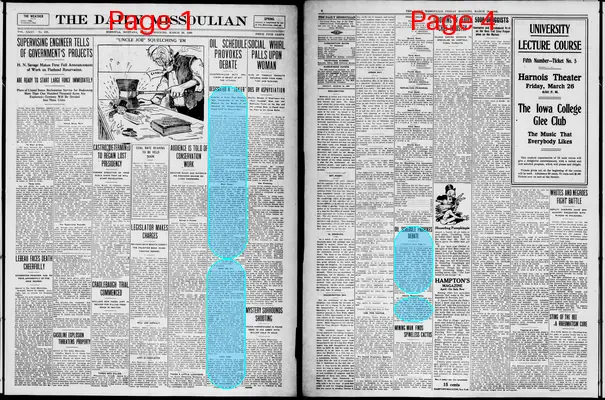
The Daily Missoulian
Missoula, Missoula County, Montana
What is this article about?
In the U.S. House on March 25, debate on the Payne tariff bill focuses on a countervailing duty on oil, seen as favoring Standard Oil. Democrats decry it as betrayal and push for revenue-only tariffs; Republicans defend protections for industries like oil and wool. Key speakers include Vreeland, Sheppard, and Custerman.
Merged-components note: Merging continuation of the tariff debate article from page 1 (reading_order 13) to page 4 (reading_order 91), as indicated by '(Continued on Page 4.)' and '(Continued from Page 1.)' in the text.
Clippings

1 of 2
OCR Quality
Full Text
Intimation Is Given That Provision Was
Incorporated in the Payne
Measure for the
Benefit of the
Standard
Oil Octopus—Democrats
Argue Tariff for Revenue Only.
Washington, March 25.—A voluntary admission by Mr. Vreeland of New York that he was to some extent responsible for retaining in the Payne tariff bill the countervailing duty on oil was the climax of today's tariff discussion in the house. Mr. Vreeland had sat for some time and heard various insinuations that the duty, which some have characterized as a joker, was to be levied solely in the interest of the Standard Oil company. This he denied and explained that his action was in response to requests from thousands of oil producers and in behalf of 400,000 men engaged in the same business. The debate on the oil schedule called forth some bitter criticism of the Standard Oil company by Custerman of Wisconsin and others.
Numerous speeches were made. The democratic arguments were for a tariff for revenue only, while the republicans attacked such schedules as those on wool, wood pulp and print paper and crude petroleum.
Charging that the Payne tariff bill "is a deliberate betrayal of the American people and that it is a fresh illustration of the perfidy of the republican party," Mr. Sheppard of Texas bitterly attacked the measure.
More Power.
"Amusing, indeed, were the ponderous assurances of Mr. Taft that the republican party would revise the tariff downward," he said. "His volcanic predecessor realized the hopelessness of such a proposition and evaded it to the last. Is it possible that the complacent Mr. Taft will succeed where the bifocal wind that recently swept from Washington to Oyster Bay failed utterly. I say to you there is more real power in one 5-cent cigar between the iron lips of Joseph G. Cannon, the standpat leader, than in the big stick of a whole regiment of Roosevelts and Tafts."
Mr. Sheppard said the Payne bill was in no way a sincere and enactable revision of the tariff and asserted that it was a declaration of commercial war with all the world. He deplored the failure to remove or reduce the protection, which he claimed was afforded to the Standard Oil company by the Dingley law.
"As to the hundreds of others that menace the people's means and liberties," he remarked, "it should be said that the limited and illusionary reductions of the Payne bill affect them in no material sense. In marked contrast to the favoritism shown the trusts, to the failure to increase charges on alcoholic liquors, are the new taxes on tea and coffee, which fall directly on the masses."
He said it was true that coffee was technically on the free list, but argued that the countervailing provision made it dutiable.
Same Old Cry.
Mr. Cole of Ohio charged it always had been the cry of the democrats that American markets should be open to the products of the world and it was not contended that to invite a commercial war would be disastrous to American industries. That, he said, was contrary to the whole history of the nation. Never, he declared, had its standard been lowered below that of any competing nation.
The burden of Mr. Cole's remarks was a plea for better protection for the wool industry than is provided in the Payne bill.
In his maiden speech as a member of the house, Mr. Dies of Texas opposed the tariff policy of the republican party. He maintained that the levying of any tax not for the purpose of raising revenues to maintain the government or for a temporary encouragement of the interests of the country was an exploitation of taxpayers.
Mr. Dies in particular attacked the provisions of the bill relating to farm implements. He said the people of the south did not object to a reasonable tax on such products, but they did object to placing the proceeds of the tax in the pockets of the International Harvester company.
Mr. Custermann of Wisconsin opposed the countervailing duty on oil which, he argued, had enabled the Standard Oil company to sell oil in England at from 3 to 4 cents a gallon less than in the United States. He declared he had received positive assurance that that feature of the Dingley bill would be omitted from the Payne bill.
Little Joker.
"But," he said, holding up a copy of the measure, "here is the little joker standing before me in all its wickedness, ready to take at least $15,000,000 out of the pockets of our people and adding it to the vast profits of the greatest trust on earth."
While asserting that he was not defending the Standard Oil company, Mr. Smith of California said it had no advantage over others in the refining of oil. The trouble, he said, was in the transportation of the oil.
(Continued on Page 4.)
OIL SCHEDULE PROVOKES DEBATE
(Continued from Page 1.)
He contended that if others could get the same price as the Standard, as to the transportation, they could distribute oil and, in fact, were distributing it. He argued that the production of crude oil in the United States was the business of the comparatively small capitalist. Those producers, he declared, needed the duty in order that they might realize a fair profit. Indeed, he said, if the Standard Oil company was represented on the floor of the house and had the decision of the question, it would strike out the provision with reference to the countervailing duty. Not Russia, but Mexico, he said, was the competitor of the United States, and Mexico was the place where the Standard would go to buy oil if the duty was taken off and leave the American producer with his wells shut down.
Mr. Vreeland of New York said that to some extent he was responsible for retaining the oil duty in the Payne bill. "I did it," he declared, "in response to requests from thousands of men in my district engaged in producing oil. I did it in behalf of 400,000 citizens engaged in producing oil every day of the year. I did not do it in behalf of the Standard Oil company."
The bill was then laid aside and the house adjourned.
What sub-type of article is it?
What themes does it cover?
What keywords are associated?
What entities or persons were involved?
Where did it happen?
Story Details
Key Persons
Location
Washington
Event Date
March 25
Story Details
Debate in the House over the Payne tariff bill's countervailing duty on oil, accused of benefiting Standard Oil; Democrats argue for revenue-only tariff, Republicans defend protection; speeches criticize betrayal and favoritism toward trusts.