Thank you for visiting SNEWPapers!
Sign up free
Phenix Gazette
Alexandria, Virginia
What is this article about?
In the U.S. House of Representatives, debate resumed on a resolution to discontinue the $1,500 annual allowance for a draftsman. Mr. De Witt modified it, facing opposition from Mr. Chilton and support from Mr. Daniel. Other bills on lands, war claims, and revolutionary officers were considered, with the latter passing to third reading.
Clipping
OCR Quality
Full Text
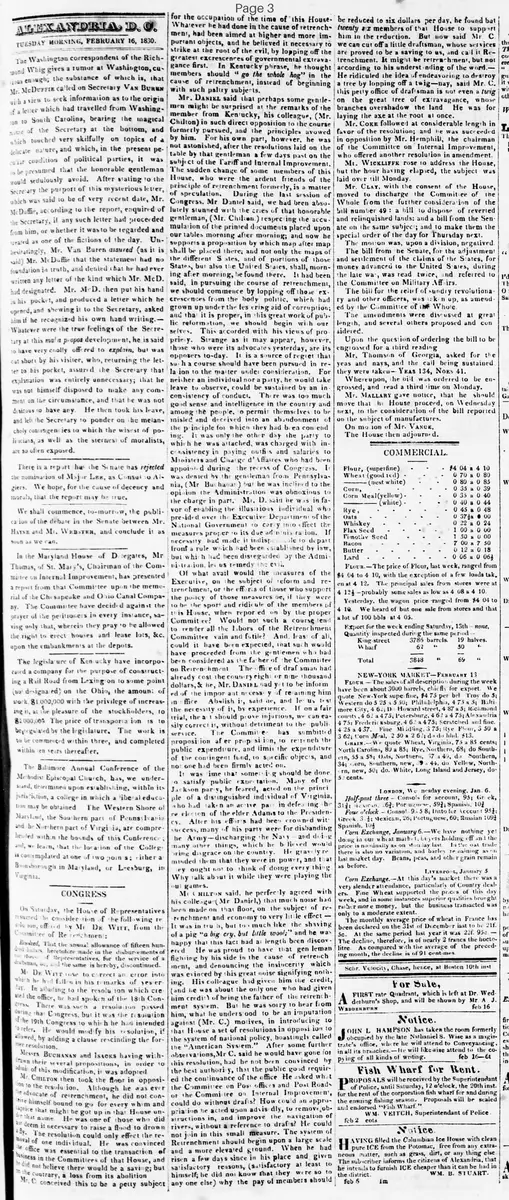
On Saturday, the House of Representatives resumed the consideration of the following resolution, offered by Mr. De Witt, from the Committee of Retrenchments:
Resolved, That the annual allowance of fifteen hundred dollars, heretofore made in the disbursements of the House of Representatives, for the service of a draftsman, &c. and the same is hereby, discontinued.
Mr. De Witt rose to correct an error into which he had fallen in his remarks of yesterday. In alluding to the resolution which created the office, he had spoken of the 18th Congress.
There was such a resolution passed during that Congress, but it was the resolution of the 19th Congress to which he had intended to refer. He would modify his resolution, if allowed, by adding a clause rescinding the former resolution.
Messrs. Buchanan and Yancey having withdrawn their several propositions, in order to admit of this modification, it was adopted.
Mr. Chilton then took the floor in opposition to the resolution.
Although he was ever the advocate of retrenchment, he did not conceive himself bound to go for every whim and caprice that might be got up in that House under that name.
He was one of those who did not deem it necessary to raise a flood to drown a rat with a resolution that could only effect the removal of one individual.
He was convinced the office was essential to the transaction of business in the Committees of that House.
He did not believe there would be a saving, but on the contrary a loss from its abolition.
Mr. C. conceived this to be a petty subject for the occupation of the time of this House.
Whatever he had done in the cause of retrenchment, had been aimed at higher and more important objects, and he believed it necessary to strike at the root of the evil, by lopping off the greatest excrescences of governmental extravagance first. In Kentucky phrase, he thought members should "go the whole hog" in the cause of retrenchment, instead of beginning with such paltry subjects.
Mr. Daniel said that perhaps some gentlemen might be surprised at the remarks of the member from Kentucky, his colleague, (Mr. Chilton) in such direct opposition to the course formerly pursued, and the principles avowed by him. For his own part, however, he was not astonished, after the resolutions laid on the table by that gentleman a few days past on the subject of the Tariff and Internal Improvement.
The sudden change of some members of this House, who were the ardent friends of the principle of retrenchment formerly, is a matter of speculation. During the last session of Congress, Mr. Daniel said, we had been absolutely stunned with the cries of that honorable gentleman, (Mr. Chilton) respecting the accumulation of the printed documents placed upon our tables morning after morning; and now he supports a proposition by which map after map shall be placed there: and not only the maps of the different States, and of portions of those States, but also the United States, shall, morning after morning, be found there. It had been said, in pursuing the course of retrenchment, we should commence by lopping off those excrescences from the body politic, which had grown up under the fostering aid of corruption; and that it is proper, in his great work of public reformation, we should begin with ourselves. This accorded with his views of propriety. Strange as it may appear, however, those who were its advocates yesterday, are its opposers to-day. It is a source of regret that such a course should have been pursued in relation to the matter under consideration. For neither an individual nor a party, he would take leave to observe, could be sustained by an inconsistency of conduct. There was too much good sense and intelligence in the country and among the people, to permit themselves to be misled and deceived into an abandonment of the principle for which they had been contending. It was only the other day the party to which he was attached, was charged with inconsistency in paying out fees and salaries to Ministers and Charge d'Affaires who had been appointed during the recess of Congress. It was denied by the gentleman from Pennsylvania, (Mr. Buchanan;) but he was inclined to the opinion the Administration was obnoxious to the charge in part. Mr. D. said he was in favor of enabling the illustrious individual who presided over the Executive Department of the National Government to carry into effect the measures proper to its due administration. If necessity had made it indispensable to depart from a rule which had been established by law, but which had been disregarded by the Administration, let us remedy the evil.
Of what avail would the measures of the Executive, on the subject of reform and retrenchment, or the efforts of those who support the policy of those measures be, if they were to be the sport and ridicule of the members of this House, when reported on by the proper Committee? Would not such a course tend to render all the labors of the Retrenchment Committee vain and futile? And, least of all, could it have been expected, that such would have proceeded from the gentleman who had been considered as the father of the Committee on Retrenchment. The office of draftsman had already cost the country eight or nine thousand dollars, & he, Mr. Daniel, had yet to be informed of the important necessity of retaining him in office. Abolish it, said he, and let us test the necessity of it, by experience. If on a fair trial, the act should prove injurious, we can easily correct it, without detriment to the public service.
The Committee has submitted proposition after proposition, to retrench the public expenditure, and limit the expenditure of the contingent fund, to specific objects, and not one had been firmly acted on.
It was time that something should be done to satisfy public expectation. Many of the Jackson party, he feared, acted on the principle of a distinguished individual of Virginia, who had taken an active part in defeating the re-election of the elder Adams to the Presidency. After his efforts had been crowned with success, many of his party were for disbanding the Army—discharging the Navy—and doing many other things, which he believed would bring disgrace on the country. He gravely reminded them that they were in power, and that they ought not to think of doing every thing at once.
Why talk about it while they were playing the rogue's games.
Mr. Chilton said, he perfectly agreed with his colleague (Mr. Daniel,) that much noise had been made on that floor, on the subject of retrenchment and economy to very little effect.
It was in truth, but too much like the shaving of a pig "a big cry, but little wool;" and he was happy that this fact had at length been discovered. He was proud to have that gentleman fighting by his side in the cause of retrenchment, and denouncing the insincerity which was evinced by this great noise signifying nothing. His colleague had given him the credit, (and he was about the only one who had given him credit) of being the father of the retrenchment system. But he was sorry to hear from him, what he understood to be an imputation against (Mr. C.) motives, in introducing to that House a set of resolutions in opposition to the system of national policy, boastingly called the "American System." After some further observations, Mr. C. said he would have gone for this resolution, had he not been convinced by the best authority, that the public good required the continuance of the office. He asked what the Committee on Post offices and Post Roads or the Committee on Internal Improvement, could do without drafts? How could an appropriation be acted upon advisedly, to remove obstructions in, and improve the navigation of rivers, without a reference to drafts? He could not join in this small measure. The system of Retrenchment should begin upon a large scale and a more elevated ground. When he had risen a few days since in his place and given satisfactory reasons, (satisfactory at least to himself; he did not know that they were so to any one else) why the pay of members should be reduced to six dollars per day, he found but twenty six members of that House to support him in the reduction. But now said Mr. C. we can cut off a little draftsman, whose services are proved to be a saving to us, and call it Retrenchment. It might be retrenchment, but not according to his understanding of the word.-
He ridiculed the idea of endeavoring to destroy a tree by lopping off a twig—nay, said Mr. C. this petty office of draftsman is not even a twig on the great tree of extravagance, whose branches overshadow the land. He was for laying the axe at the root at once.
Mr. Coke followed at considerable length in favor of the resolution; and he was succeeded in opposition by Mr. Hemphill, the chairman of the Committee on Internal Improvement, who offered another resolution in amendment.
Mr. Wickliffe rose to address the House, but the hour having elapsed, the subject was laid over till Monday.
Mr. Clay, with the consent of the House, moved to discharge the Committee of the Whole from the further consideration of the bill number 49: a bill to dispose of reverted and relinquished lands: and a bill from the Senate on the same subject; and to make them the special order of the day for Thursday next.
The motion was, upon a division, negatived.
The bill from the Senate, for the adjustment and settlement of the claims of the States, for money advanced to the United States, during the late war, was read twice, and referred to the Committee on Military Affairs.
The bill for the relief of sundry revolutionary and other officers, was taken up, as amended by the Committee of the Whole.
The amendments were discussed at great length, and several others proposed and considered.
Upon the question of ordering the bill to be engrossed for a third reading Mr. Thomson of Georgia, asked for the yeas and nays, and the call being sustained they were taken--Yeas 134, Noes 41.
Whereupon, the bill was ordered to be engrossed, and read a third time on Monday.
Mr. Mallory gave notice, that he should move that the House proceed, on Wednesday next, to the consideration of the bill reported on the subject of manufactures.
On motion of Mr. Varnum, The House then adjourned.
What sub-type of article is it?
What themes does it cover?
What keywords are associated?
What entities or persons were involved?
Where did it happen?
Story Details
Key Persons
Location
House Of Representatives
Event Date
Saturday, During The 19th Congress
Story Details
Debate on resolution to discontinue draftsman allowance, with Mr. De Witt proposing modification, opposition from Mr. Chilton emphasizing larger retrenchment, support from Mr. Daniel criticizing inconsistency; other bills on lands, war claims, and revolutionary officers advanced.