Thank you for visiting SNEWPapers!
Sign up free
Virginia Argus
Richmond, Virginia
What is this article about?
The Democratic Press analyzes a recent London Courier article, noting a shift in British ministerial tone from hostility to appeals for reconciliation with the US, amid tensions like the Chesapeake outrage and Capt. Bingham's letter, as King George III's death looms, potentially affecting peace or war prospects.
Clipping
OCR Quality
Full Text
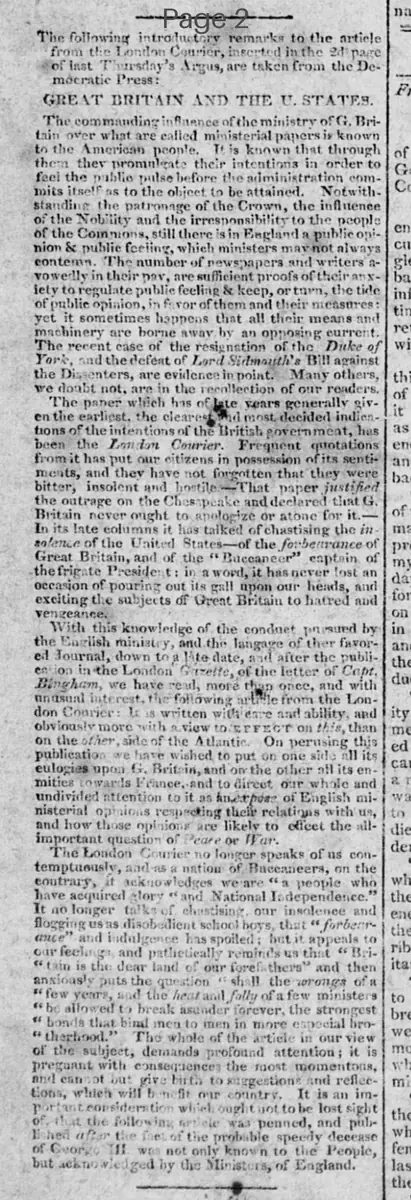
GREAT BRITAIN AND THE U. STATES.
The commanding influence of the ministry of G. Britain over what are called ministerial papers is known to the American people. It is known that through them they promulgate their intentions in order to feel the public pulse before the administration commits itself as to the object to be attained. Notwithstanding the patronage of the Crown, the influence of the Nobility and the irresponsibility to the people of the Commons, still there is in England a public opinion & public feeling, which ministers may not always contemn. The number of newspapers and writers avowedly in their pay, are sufficient proofs of their anxiety to regulate public feeling & keep, or turn, the tide of public opinion, in favor of them and their measures: yet it sometimes happens that all their means and machinery are borne away by an opposing current.
The recent case of the resignation of the Duke of York, and the defeat of Lord Sidmouth's Bill against the Dissenters, are evidence in point. Many others, we doubt not, are in the recollection of our readers.
The paper which has of late years generally given the earliest, the clearest most decided indications of the intentions of the British government, has been the London Courier. Frequent quotations from it has put our citizens in possession of its sentiments, and they have not forgotten that they were bitter, insolent and hostile. That paper justified the outrage on the Chesapeake and declared that G. Britain never ought to apologize or atone for it.
In its late columns it has talked of chastising the insolence of the United States—of the forbearance of Great Britain, and of the "Buccaneer" captain of the frigate President: in a word, it has never lost an occasion of pouring out its gall upon our heads, and exciting the subjects of Great Britain to hatred and vengeance.
With this knowledge of the conduct pursued by the English ministry, and the language of their favored Journal, down to a late date, and after the publication in the London Gazette, of the letter of Capt. Bingham, we have read, more than once, and with unusual interest, the following article from the London Courier: It is written with care and ability, and obviously more with a view to effect on this, than on the other, side of the Atlantic. On perusing this publication we have wished to put on one side all its eulogies upon G. Britain, and on the other all its enmities towards France, and to direct our whole and undivided attention to it as an expose of English ministerial opinions respecting their relations with us, and how those opinions are likely to affect the all-important question of Peace or War.
The London Courier no longer speaks of us contemptuously, and as a nation of Buccaneers, on the contrary, it acknowledges we are "a people who have acquired glory and National Independence."
It no longer talks of chastising our insolence and flogging us as disobedient school boys, that "forbearance" and indulgence has spoiled: but it appeals to our feeling, and pathetically reminds us that "Britain is the dear land of our forefathers" and then anxiously puts the question "shall the wrongs of a few years, and the heat and folly of a few ministers be allowed to break asunder forever, the strongest bonds that bind men to men in more especial brotherhood." The whole of the article in our view of the subject, demands profound attention: it is pregnant with consequences the most momentous, and can not but give birth to suggestions and reflections, which will be fit for our country. It is an important consideration which ought not to be lost sight of, that the following article was penned, and published after the fact of the probable speedy decease of Geo. III was not only known to the People, but acknowledged by the Ministers, of England.
What sub-type of article is it?
What keywords are associated?
What entities or persons were involved?
Where did it happen?
Foreign News Details
Primary Location
Great Britain
Event Date
After The Publication In The London Gazette, Of The Letter Of Capt. Bingham
Key Persons
Outcome
shift in british tone from hostility to appeals for reconciliation, potentially affecting peace or war with the us
Event Details
The Democratic Press comments on a London Courier article reflecting ministerial opinions, noting a change from contemptuous language about the US to recognition of American independence and pleas to maintain fraternal bonds despite recent wrongs, written after Capt. Bingham's letter and amid King George III's impending death.