Thank you for visiting SNEWPapers!
Sign up free
Morning Star
Limerick, York County, Maine
What is this article about?
Descriptive overview of the Island of Hayti (Haiti), covering its geography, population, major towns, economy, education, government as a republic since 1822, and current President Boyer. Exports total eight million dollars annually; soil fertile with sugar, coffee, and timber production.
Clipping
OCR Quality
Full Text
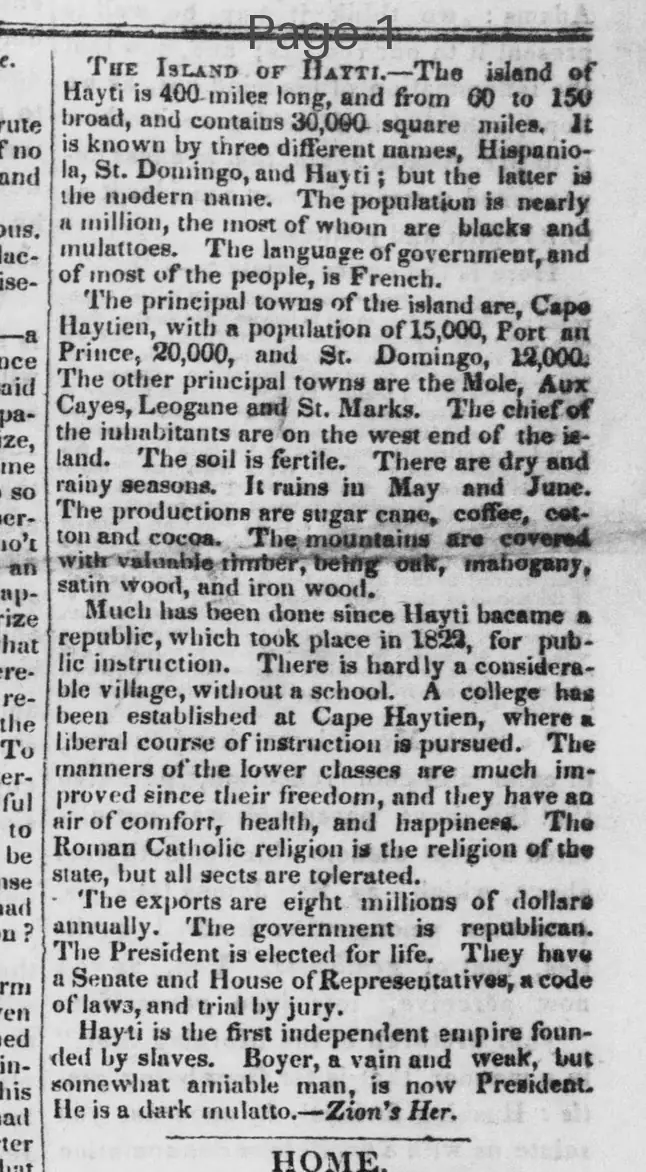
The principal towns of the island are, Cape Haytien, with a population of 15,000, Port au Prince, 20,000, and St. Domingo, 12,000 The other principal towns are the Mole, Aux Cayes, Leogane and St. Marks. The chief of the inhabitants are on the west end of the island. The soil is fertile. There are dry and rainy seasons. It rains in May and June.
The productions are sugar cane, coffee, cotton and cocoa. The mountains are covered with valuable timber, being oak, mahogany. satin wood, and iron wood.
Much has been done since Hayti became a republic, which took place in 1822, for public instruction. There is hardly a considerable village, without a school. A college has been established at Cape Haytien, where a liberal course of instruction is pursued. The manners of the lower classes are much improved since their freedom, and they have an air of comfort, health, and happiness. The Roman Catholic religion is the religion of the state, but all sects are tolerated.
The exports are eight millions of dollars annually. The government is republican. The President is elected for life. They have a Senate and House of Representatives, a code of laws, and trial by jury.
Hayti is the first independent empire founded by slaves. Boyer. a vain and weak, but somewhat amiable man. is now President. He is a dark mulatto.—Zion's Her.
What sub-type of article is it?
What keywords are associated?
What entities or persons were involved?
Where did it happen?
Foreign News Details
Primary Location
Island Of Hayti
Event Date
1822
Key Persons
Event Details
The island of Hayti, 400 miles long and 60-150 miles broad with 30,000 square miles, has a population of nearly a million, mostly blacks and mulattoes, speaking French. Principal towns include Cape Haytien (15,000), Port au Prince (20,000), St. Domingo (12,000), and others. Fertile soil produces sugar cane, coffee, cotton, cocoa; mountains have valuable timber. Became a republic in 1822 with advancements in public instruction, schools in villages, college in Cape Haytien. Improved manners post-freedom. Roman Catholic state religion, all sects tolerated. Exports eight million dollars annually. Republican government with life-elected President, Senate, House, code of laws, trial by jury. First independent empire founded by slaves; current President Boyer, a dark mulatto, described as vain, weak, but amiable.