Thank you for visiting SNEWPapers!
Sign up free
Springfield Weekly Republican
Springfield, Hampden County, Massachusetts
What is this article about?
Revival of the Daily Avalanche in Memphis, TN, as a key southern voice post-Civil War: accepts defeat, supports freedmen's labor success, respects Union soldiers but slams northern politicians for bad faith, opposes radicalism, and seeks dignified reunion.
Clipping
OCR Quality
Full Text
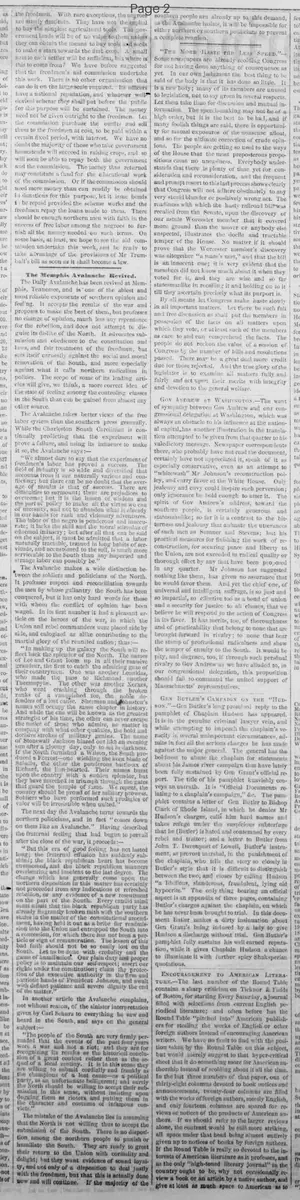
The Daily Avalanche has been revived at Memphis, Tennessee, and is one of the ablest and most reliable exponents of southern opinion and feeling. It accepts the results of the war and proposes to make the best of them, but professes no change of opinion, much less any repentance for the rebellion, and does not attempt to disguise its dislike of the North. It advocates submission and obedience to the constitution and laws, and fair treatment of the freedmen, but sets itself earnestly against the social and moral renovation of the South, and more especially against what it calls northern radicalism in politics. The scope of some of its leading articles will give, we think, a more correct idea of the state of feeling among the controlling classes in the South than can be gained from almost any other source.
The Avalanche takes better views of the free labor system than the southern press generally. While the Charleston South Carolinian is continually predicting that the experiment will prove a failure, and using its influence to make it so, the Avalanche says:-
"We almost dare to say that the experiment of freedmen's labor has proved a success. The field of industry is so wide and diversified that accounts from it are naturally various and conflicting; but there can be no doubt that the average of results is that of success. There are difficulties to surmount; there are prejudices to overcome; but it is the lesson of wisdom and the part of policy to make all the virtue we can of necessity, and not to abandon what is already in our hands for rash and visionary adventures. The labor of the negro is ponderous and inaccurate; it lacks the skill and the moral stimulus of educated industry; but after all that can be said on the subject, it must be admitted that a labor naturally tractable, trained in long habits of servitude, and accustomed to the soil, is much more serviceable to the South than any imported and strange labor can possibly be."
The Avalanche makes a wide distinction between the soldiers and politicians of the North. It professes respect and reconciliation towards the men by whose gallantry the South has been conquered, but it has only hard words for those with whom the conflict of opinion has been waged. In its first number it had a pleasant article on the heroes of the war, in which the Union and rebel commanders were placed side by side, and eulogized as alike contributing to the martial glory of the reunited nation; thus:-
"In making up the galaxy the South will reflect back the splendor of the North. The names of Lee and Grant loom up in all their massive grandeur, the first to catch the admiring gaze of their countrymen. One was another Leonidas, who made the pass to Richmond another Thermopylae. The other was another Xerxes, who went crashing through the broken ranks of a vanquished foe, the noble defenders of a lost cause. Sherman and Johnston's names will occupy the same chapter in history. And while the one will be known as the greatest strategist of his time, the other can never escape the notice of those who admire, no matter in company with what other qualities, the bold and decisive strokes of military genius. The name of Stonewall Jackson blazed out like an evening sun after a gloomy day, only to set in darkness. If the North furnished a Wilson, the South produced a Forrest—one wielding the keen blade of Saladin, the other the ponderous battle-ax of Richard, the lion-hearted. Their names burst upon the country with a sudden splendor, but they have marched in triumph through the gates that guard the temple of fame. We repeat, the country should be proud of her military prowess. Soldiers who have performed such prodigies of valor will be irresistible when united."
The next day the Avalanche turns towards the northern politicians, and in fact "comes down on them like an Avalanche." Having described the fraternal feeling that had begun to prevail after the close of the war, it proceeds:
"But this era of good feeling has not lasted long: the fraternal effusion has suddenly subsided; the black republican heart has become envenomed, and the black republican manners overbearing and insolent to the last degree. The change which has generally come upon the northern disposition in this matter has certainly not proceeded from any indications of refreshed rebellion, or any evidence of a new resentment on the part of the South. Every candid mind must admit that the black republican party has already flagrantly broken faith with the southern states in the matter of the constitutional amendment, having held it out as a bribe for readmission into the Union and entrapped the South into a concession, for which there has not been a particle or sign of remuneration. The lesson of this bad faith should not be so easily lost on the South. Let us be done with credulity and the game of humiliation. Our plain duty and proper policy is to maintain our self-respect; assert our rights under the constitution; claim the protection of the executive authority in the firm and patriotic hands of President Johnson, and await with defiant patience and severe dignity the end of the matter."
In another article the Avalanche complains, not without reason, of the sinister interpretation given by Carl Schurz to everything he saw and heard in the South, and says on the general subject:-
"The people of the South are very firmly persuaded that the events of the past four years were a war and not a riot; and they are for recognizing its results as the historical conclusion of a great contest rather than as the sequel of a local mutiny. It is in this sense they are willing to submit cordially and frankly as the champions of a lost cause—as a political party, as an unfortunate belligerent; and surely the North should be willing to accept their submission in this sense, without insisting upon dogging them as rioters and putting them in the character and costume of infamous convicts."
The mistake of the Avalanche lies in assuming that the North is not willing thus to accept the submission of the South. There is no disposition among the northern people to punish or humiliate the South. They are ready to greet their return to the Union with cordiality and delight; but they want evidence of sound loyalty, and not only of a disposition to deal justly with the freedmen, but that this is actually done now and will continue. If the majority of the southern people are already up to this demand, as the Avalanche insists, it will be impossible for either northern or southern politicians to prevent a complete reunion.
What sub-type of article is it?
What keywords are associated?
What entities or persons were involved?
Where did it happen?
Domestic News Details
Primary Location
Memphis, Tennessee
Key Persons
Event Details
The Daily Avalanche newspaper has been revived in Memphis, Tennessee, as an exponent of southern opinion post-Civil War. It accepts war results, advocates submission to laws and fair treatment of freedmen, but opposes northern radicalism and social renovation of the South. It views freedmen's labor as successful and preferable to imported labor. It distinguishes between respect for northern soldiers and criticism of northern politicians, accusing them of bad faith on constitutional amendments. It complains of Carl Schurz's interpretations of the South and insists on recognition of the war as a great contest, not a riot.