Thank you for visiting SNEWPapers!
Sign up free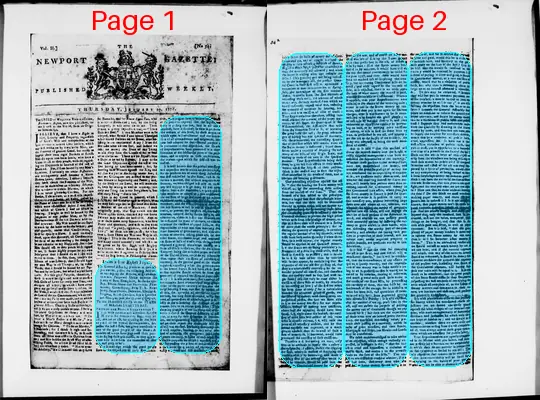
The Newport Gazette
Newport, Newport County, Rhode Island
What is this article about?
The Massachusetts House of Representatives addresses inhabitants explaining an act to call in state paper bills by loan amid war expenses, counterfeiting, and depreciation, responding to petitions and objections while accompanying the Articles of Confederation.
Merged-components note: Continuation of the official address from the General Assembly regarding currency and the war efforts, spanning pages 1 and 2. The content is domestic political and economic news, not an editorial opinion piece, so relabeling and merging for coherence.
Clippings
1 of 2
OCR Quality
Full Text
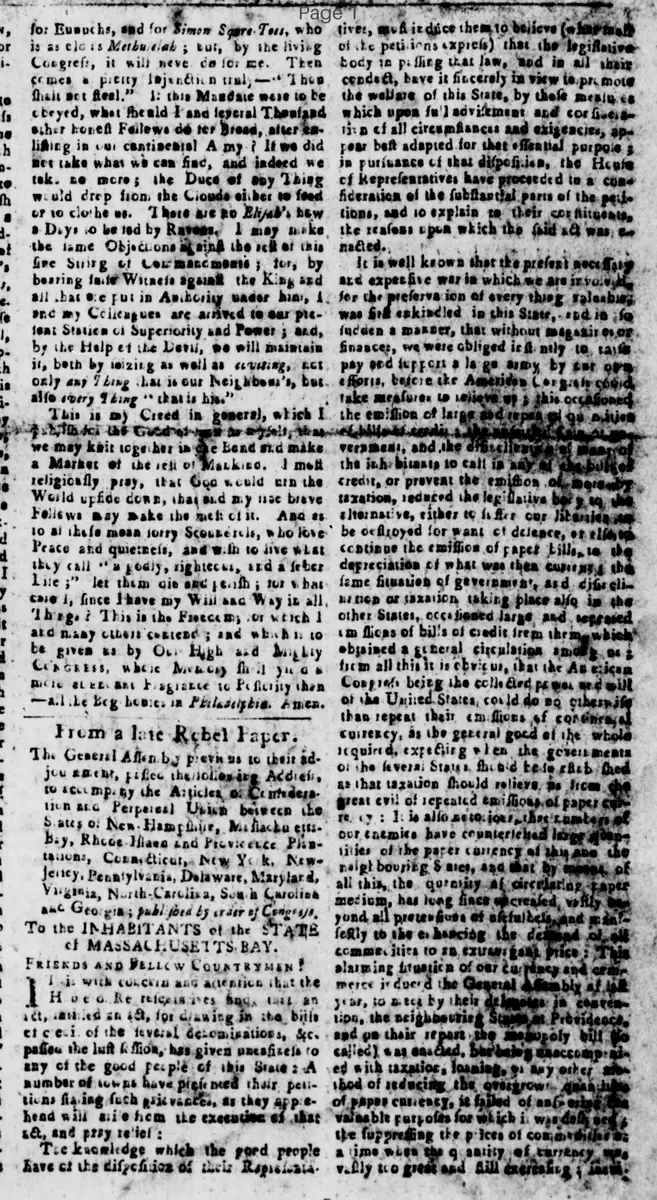
The General Assembly, previous to their adjournment, sent them the following Address, to accompany the Articles of Confederation and Perpetual Union between the States of New-Hampshire, Massachusetts-Bay, Rhode-Island and Providence Plantations, Connecticut, New York, New-Jersey, Pennsylvania, Delaware, Maryland, Virginia, North-Carolina, South Carolina and Georgia; published by order of Congress.
To the INHABITANTS of the STATE of MASSACHUSETTS-BAY.
Friends and Fellow Countrymen!
It is with concern and attention that the House of Representatives find, that an act, entitled an act, for emitting in the bill of the several denominations, &c. passed the last session, has given uneasiness to any of the good people of this State: A number of towns have presented their petitions praying such relief, as they apprehend will be from the execution of that act, and pray relief:
The knowledge which the good people have of this disposition of their Representatives. that they have sincerely in view the welfare of this State, by those measures which upon full advisement and consideration of all circumstances and exigencies, appear best adapted for that essential purpose; in pursuance of that disposition, the House of Representatives have proceeded to a consideration of the substantial parts of the petitions, and to explain to their constituents. the reasons upon which the said act was enacted.
It is well known that the present necessary and expensive war in which we are involved for the preservation of every thing valuable was first kindled in this State,-and in so sudden a manner, that without much precaution or finance, we were obliged instantly to, take pay and support a large army by our own efforts, before the American Congress could take measures to relieve us; this occasioned. the emission of large and repeated quantities of government, and the debauched taste of men of the inhabitants to call in an effectual system of credit, or prevent the emission of more b. taxation, reduced the legislative body to the alternative, either to let our country be destroyed for want of defence, or else to continue the emission of paper bills in tha-the depreciation of what was then current in the same situation of government, and dishonest taxation or taxation taking place also in the other States, occasioned large and repeated emissions of bills of credit from them which gained a general circulation among us:
By all this it is obvious, that the American Congress, being the central and superintending will of the United States, could do no otherwise than repeat their emissions of Congressional currency, as the general good of the whole required, expecting on the governments of the several States, in aid thereof, that taxation should relieve, as from the great evil of repeated emission of paper currency: It is also sufficiently known that our enemies have counterfeited large quantities of the paper currency of this and the neighbouring States, and did by means of all this, the quantity of circulating paper medium, has long since exceeded very greatly all pretensions of usefulness and good faith to the changing the debt of gi-commerce. it to such extravagant and prices: This alarming situation of our currency and commerce in duced the General Assembly last year, to meet by their delegates in convention, the neighbouring States at Providence. and on their report the monopoly bill as called) was enacted. but being unaccompanied -with taxation, loans, or any other me-ans of reducing the overgrown quantity of paper currency, it failed of any e-valuable purposes for which it was desi-gned the suppressing the prices of commodi-ties at a time when the quantity of currency i-s very great and still increasing it seems It ably threw the bulk of money out of circulation and of course inclined the holders of such useless quantities of money to give a much larger price for commodities than the monopoly bill allowed; and when the buyer is willing what can restrain the seller? This growing evil not being redressed by the monopoly bill, the present General Court in their first session, appointed a committee to meet in convention at Springfield, the committee of the five northern States, to confer upon the best method, of redressing these evils, the amount of whose report was, the only method from which we could reasonably expect relief was, reducing the quantity of currency by loaning, taxation, and non-emission of bills of credit: Your Representatives therefore, taking into consideration the amount of the paper currency, of this State, the quantity of it that is counterfeited, the difficulties that arise from the numerous sorts of it, of knowing the good from the bad; the great advantages of having but one species of currency, viz. the continental; the exceeding quantity of that sort which will remain when all the States money is destroyed; found themselves under a necessity of stopping the currency of the bills of any single State, and calling in those of our own in the speediest manner. Your Representatives being desirous to give full satisfaction to their constituents upon this subject, of their petition, think it the readiest way to state the object contained in this whole of them, and to obviate the seeming grievances. One prevailing objection against this act is, "that the loaning the States money will distress us by the crushing debt arising from the interest of the sums." That the interest of a sum added to the principal, makes a larger sum than the principal is certain, but that the debt will be increased thereby in certain cases will not appear upon a circumspect examination generally is lessened; this has a natural tendency to prevent the high prices which arise from a surplusage of money, and this in a short time will amount to a saving of more than the whole principal; the reducing the quantity of currency, is certainly the regular method of curing the evils, which arise from such excessive quantity; when therefore, such evils appear, the regular remedy should be applied in the speediest manner, the States money being particularly instrumental of producing those evils, must be sunk as speedily as possible: that it should be sunk by loan rather than by taxation will further appear, by considering that the expenses of the war are still pressing us, that they are unavoidably increasing by the increased price of all necessaries, and therefore that the treasury must be supplied with larger sums than it can only be done either by emission of more bills of credit, by taxation or borrowing on loan of the first too much has been done already: for a calculation founded the advanced prices of goods, and the interest of money, and (something) unprejudiced person, that had we been able to raise the money necessary for our expenses, instead of making new emissions, above half the expenses would have been saved, i.e. eight times the interest, the emission of more bills will enhance of less value what is already currency, i.e. will raise the price of all necessary articles, and by that means exacerbate our expenses, to a much greater amount than the interest of such a sum of money, as, if borrowed, would have prevented the necessity of such emissions. Taxation and borrowing on loan, only remain as methods to supply the treasury; the exigencies of affairs, forbid the risking that low, uncertain method of supplying the treasury wholly by borrowing, and made it absolutely necessary that as much money as could be raised by taxation, should be paid into the treasury in Continental money for the support of the war, and of course no other method was left of sinking the States money than that prescribed in the act, of drawing it in by loan: Had the States money been called in by taxation, it would have cost all the tax that could conveniently be raised for the year 1777, and then there would have been no method left of supplying the treasury, but borrowing Continental bills on interest; and with regard to the increase of debt, as is objected, there is no odds upon the loan of what money the interest is paid, whether States bills or Continental: Whence it appears, that your Representatives were reduced to the choice of the following cases; either to call in the States money by taxation, and then pay it out again for current charges, latterly was known to be so counterfeited as to deceive the good people; or to call it in by tax and destroy it, and then endeavour to supply the treasury by borrowing on loan, or by making more emissions of money, or else to sink the States bills by loan, as prescribed in the act, and appropriate the tax to the supply of the treasury. The last was adopted as being the most beneficial etc. But it is said "that this method will throw the interest money into the hands of every disposed monopolist who have calculated the depreciation of our currency," Whether those nervous called monopolizers, have not paid undervalued the money. and whether the great surplusage of money has not occasioned the monopolizing of commodities, are questions easily determined, and whether the receiving interest for States money, will benefit such persons more than receiving interest for, Continental money in the Continental loan office, where draughts for silver money in France is paid for interest, and whether it is possible to carry on this necessary war, without borrowing large sums over and above all our taxation, and whether the taking this money of particular persons into our hands, will not cause the allegiance of such persons to the American interest, and whether we can possibly punish those unworthy persons by restoring the currency to grow useless in their hands, without distressing the worthy part of the community; and whether the taxing such persons in proportion to their interest, will not reduce their, newly acquired property. to public benefit, are questions worthy of consideration. It is said "that the time for executing the act is too short, and that distress will be occasioned thereby," but it will be considered, that the circumstances of our affairs require a speedy remedy, and the depreciation of our money was in some measure owing to an apprehension that it would not be called in by taxation, loaning or otherwise, and much greater evils must have arisen to the credit of our State bills, by protracting the currency of them, than can arise by the suddenness of the change, for in addition to what has been said, vast quantities of counterfeited bills has been prevented getting into circulation thereby: It is also objected, that the method of calling, prescribed in the act, will not answer the purpose of putting the money out of circulation though we pay interest for it: but doth not the experience of those notes now on interest prove the contrary, the continual increasing value; prove their paling as a currency. unless in cases of great occasion and then Bonds, Mortgages and Ships, yea Houses and Lands may be transferred. We think ourselves obliged to take notice of an objection which though variously expressed, in substance is this; "that the said act is cruel and oppressive, a violation of public faith, and contrary to the promise made on the face of the bills." The objectors are desired to consider whether, if the act had been, that every man who has possessed or States money, should bring it to the treasurer, and for it receives the amount in silver and gold, would this be a violation of public faith, and contrary to the promise made on the face of the bill? Can it be said. that the money so received at. the treasury would be received.in payment i. instead of paying in silver and gold, it should in Continental money, or a new emission of money, would that be a violation of public faith, &c. why then is redeeming them by large notes on interest esteemed a violation, &c. To this may be answered, ". because they will) not pass in common payment, nor at the treasury, a man:io forced-io loan his money whorhor he wi I or net;"io not this shifting the objection from the letter to the spirit? Suppose the General Assembly had taken no measures to reduce the quantityof paper currency, and secure its value would there be o citation df public fnk and puay tsua? Suppose they hed undertaken toie. duce tho quantity by drawing in the States money by coxen, and then had net boengable to supply the treasury for necessary defense, wouid this be a violation o. public faith. c'uel. oppressive, dt. dis here not a real deft:uRtiro violation o public taith,nd public uut, pur ia oppcurioa to a suppefed violt.on of a piomise in the face of the ligj Doth not the hole torce of this ctje&oe arif frox the obiccterv nor briag wihis to lead their money tor public afe? If thegoel Inisntion and cifodt of the act was dut fup. portrd by s fpiric of pateioti(ms would iiar be any cemplaising of boing ferted r desa : linle furpiufage morey jor oommox good! Harh it xgt boca the knjverfal tenciatremr Band thie oas breke ont, that this geaeratioatned fehtaand the next pay what we are-sat.ol ( ? Hou cen tbar be dene wirhoat joans the debt ? De any think we makt toatis makiag paper mrency, aed itave c joncta:ian to rodeed it i Io iz apt @er knooa, that paper moniy cen' bo gm) vand i corsaia anan r i y c.es thst are nlually wd st axakfea bayend chat, anly tha. nogrinal. faai( creafad, and dot the value, compared. thinzi to .be baugat, and thae thia cafe with gold aad.hiver, ao woll a ptt currency. Bue it is faid, * that the 27e jlon ty of poper meney readers it gore ew to redeem shic States mondy by tax ape thaa it - wiit bo :hereateer when mences. fearos." This is.an andoubted reafonn we fould coliek ao much morey.by (ax, c wi can bear, aad if the: curredi eapease will admit, that any af.sha notzs en jatogk Shouid be reduemed, ie fhoeld be doae g:but whoerer coafidete the: unavoid: bts dxpesn of dbe peeseas nar, ixxledinz oux Sase.d the Contigcatal expenec, vill bardfy fup pole our tsx:a.will bo cgual to it. bje got much to bc wondsred, inet the good, pxo?h of thio State fhanld difr ia their feaumepg respetting the bek marihod: of remeiying the ovile which all coaplain of, ay tke fyaom ef donoy-matrets aax commerse in sbsir ae- ture, are jatricate aad ehl: uce and paihaps not geperaily upd Rogdsd rg thina I io with pleatorowsnbfervoahatjec/sa) for liberty which has occohoned tbela ob- je&tiani yet. . wg- lhon/d. csu:jonly zpard againf the subtil defzns of cur iaterual cro- mier, wka emit noepportuaity of fomensipz divifions: and jealonfoe by wbich oaly tbey can hipe to subdue uy ;. cod we hoyld vell confidsr,': whether, shere are more evile and inconveniencse arifing from de eA complaio- ed cf, than eiwage airend those great gpaja- tione which ore neceSary for public fatety, Your Reprefeuiative; are .qually confgra- .ed ia th= Mutpr with vou foiyer, and cae- only ubjeetion ihat remsins go be obviatedi -to (hci rprqperey as fstiled by iox:bill : The in which thsy dp nor partaige in proporijon not pahibly lay * burthen vo (he commuant) "remaining in the. handgof poor pucpk " that here vnavoidably will be mall nms "" who mhay nct be abie to chenco it wiih ih
What sub-type of article is it?
What keywords are associated?
Where did it happen?
Domestic News Details
Primary Location
Massachusetts Bay
Event Date
1777
Event Details
The House of Representatives addresses concerns over an act for emitting bills, explaining its necessity due to war expenses, paper currency emissions, counterfeiting, and failed prior measures like the monopoly bill; proposes calling in state bills by loan to reduce quantity and stabilize economy, responding to petitions and objections.