Thank you for visiting SNEWPapers!
Sign up free
Republican Herald
Providence, Providence County, Rhode Island
What is this article about?
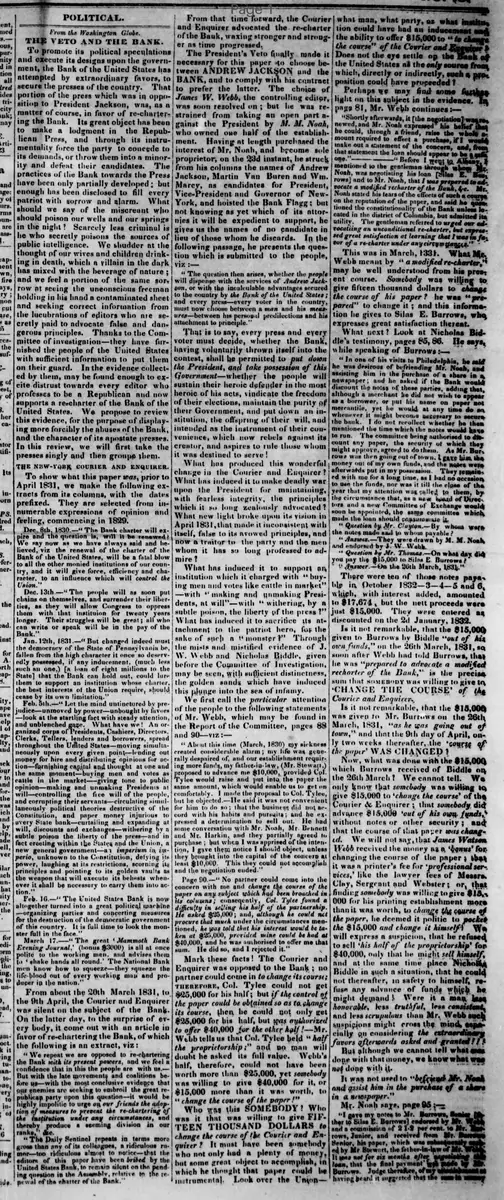
Editorial from the Washington Globe denounces the Bank of the United States for corrupting the press to secure re-charter support against President Jackson's veto. Focuses on the New-York Courier and Enquirer's shift in stance, alleging a $15,000 Bank payment via Silas E. Burrows to influence editor James W. Webb, citing committee evidence.
Merged-components note: Continuation of the political article discussing the Bank of the United States and its influence on the press, originally labeled as 'story' on page 2.
Clippings
1 of 2
OCR Quality
Full Text
From the Washington Globe,
THE VETO AND THE BANK.
To promote its political speculations and execute its designs upon the government, the Bank of the United States has attempted by extraordinary favors, to secure the presses of the country. That portion of the press which was in opposition to President Jackson, was, as a matter of course, in favor of re-chartering the Bank. Its great object has been to make a lodgment in the Republican Press, and through its instrumentality force the party to concede to its demands, or throw them into a minority and defeat their candidates. The practices of this Bank towards the Press have been only partially developed: but enough has been disclosed to fill every patriot with sorrow and alarm. What should we say of the miscreant who should poison our wells and our springs in the night? Scarce less criminal is he who secretly poisons the sources of public intelligence. We shudder at the thought of our wives and children drinking in death, which a villain in the dark has mixed with the beverage of nature; and we feel a portion of the same sorrow at seeing the unconscious freeman holding in his hand a contaminated sheet and seeking correct information from the lucubrations of editors who are secretly paid to advocate false and dangerous principles. Thanks to the Committee of investigation-they have furnished the people of the United States with sufficient information to put them on their guard. In the evidence collected by them, may be found enough to excite distrust towards every editor who professes to be a Republican and now supports a re-charter of the Bank of the United States. We propose to review this evidence, for the purpose of displaying more forcibly the abuses of the Bank, and the character of its apostate presses. In this review, we will first take the presses singly and then group them.
THE NEW-YORK COURIER AND ENQUIRER.
To show what this paper was, prior to April 1831, we make the following extracts from its columns, with the dates prefixed. They are selected from innumerable expressions of opinion and feeling, commencing in 1829.
Dec. 8th. 1830. -" The Bank charter will expire and the question is, will it be renewed? We say now as we have always said and believed, viz the renewal of the charter of the Bank of the United States, will be a fatal blow to all the other monied institutions of our country. and it will give force, efficiency and character. to an influence which will control the Union."
Dec. 13th.-" The people will as soon put chains on themselves. and surrender their liberties, as they will allow Congress to oppress them with that institution for twenty years longer. Their struggles will be great: all who can write or speak will be in the pay of the Bank."
Jan. 12th, 1831.-" But changed indeed must the democracy of the State of Pennsylvania be, fallen from the high character it once so deservedly possessed, if any inducement, (much less such an one.) [a Loan of eight millions to the State] that the Bank can hold out, could lure them to support an institution whose charter, the best interests of the Union require, should cease by its own limitation."
Feb. 5th.-" Let the mind untinctured by prejudice-unmoved by power-unbought by favors --look at the startling fact with steady attention, and unblenched gaze. What have we! An organized corps of Presidents, Cashiers, Directors. Clerks, Tellers, lenders and borrowers, spread throughout the United States-moving simultaneously upon every given point-finding out money for hire and distributing opinions for action-furnishing capital and thought at one and the same moment-buying men and votes as cattle in the market--giving tone to public opinion-making and unmaking Presidents at will-controlling the free will of the people, and corrupting their servants--circulating simultaneously political theories destructive of the Constitution, and paper money injurious to every State bank-curtailing and expanding at will, discounts and exchanges-withering by a subtle poison the liberty of the press-and in fact erecting within the States and the Union, a new general government-an imperium in imperio, unknown to the Constitution, defying its power, laughing at its restrictions, scorning its principles and pointing to its golden vaults as the weapon that will execute its behests whenever it shall be necessary to carry them into action."
Feb. 16.-" The United States Bank is now altogether turned into a great political machine -organizing parties and concerting measures for the destruction of the democratic government of this country. It is full time to look the monster full in the face."
March 17.—-" The great 'Mammoth Bank Evening Journal,' (bonus $3000) is all at once polite to the working men. and advises them to 'shake hands all round.' The National Bank men know how to squeeze-they squeeze the life-blood out of every working man and producer in the nation."
From about the 20th March 1831, to the 9th April, the Courier and Enquirer was silent on the subject of the Bank.
On the latter day, to the surprise of everybody, it come out with an article in favor of re-chartering the Bank, of which the following is an extract, viz:
" We repeat we are opposed to re-chartering the Bank with its present powers, and we feel a confidence that in this the people are with us.- But with the late movements and coalitions before us-with the most conclusive evidence that our enemies are seeking to embroil the great republican party upon this question--it would be highly impolitic to urge on our friends the adoption of measures to prevent the re-chartering of the institution under any circumstances, and thereby produce a seeming division in our ranks," &c.
" The Daily Sentinel repeats in terms more gross than any of its colleagues, a ridiculous rumor-too ridiculous almost to notice-that the editors of this paper have been bribed by the United States Bank, to remain silent on the pending question in the Assembly, relative to the renewal of the charter of the Bank.'
From that time forward, the Courier and Enquirer advocated the re-charter of the Bank, waxing stronger and stronger as time progressed.
The President's Veto finally made it necessary for this paper to choose between ANDREW JACKSON and the BANK, and to comply with his contract to prefer the latter. The choice of James W. Webb, the controlling editor, was soon resolved on; but he was restrained from taking an open part against the President by M. M. Noah, who owned one half of the establishment. Having at length purchased the interest of Mr, Noah, and become sole proprietor, on the 23d instant, he struck from his columns the names of Andrew Jackson, Martin Van Buren and Wm. Marcy, as candidates for President, Vice-President and Governor of New York, and hoisted the Bank Flag; but not knowing as yet which of its attorneys it will be expedient to support, he gives us the names of no candidate in lieu of those whom he discards. In the following passage, he presents the question which is submitted to the people, viz :
" The question then arises, whether the people will dispense with the services of Andrew Jackson, or with the incalculable advantages secured to the country by the Bank of the United States; and every press-every voter in the country, must now choose between a man and his measures-between his personal predilections and his attachment to principle."
That is to say, every press and every voter must decide, whether the Bank, having voluntarily thrown itself into the contest, shall be permitted to put down the President, and take possession of this Government-whether the people will sustain their heroic defender in the most heroic of his acts, vindicate the freedom of their elections, maintain the purity of their Government, and put down an institution, the offspring of their will, and intended as the instrument of their convenience, which now rebels against its creator, and aspires to rule those whom it was destined to serve!
What has produced this wonderful change in the Courier and Enquirer?
What has induced it to make deadly war upon the President for maintaining with fearless integrity, the principles which it so long zealously advocated?
What new light broke upon its vision in April 1831, that made it inconsistent with itself, false to its avowed principles, and now a traitor to the party and the men whom it has so long professed to admire?
What has induced it to support an institution which it 'charged with "buying men and votes like cattle in market" -with "making and unmaking Presidents, at will"-with "withering, by a subtle poison, the liberty of the press ?"
What has induced it to sacrifice its attachment to the patriot hero, for the sake of such a "monster ?" Through the mists and mystified evidence of J. W. Webb and Nicholas Biddle, given before the Committee of Investigation, may be seen, with sufficient distinctness, the golden sands which have induced this plunge into the sea of infamy.
We first call the particular attention of the people to the following statements of Mr. Webb, which may be found in the Report of the Committee, pages 88 and 90--viz:-
"About this time (March, 1830) my sickness created considerable alarm; my life was generally despaired of, and our establishment requiring more funds, my father-in-law, (Mr. Stewart,) proposed to advance me $10,000, provided Col. Tylee would raise and put into the paper the same amount, which would enable us to get on comfortably. I made the proposal to Col. Tylee, but he objected.-He said it was not convenient for him to do so; that the business did not accord with his habits and pursuits; and he expressed a determination to sell out. He had some conversation with Mr. Noah, Mr. Bennett and Mr. Harkin, and they partially agreed to purchase; but when I was apprised of the intention, I gave them notice I should object, unless they brought into the capital of the concern at least 10,000. This they could not accomplish and the negotiation ended."
Page 90.-" No partner could come into the concern with me and change the course of the paper on any subject which had been broached in its columns; consequently, Col. Tylee found a difficulty in selling his half of the partnership. He asked $25,000; and, although he could not procure that much under the circumstances mentioned, he was told that his interest would be taken at 25,000, provided mine could be had at $40,000, and he was authorized to offer me that sum. He did so, and I rejected it."
Mark these facts! The Courier and Enquirer was opposed to the Bank ; no partner could come in to change its course; THEREFORE, Col. Tylee could not get $25,000 for his half; but if the control of the paper could be obtained so as to change its course, then he could not only get $25,000 for his half, but was authorized to offer $40,000 for the other half!--Mr. Webb tells us that Col. Tylee held "half the proprietorship;" and no man will doubt he asked its full value. Webb's half, therefore, could not have been worth more than $25,000, yet somebody was willing to give 40,000 for it, or $15,000 more than it was worth, to " change the course of the paper!"
Who was this SOMEBODY! Who was it that was willing to give FIFTEEN THOUSAND DOLLARS to CHANGE THE COURSE of the Courier and Enquirer? It must have been somebody who not only had a plenty of money, but some great object to accomplish, in which he thought that paper could be instrumental. Look over the Union- what man, what party, or what institution could have had an inducement and the ability to offer $15,000 to " to change the course" of the Courier and Enquirer?
Does not the eye settle on the Bank of the United States as the only source from which, directly or indirectly, such a proposition could have proceeded?
Perhaps we may find some further light on this subject in the evidence. On page 81, Mr. Webb continues:-
"Shortly afterwards, it [the negotiation] was renewed, and Mr. Noah expressed his belief that he could, through a friend, raise the whole mount required to effect a purchase, if I would make out a statement of the concern, and, on that statement the loan should appear to be against one.
"Before I went to Albany, I mentioned to the gentleman through whom Mr. Noah, was negotiating his loan [Silas E. Burrows] and to Mr. Noah, that I was prepared to advocate a modified recharter of the Bank, &c. Mr. Noah stated his fears of the effects of such a course on the reputation of the paper, and said he questioned the constitutionality of the Bank unless located in the district of Columbia, but admitted its utility. The gentleman referred to urged our advocating an unconditional re-charter, but expressed great satisfaction at learning that I was in favor of a re-charter under any circumstances?.
This was in March, 1831. What Mr. Webb meant by " a modified re-charter" may be well understood from his present course. Somebody was willing to give fifteen thousand dollars to change the course of his paper? he was "prepared" to change it ; and this information he gives to Silas E. Burrows, who expresses great satisfaction thereat.
What next? Look at Nicholas Biddle's testimony, pages 85, 86. He says. while speaking of Burrows:---
" In one of his visits to Philadelphia, he said he was desirous of befriending Mr. Noah, and assisting him in the purchase of a share in newspaper; and he asked if the Bank would discount the notes of those parties, adding that, although a merchant he did not wish to appear as a borrower, or put his name on paper not mercantile, yet he would at any time do so whenever it might become necessary to secure the bank. I do not recollect whether he then mentioned the time which the notes would have to run. The committee being authorised to discount any paper, the security of which they might approve, agreed to do so. As Mr. Burrows was then going out of town. I gave him the money out of my own funds, and the notes were afterwards put in my possession. They remained with me for a long time, as I had no occasion to use the funds, nor was it till the close of the year that my attention was called to them, by the circumstance that, as a new board of Directors and a new Committee of Exchange would soon be appointed, the same committee which made the loan should consummate
" Question by Mr. Clayton.-By whom were the notes made and to whom payable?
" Answer.-They were drawn by M. M. Noah and endorsed by J. W. Webb.
" Question by Mr. Thomas.-On what day did you pay the $15,000 to Silas E. Burrows?
" Answer.-On the 26th March, 1831."
There were ten of those notes payable in October 1832-3-4-5 and 6. which, with interest added, amounted to $17,674. but the nett proceeds were just $15,000. They were entered as discounted on the 2d January, 1832.
Is it not remarkable, that the $15,000 given to Burrows by Biddle "out of his own funds," on the 26th March, 1831, so soon after Webb had told Burrows, that he was "prepared to advocate a modified recharter of the Bank," is the precise sum that someBody was willing to give to 'CHANGE THE COURSE' of the Courier and Enquirer.
Is it not remarkable, that the $15,000 was given to Mr. Burrows on the 26th March, 1831, "as he was going out of town," and that the 9th day of April, only two weeks thereafter, the course the paper' WAS CHANGED !
Now, what was done with the $15,000 which Burrows received of Biddle on the 26th March? We cannot tell. We only know that somebody was willing to give $15,000 to 'change the course' of the Courier & Enquirer ; that somebody did advance $15,000 'out of his own funds,' without notes or other security; and that the course of that paper was changed. We will not say, that James Watson Webb received the money as a 'bonus' for changing the course of the paper ; that it was a printer's fee for 'professional services,' like the lawyer fees of Messrs. Clay, Sergeant and Webster; or, that finding somebody was willing to give $15,000 for his printing establishment more than it was worth, to change the course of the paper, he deemed it politic to pocket the $15,000 and change it himself We will express a suspicion, that he refused to sell 'his half of the proprietorship' for $40,000, only that he might sell himself. and at the same time place Nicholas Biddle in such a situation, that he could not thereafter, in safety to himself. refuse any advance of funds which he might demand Were it a man less honorable, less truthful, less consistent and less scrupulous than Mr. Webb such suspicions might cross the mind. especially on considering the extraordinary favors afterwards asked and-granted!!!
But although we cannot tell what was done with that money, we know what was not done with it.
It was not used to "befriend Mr. Noah and assist him in the purchase of a share in a newspaper."
Mr. Noah says, page 95
"I gave my notes to Mr. Burrows, (either to Silas E. Burrows) endorsed by Mr. Webb and a commission of 2 1-8 per cent. to Mr. Burrows, Junior, and received from Mr. Burrows, Senior, his paper, which was subsequently endorsed by Mr Stewart, the father-in-law of Mr Webb. It was not for six months after loan, that the final payment Burrows. Judge therefore, of my having heard it suggested that the
was loaned by Mr. Biddle, for my use when, throughout the whole negotiation, the name of the United States Bank was not even mentioned, and I never, for a moment, suspected that the loan emanated from any other source than Mr. Enoch Burrows, of Connecticut.
Mr. Webb says, page 52: "I will also state, for the information of the committee, that I am satisfied in my own mind, [Burrows] did not act as the agent of the bank in making the loan to Mr. Noah, and for the following reasons: In the first place, I presume he would not then have received a commission of two and a half per cent.; and, secondly, the money in such case would have been forthcoming when required; but, instead of that being the case, he gave his and his father's paper at short dates; which was not paid when due, which in my case, he gave his and his father's paper at short dates; which was not paid when due, in which case, his father-in-law, Mr. Stewart, cashed, and one-third of which was replaced by his notes at sixty days and six months, because he could not raise the funds at the time he had agreed on."
The $15,000 advanced by Mr. Biddle to Mr. Burrows out of his own funds, on the 26th March, 1831, did not, therefore, go to Mr. Noah. It went to some other point--not, perhaps, to Mr. Webb, to pay for the 'change in the course of the paper,' which he had told Burrows he was prepared to make, and actually did make!
It is singular, that President Biddle does not state when Mr. Noah's ten notes with Mr. Webb's endorsement, came into his possession. He says, "they remained with me a long time;" but in this other evidence shows that he is mistaken. Through Webb, we have Burrows' statement of the time they were handed to Biddle and the object.-- Page 75, in a letter dated 10th March, 1832, Mr. Webb says ;-- "Mr. Burrows called yesterday and made me acquainted with a fact which may be misconstrued," &c.-"I now learn from Mr. Burrows. notes discounted in the United States Bank on that in January he wanted money, and had these some collateral security." &c.
Again, page 83, in his examination before the committee on oath he says:- "I have understood from the gentleman. [Burrows] within the last month, that this money was loaned [to Noah] by his father; that he was in want of funds in January last; that he went to Connecticut, procured these notes, and had them discounted at the Bank of the United States upon some collateral security.
The account of this affair is confirmed by the fact, that the notes were entered in the books of the Bank as discounted on the 2d January, 1832, and by other incidents. On the 9th of August 1831, a loan of $20,000 was granted to Messrs. Webb and Noah, and on the 16th December 15,000 more, without any security but their own names; and on neither of these occasions did Mr. Biddle, as he himself admits, inform the Directors who made the discounts, that these parties already owed the bank $17,975. loaned upon their names only. Would he not have done so, had he then considered it a loan from the bank, or which he had their notes in his pocket ?
Page 543-Question by Mr. Cambreleng to Joshua Lippincott, a Director.-Had you any knowledge at the time of the discount of the 9th August, 1831, of the existence of a loan of $17,975, made directly or indirectly to any person upon the paper of M. M. Noah, endorsed by J. W. Webb, antecedent to that date? Answer.-I had not.
Although some of the exchange Committee had an indistinct recollection that a loan to Burrows with these notes as a collateral security had been spoken of; yet, no one pretended that he had any knowledge that it had been made- when they granted the loans of August and December, and Thomas Cope, page 561, says, they made the discount on 2d January, 1832, "because we supposed we had previously given our consent," that is to say, President Biddle told them so, and we believe him.
But is it credible that the President of the Bank carries the securities of the institution in his pocket for eight or ten months after they are received? Does he advance his own friends by tens and fifteens of thousands at a time, to enable gentlemen to befriend editors hostile to the Bank, sacrificing the use and interest of his money, and especially in times of great pressure, like the fall and winter of 1831? Does he suffer the board to discount fifteens and twenties of thousands to parties who already have heavy loans without their knowledge, the security of which he has in his breeches pocket, and says not a word about it ?— Is President Biddle so disinterested, so careless of his own interest and so negligent of his duty to the other directors? No; this story will not bear telling.
Burrows undoubtedly told the truth to Webb. Instead of being in Mr. Biddle's pocket, these notes were in Connecticut until near the first of January, 1832;- Burrows wanted money, went for the notes and got them discounted at the Bank on the 2d January. To whose credit were they discounted? Not to Biddle's, nor yet to Burrows', but to Webb's. Noah was the drawer and Webb the endorser. Nothing but Webb's check could have drawn the money from the Bank, or placed it to the credit of Burrows or Biddle. That it went to the benefit of Burrows who got the notes discounted in January, to raise money, there is no reasonable ground to doubt,
The advance of $15,000 by Biddle, but of his own funds, in March 1831, and the discount of these notes in January 1832, were therefore, separate transactions. The story may be explained thus: Silas E. Burrows knowing that $15,000 had been offered in "change the course" of the Courier and Enquirer- Being told by Webb that he was "prepared to advocate a modified re-charter of the Bank," and apprised of Mr. Noah's intention to purchase, which would much increase the circulation and influence of the paper, carried all this gratifying intelligence to President Biddle, and asked for means to render efficient the good dispositions which had sprung up in that quarter towards the Bank, "Biddle advanced him; $15,000 "out of his own funds," and in two weeks all the arrangements were made, and Mr. Webb was out in favor of re-chartering the Bank!
For the $15,000 advanced by Biddle, he received no security whatever, not even the note or memorandum of Burrows. The notes which he pretends were given him afterwards, as security were not executed until 1st April, 1831, they were then given to Enoch Burrows, of Connecticut, in exchange for his paper, at a short date, and by him carried home; they remained with him in Connecticut, until about the 1st January, 1832, when Silas E. Burrows procured them, and had them discounted, on the 2d of that month, for his benefit. As these notes went to swell the apparent debt of Messrs. Webb, and Noah to a suspicious amount, Mr. Burrows, on the 2d March 1832, procured the discount of other paper, paid them up with the proceeds, and withdrew them from the Bank. Had they not been discounted for his benefit, he certainly would not have taken them up. This is the second transaction, and wholly independent of the first.
Well, what was done with the FIFTEEN THOUSAND DOLLARS advanced by Biddle on the 26th of March, 1831, without note or security? Silas E. Burrows could tell. The Committee issued a summons for him; he came to Washington from the South; he met President Biddle in the City, as we heard, whither he had come during the sessions of the Committee. If Burrows and Biddle agreed upon the circumstances of this advance of money and the loans of the Bank, why did not Burrows go to Philadelphia and present himself for examination? He did not want to be examined, nor Biddle want he should be. He knew well enough what was done with the $15,000 advanced by Biddle in March, 1831, he knew well enough, what had changed the course of the Courier and Enquirer; he knew when the ten notes were sent to Biddle-to whose credit they were discounted-and by whose check the money was drawn; and he knew much more about the Bank in many respects than he cared to tell, and more than Biddle wanted he should tell.
He, therefore, fled from Washington, where the Sergeant-at-arms had a summons for him-took care not to be seen in Philadelphia, where the Marshal had a summons-passed through New York, where the Marshal had a summons incognito, or crossed the North river above the city-and took refuge in Connecticut until the Committee had finished their investigations! If his story on oath would have agreed with Biddle's why this flying and hiding like a criminal to avoid an examination? Would he not rather have sought the Committee and begged them to put him on oath that he might give them "the truth, the whole truth and nothing but the truth?"
This witness knew too much for Mr. Biddle's interest, if not for his reputation. But he did not choose either to perjure himself or tell the truth: and therefore fled to Connecticut!! Is there not enough in this single transaction to justify a thousand vetoes, unless it be fully explained? When many of the community suspect and charge direct bribery on part of the Bank; when the evidence produced is obscure and contradictory; and when the witness who can explain, after consulting with President Biddle, flees and eludes the officers of the law, like a felon to avoid an examination, shall it be said that all is pure— all is right, all is open, frank, honest and honorable on the part of this institution?
No, the circumstances disclosed in this case, instead of quieting, only aggravate the damning suspicions which had already been excited. No cautious statesman or jealous patriot ought to consent to the re-chartering of this institution, until this matter be sifted to the bottom- until Silas E. Burrows and Enoch Burrows be brought to state upon their oaths what was done with the $15,000 advanced, by President Biddle-when the ten notes went into his possession, and for whose benefit they were discounted.
We are not yet done with the conduct of the Bank in relation to the Courier and Enquirer.
What sub-type of article is it?
What keywords are associated?
What entities or persons were involved?
Editorial Details
Primary Topic
Bank Of The United States Corruption Of The Press Via Financial Influence To Oppose Jackson's Veto
Stance / Tone
Strongly Anti Bank, Pro Jackson, Alarmist About Corruption
Key Figures
Key Arguments