Thank you for visiting SNEWPapers!
Sign up free
Southern Standard
Columbus, Lowndes County, Mississippi
What is this article about?
Newspaper editorial endorsing Judge Clayton for re-election to Mississippi's Supreme Court, John I. Guion for Chancellor, and Capt. A. K. Blythe for Vice Chancellor, stressing merit and non-partisan selection over political affiliations amid upcoming elections.
Clipping
OCR Quality
Full Text
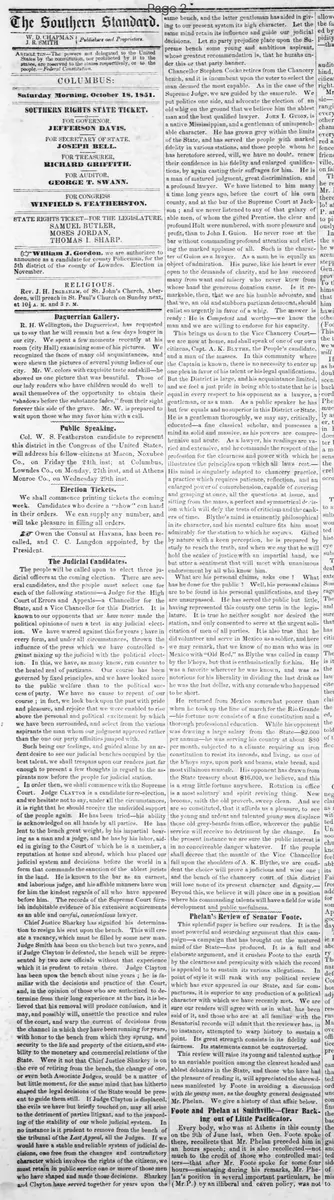
The people will be called upon to elect three judicial officers at the coming election. There are several candidates, and the people must select one for each of the following stations—a Judge for the High Court of Errors and Appeals—a Chancellor for the State, and a Vice Chancellor for this District. It is known to our opponents that we have never made the political opinions of men a test in any judicial election. We have warred against this for years; have in every form, and under all circumstances, thrown the influence of the press which we have controlled against mixing up the judicial with the political election. In this, we have, as many know, run counter to the heated zeal of partisans. Our course has been governed by fixed principles, and we have looked more to the public welfare than to the political success of party. We have no cause to repent of our course; in fact, we look back upon the past with pride and pleasure, and rejoice that we were enabled to rise above the personal and political excitement by which we have been surrounded, and select from the various aspirants the man whom our judgment approved rather than the one our party affinities jumped with.
Such being our feelings, and guided alone by an ardent desire to see our judicial benches occupied by the best talent, we shall trespass upon our readers just far enough to present a few thoughts in regard to the aspirants now before the people for judicial station.
In order then, we shall commence with the Supreme Court. Judge Clayton is a candidate for re-election, and we hesitate not to say, under all the circumstances, it is right that he should receive the undivided support of the people again. He has been tried—his ability is acknowledged on all hands by all parties. He has lent to the bench great weight, by his impartial bearing as a man and a judge, and he has by his labor, aided in giving to the Court of which he is a member, a reputation at home and abroad, which has placed our judicial system and decisions before the world in a form that commands the sanction of the ablest jurists in the land. He is known to the bar as an earnest, and laborious judge, and his affable manners have won for him the kindest regards of all who have appeared before him. The records of the Supreme Court furnish indubitable evidence of his extensive acquirements as an able and careful, conscientious lawyer.
Chief Justice Sharkey has signified his determination to resign his seat upon the bench. This will create a vacancy, which must be filled by some new man. Judge Smith has been on the bench but two years, and if Judge Clayton is defeated, the bench will be represented by two new officials without that experience which it is prudent to retain there. Judge Clayton has been upon the bench about nine years: he is familiar with the decisions and practice of the Court, and, in the opinion of those who are authorized to determine from their long experience at the bar, it is believed that his removal will produce confusion, and it may, and possibly will, unsettle the practice and rules of the court, and warp the current of decisions from the channel in which they have been running for years, with honor to the bench from which they sprung, and security to the life and property of the citizen, and stability to the monetary and commercial relations of the State. Were it not that Chief Justice Sharkey is on the eve of retiring from the bench, the change of one, or even both Associate Judges, would be a matter of but little moment, for the same mind that has hitherto shaped the legal decisions of the State would be present to guide them still. If Judge Clayton is displaced, the evils we have but briefly touched on, may all arise to the detriment of parties litigant, and to the jeoparding of the stability of our whole judicial system. In no instance is it prudent to remove from the bench of the tribunal of the Last Appeal, all the Judges. If we would have a stable and reliable system of judicial decisions, one free from the changes and contradictory character which involves the rights of the citizens, we must retain in public service one or more of those men who have shaped and made those decisions. Sharkey and Clayton have served together for years upon the same bench, and the latter gentleman has aided in giving to our present system its high character. Let the same mind retain its influence and guide our judicial decisions. Let no party prejudice place upon the Supreme bench some young and ambitious aspirant, whose greatest recommendation is, that he huzza's under this or that party banner.
Chancellor Stephen Cocke retires from the Chancery bench, and it is incumbent upon the voter to select the man deemed the most capable. As in the case of the Supreme Judge, we are guided by the same rule. We put politics one side, and advocate the election of an old whig on the ground that we believe him the ablest man and the best qualified lawyer. John I. Guion, is a native Mississippian, and a gentleman of unimpeachable character. He has grown grey within the limits of the State, and has served the people with marked fidelity in various stations, and those people whom he has heretofore served, will, we have no doubt, renew their confidence in his fidelity and enlarged qualifications, by again casting their suffrages for him. He is a man of matured judgment, great discrimination, and a profound lawyer. We have listened to him many a time long years ago, before the court of his own county, and at the bar of the Supreme Court at Jackson; and we never listened to any of that galaxy of able men, of whom the gifted Prentiss, the clear and profound Holt were numbered, with more pleasure and profit, than to John I. Guion. He never rose at the bar without commanding profound attention and eliciting the marked applause of all. Such is the character of Guion as a lawyer. As a man he is equally an object of admiration. His purse, like his heart is ever open to the demands of charity, and he has succored many from want and misery who never knew from whose hand the generous donation came. Is it remarkable, then, that we are his humble advocate, and that we, an old and stubborn partisan democrat, should enlist so urgently in favor of a whig. The answer is ready: He is competent and worthy—we know the man and we are willing to endorse for his capacity.
This brings us down to the Vice Chancery Court—we are now at home, and shall speak of one of our own citizens, Capt. A. K. Blythe, the People's candidate, and a man of the masses. In this community where the Captain is known, there is no necessity to enter upon one plea in favor of his talent or his legal qualifications. But the District is large, and his acquaintance limited, and we feel a just pride in being able to state that he is equal in every respect to his opponent as a lawyer, a gentleman, or as a man. As a public speaker he has but few equals and no superior in this District or State. He is a gentleman thoroughly, we may say, critically educated—a fine classical scholar, and possesses a mind as solid and massive, as his powers are comprehensive and acute. As a lawyer, his readings are varied and extensive, and he commands the respect of the profession for the clearness and power with which he illustrates the principles upon which all laws rest.
His mind is singularly adapted to chancery practice, a practice which requires patience, reflection, and an enlarged power of comprehension, capable of covering and grasping at once, all the questions at issue, and sifting from the mass, a perfect and symmetrical decision which will defy the tests of criticism and the cankers of time. Blythe's mind is eminently philosophical in its character, and his mental culture fits him most admirably for the station to which he aspires. Gifted by nature with a keen perception, he is prepared by study to reach the truth, and when we say that he will hold the scales of justice with an impartial hand, we but utter a sentiment that will meet with unanimous endorsement by all who know him.
What are his personal claims, asks one? What has he done for the public? Well, his personal claims are to be found in his personal qualifications, and they are unsurpassed. He has served the public but little, having represented this county one term in the legislature. It is true he neither sought nor desired the station, and only consented to serve at the urgent solicitation of men of all parties. It is also true that he did volunteer and serve in Mexico as a soldier, and here we may remark, that we know of no man who was in Mexico with "Old Red," as Blythe was called in camp by the b'hoys, but that is enthusiastically for him. He was a favorite wherever he was known, and was as notorious for his liberality in dividing the last drink as he was the last dollar, with any comrade who happened to be short.
He returned from Mexico somewhat poorer than when he took up the line of march for the Rio Grande—his fortune now consists of a fine constitution and a thorough professional education. While his opponent was drawing a large salary from the State—$2,000 per annum—he was serving his country at about $80 per month, subjected to a climate requiring an iron constitution to resist its inroads, and living, as one of the b'hoys says, upon pork and beans, stale bread, and most villainous muscale. His opponent has drawn from the State treasury about $16,000, we believe, and this is a snug little fortune anywhere. Rotation in office is a most salutary and spirit reviving thing. New brooms, saith the old proverb, sweep clean. And we are so constituted, that it affords us a pleasure, to see the young and ardent and talented young men displace those old grey-beards from office, wherever the public service will receive no detriment by the change. In the present instance we are sure the public interest is in no conceivable danger whatever. If the people shall decree that the mantle of the Vice Chancellor fall upon the shoulders of A. K. Blythe, we are confident the choice will prove a judicious and wise one; and the bench of the chancery court of this district will lose none of its present character and dignity.—Beyond this, we believe it will place one in a position where his commanding talents will have a field for wide development and public usefulness.
What sub-type of article is it?
What themes does it cover?
What keywords are associated?
What entities or persons were involved?
Where did it happen?
Story Details
Key Persons
Location
Mississippi
Story Details
Editorial from a Democratic newspaper endorsing Judge Clayton's re-election to the Supreme Court for his experience and impartiality, especially with Sharkey's resignation; John I. Guion for Chancellor due to his legal prowess and character despite being a Whig; and A. K. Blythe for Vice Chancellor for his qualifications, military service, and potential, advocating merit over party politics.