Thank you for visiting SNEWPapers!
Sign up free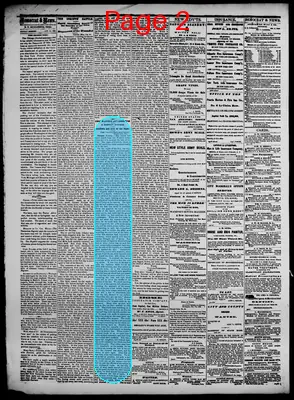
Daily Democrat And News
Davenport, Scott County, Iowa
What is this article about?
A soldier's detailed account from the 10th Iowa Regiment describes the Battle of Corinth on October 3-4, 1862, including skirmishes, retreats, rebel charges, artillery fire, and the Union victory under General Rosecrans, followed by pursuit of the enemy.
Clipping

OCR Quality
Full Text
THE BATTLE OF CORINTH
A Soldier's Account.
Incidents and Acts of the Fight.
Camp 10th Iowa Reg't. Near Corinth,
October 12th, 1862.
Messrs. Editor:- The nation has again heard from her Western volunteers, and it is, as usual, the tale of victory. The name of Corinth, classic in the old world, has been rendered doubly so in the new.
On the night of the 2nd, our regiment reached its camping ground, pitched its tents, and settled down for the night, hoping to have a few day's rest from the fatigue and excitements of the Iuka conflict. This was not to be, for the dawn of day brought the long roll, and we sprang from our dreams to our arms, and formed in line to repel the forever vigilant foe. We marched off and took position behind one of the old deserted forts which form a line around the town. The fort was mounted with a couple of field pieces, more to deceive the enemy than for defense. Off to the front we heard heavy skirmishing along the picket lines, which took the form of a battle in the course of a couple of hours. On account of the enemy making a flank movement on the fort our brigade shifted its position to the brow of a heavily timbered hill, and there awaited the course of events. The first line began fighting at about 10 o'clock, which was the first intimation we had of being on the reserve. The fighting did not continue long, however, before the first line broke in confusion. From our position we could see the smoke of the battle, could hear every order given, and could feel the ground rock under us, but could not see the combatants. When the line broke we did not await the reports of the fugitives, for we could hear the shrieks of the vanquished, the yells of the pursuers, and the words of our leaders vainly endeavoring to rally the overpowered ranks; and to render the affair more appalling, we could hear at the lapse of every few minutes loud explosions of musketry, which plainly told that the enemy thought not of mercy. Soon came a rush of fugitives which well nigh bore us away; terror was on each face, and occasionally a mangled limb hung by the side of the fugitive, or a dreadful gash marked the face. Ambulances hurried by, loaded with wounded, whose groans filled the air, while beyond could be heard the clear, wild cheers of the Southerners. It required the hardest exertions of the mind to face the coming storm. It was vain to attempt to rally the fugitives while the air was filled with missiles, and they passed on towards town. In a few moments a startling silence ensued, more appalling than the tempest which had just passed. At this time all were ordered to town, excepting the 15th and 16th, which were left to cover the retreat of our portion of the line. We stood watching the brow of the opposite hill, attentively awaiting the approach of the enemy. In a short time a few bullets begun to cut the air, from unseen marksmen, and later still a line of skirmishers came over the hill, dressed in our uniform. "Don't fire; they are our men," shouted some one, but before he could be contradicted, a rebel brigade made its appearance. Many drew up their muskets to fire, but were ordered to withhold. The rebels came marching on at common time, and as soon as this line was half way down the hill, another line of the same size made its appearance, marching along at the same speed and in the same silent manner. The excitement was intense, and for a few moments we forgot everything but the silent columns moving upon us. Steadily they came down the opposite hill-side and steadily up the slope toward us, keeping the most perfect line. When within a hundred yards of us, we could hear a softly-uttered command, and their front line cocked their muskets. This was a signal for slaughter, and without waiting for the command our whole line fired simultaneously. That volley must have told dreadfully on the enemy, for our muskets are among the best in the service, the distance was short, and the enemy in plain sight. After that all was dust, noise and confusion. We fired as fast as possible, but such a wall of dust and smoke rose between us that we could not see the enemy-but too well we saw the effects of his volleys in our decimated ranks. At one time a gust of wind partly moved the smoke and we could see that the rebel line was broken, but their second line moved up and restored the tide of battle. For half an hour we held them, but we were finally overpowered and driven back a few hundred yards, where we rallied and awaited the enemy. But hence satisfied with his former reception, and did not make his appearance. Soon after orders arrived for us to retreat to town, which we did, taking position behind the 5th Ohio battery, which was posted on an eminence to the right of Fort Phillip. While in line, Gen. Rosecrans came riding past with his staff. The usual smile was on his countenance; his face was as well known to every one in the regiment as that of a brother, and instantaneously every hat was swung in the air, and we gave him six hearty cheers. He is the man for the Western army. He addressed a few words of encouragement, and galloped off to restore affairs to order, amid the loudest cheers. We slept that night without blankets, and awoke refreshed, ready for the day's slaughter. At the earliest dawn the ball was opened by the rebels who began to shell the town, but our siege guns soon stopped that proceeding. For awhile the thunder was deafening, but it finally subsided, and nothing was heard but the occasional shots of sharpshooters. On the hill opposite our regiment was a lot of cut timber, behind which the rebel sharpshooters secreted themselves, and as soon as a man stood up he was greeted with the hiss of a bullet. This was very annoying. The battery finally opened on the woods, but as soon as it ceased, the rebels began again. Company A was detailed to skirmish with them, and a limited number of volunteers were called for from the remainder of the regiment, who took post in the ruins of an old house. Ten of us were placed behind an oak log, where we had a full view of the rebels. They were very bold. One fellow who stood behind a tree by the road side, would occasionally step out into the road, swing his hat, hurrah, and then jump back to escape the bullets which were fired at him. We could ascertain their exact position by the smoke of their rifles, but we were much annoyed by the shots of some unseen one, the smoke of whose gun we could never see. He was finally discovered in a sapling, and a volley was fired at him. The distance was too far for close shooting, but I venture to say that he descended that tree in quicker style than he climbed it. Capt. Smith, of company A, called our attention to a chap bolder than the rest, and drawing a bead on him, he fired. The rebel threw his arms widely in the air and fell over backwards, whether dead or wounded, we could not tell. At about noon we observed the rebels busy in cutting timber, and the matter was duly reported to the commander of Fort Phillips, who opened on them with his heavy siege guns. Their echo seemed like the noise of the falling heavens, and a few minutes sufficed to clear the wood of rebels. Later in the day they planted two field pieces and fired two volleys of grape into our regiment, doing no damage, however. The 5th Ohio battery opened on them and in less than two minutes knocked one of the cannons off its wheels, and drove the rebels with the other one. From our position we saw the famous charge of the rebels on the Fort north of town. It was a magnificent spectacle at the first, but our cannons soon turned it to a horrible one. Let no one impeach the courage of the rebels. In this instance it approached sublimity. The roar of the artillery was terrible, but how much more so were the missiles which it scattered among the advancing ranks. It seemed as though nothing could stop the advancing foe, nor did they stop until death had wiped out their leaders and thinned out their once invincible ranks. That ended the battle of Corinth, and the cheers which went up from those Forts and batteries will long be remembered by those who heard them. That night Rosecrans visited every regiment and battery, congratulating them on the achievement of such a glorious victory. He told us to take a good sleep and be ready to pursue the enemy in the morning. At dawn we left Corinth in hot pursuit of the foe. But I am weary and fear I have wearied your readers with this too long letter. Our brigade followed as far as Ripley, when we were ordered back to guard a train. We marched from Ripley to the Hatchies under a heavy rain, and crossed that stream at about 11 o'clock the first night, making twenty-eight miles for that day. The next day we marched twenty miles, and reached Corinth, hungry, ragged, frozen, and worn out. We are short of officers, and much more so of men.
Yours,
Clinton Parkhurst.
What sub-type of article is it?
What keywords are associated?
What entities or persons were involved?
Where did it happen?
Domestic News Details
Primary Location
Corinth
Event Date
October 3 4, 1862
Key Persons
Outcome
union victory; rebels retreated after failed charges and heavy losses; some union wounded and decimated ranks; regiment short of officers and men after pursuit.
Event Details
The 10th Iowa Regiment participated in the defense of Corinth against rebel assaults, involving skirmishing, volleys, artillery fire, and a notable rebel charge repelled by Union forces; followed by pursuit to Ripley and return to Corinth.