Thank you for visiting SNEWPapers!
Sign up free
Springfield Weekly Republican
Springfield, Hampden County, Massachusetts
What is this article about?
Editorial criticizing British neutrality in the American Civil War, accusing UK merchants and officials of aiding the Confederacy via contraband arms shipments, and rebutting British media calls for Union surrender while highlighting English hypocrisy in expecting non-violent resolution.
Clipping
OCR Quality
Full Text
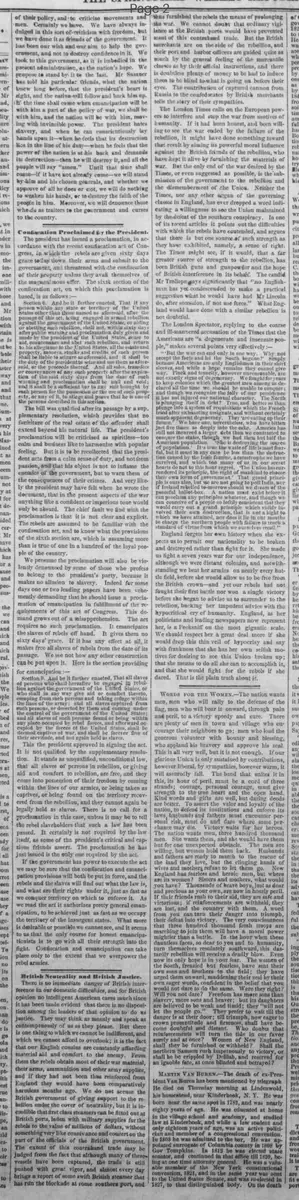
There is no immediate danger of British interference in our domestic difficulties, and for British opinion no intelligent American cares much since it has been made evident that there is no disposition among the leaders of that opinion to do us justice. They may think as meanly and speak as contemptuously of us as they please. But there is one thing to which we cannot be indifferent, and which we cannot afford to overlook; it is the fact that our English cousins are constantly affording material aid and comfort to the enemy. From them the rebels obtain most of their war material, their arms, ammunition and other army supplies, and if they had not been thus reinforced from England they would have been comparatively harmless months ago. We do not accuse the British government of giving support to the rebellion under the cover of neutrality, but it is incredible that first class steamers can be fitted out at British ports, laden with military supplies for the rebels to the value of millions of dollars, without something very like connivance and concert on the part of the officials of the British government.
The extent of this contraband trade may be judged from the fact that although many of these vessels have been captured, the trade is still pushed with great vigor, and almost every day brings a report of some swift British steamer that has run the blockade at some southern port, and thus furnished the rebels the means of prolonging the war. We cannot doubt that ordinary vigilance at the British ports would have prevented most of this contraband trade. But the British merchants are on the side of the rebellion, and their port and harbor officers are guided quite as much by the general feeling of the mercantile classes as by their official instructions, and there is doubtless plenty of money to be had to induce them to be blind to what is going on before their eyes. The contribution of captured cannon from Russia to the confederates by British merchants tells the story of their sympathies.
The London Times calls on the European powers to interfere and stop the war from motives of humanity. If it had been honest, and been willing to see the war ended by the failure of the rebellion, it might have done something toward that result by aiming its powerful moral influence against the British friends of the rebellion, who have kept it alive by furnishing the materials of war. But the only end of the war desired by the Times, or even suggested as possible, is the submission of the government to the rebellion and the dismemberment of the Union. Neither the Times, nor any other organ of the governing classes in England, has ever dropped a word indicating a willingness to see the Union maintained by the defeat of the southern conspiracy. In one of its recent articles it points out the difficulties with which the rebels have contended, and argues that there is but one source of such strength as they have exhibited, namely, a sense of right. The Times might see, if it would, that a far greater source of strength to the rebellion, has been British guns and gunpowder and the hope of British interference in its behalf. The candid Mr. Trollope says significantly that "no Englishman has yet condescended to make a practical suggestion what he would have had Mr. Lincoln do, after secession, if not use force." What England would have done with a similar rebellion is not doubtful.
The London Spectator, replying to the coarse and ill-mannered accusation of the Times that the Americans are "a degenerate and insensate people," makes several points very effectively:
"But the war can end only in one way. Why not accept the facts and let the South begone?' Simply because Americans are only Englishmen in their shirt sleeves, and while a hope remains they cannot give way. Pluck and tenacity, however unreasonable, are not exactly signs of degeneracy. We fought for years to keep colonies which the greatest men among us declared all the time we should be unable to conquer; and though we recognize the folly of our persistence it has not injured our national character. The North is plunging itself in debt? True, and better so than plunge into a system of requisitions which the French tried after exhausting assignats, and without certainly much apparent degeneracy. They 'are eating up their future.' We have one, nevertheless, who have bitten just five times as deeply into the cake. America has still not incurred a larger debt than we contracted to conquer the states, though we had then but half the American population. 'She is destroying the source of population.' It's true the waste of life is most fearful, but it must in any case be less than the destruction caused by the Irish famine, a catastrophe we have survived, and which too many of us in our secret hearts do not to this hour regret. The Union has surrendered its principle, the right of mankind to choose their own form of government.' That grand principle is ours also, but we are not going to poll India, nor if Ireland rebelled to-morrow should we dream of the peaceful ballot-box. A nation must exist before it can proclaim any principles whatever, and though we can conceive of a people so loftily consistent that they would carry out a grand principle which visibly involved their own destruction, that is not a height to which we have attained, nor does it lie in our mouths to charge the northern people with failure to reach a standard of virtue from which we ourselves recoil."
England forgets her own history when she expects us to permit our nationality to be broken and destroyed rather than fight for it. She made us fight a seven years war for our independence, although we were distant colonies, and notwithstanding we beat her armies on nearly every battle field, before she would allow us to be free from the British crown—and yet our rebels had not fought their first battle nor won a single victory before she began to advise us to surrender to the rebellion, backing her impudent advice with the hypocritical cry of humanity. England, as her politicians and leading newspapers now represent her, is a Pecksniff on the most gigantic scale.
We should respect her a great deal more if she would drop this thin veil of hypocrisy and say with frankness that she has her own selfish motives for desiring to see this Union broken up; that she means to do all she can to accomplish it, and that she would fight for the rebels if she dared. That is the plain truth about it.
What sub-type of article is it?
What keywords are associated?
What entities or persons were involved?
Where did it happen?
Foreign News Details
Primary Location
England
Key Persons
Outcome
british aid prolongs the war through arms and supplies to rebels, enabling blockade running and resistance.
Event Details
British neutrality is questioned as merchants and officials facilitate contraband trade of arms, ammunition, and supplies to the Confederacy from UK ports, with steamers running the blockade despite captures. The London Times urges European intervention for humanitarian reasons but supports dismemberment of the Union, while the London Spectator defends Northern persistence against accusations of degeneracy, drawing parallels to British history.