Thank you for visiting SNEWPapers!
Sign up free
Bradford Opinion
Bradford, Orange County, Vermont
What is this article about?
An observational piece on street vendors in a metropolitan city, detailing their sales of cheap and imitation goods like suspenders and jewelry, how they profit despite low sales volume, and their rise to retail success. Highlights the trade's organization and the indistinguishability of fakes from genuine items.
Clipping
OCR Quality
Full Text
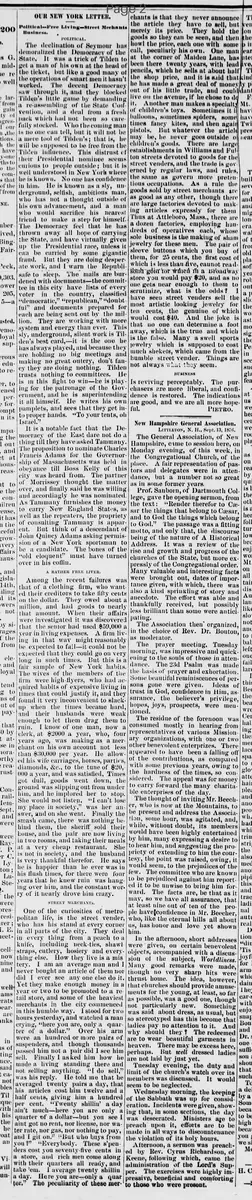
One of the curiosities of metropolitan life, is the street vender, who has his stand at every corner in all parts of the city. They deal in everything from a peach to a knife, including neck-ties, shawl straps, cutlery, hosiery and everything else. How they live is a mystery. I am an average man and I never bought an article of them nor did I ever see any one else do it. Yet they make enough money in a year or two to be promoted to a retail store, and some of the heaviest merchants in the city commenced in this humble way. I stood for two hours yesterday, and watched a man crying, "here you are, only a quarter of a dollar." Over his arm were an hundred or more pairs of suspenders, and though thousands passed him not a pair did I see him sell. Finally I asked him how he made a living standing there and not selling anything. "I do sell," was his reply. He told me that he averaged twenty pairs a day, that his articles cost him twelve and a half cents, giving him a hundred per cent. "Twenty shillin' a day ain't much—here you are only a quarter of a dollar—but you see I aint got no rent, nor license, nor water rate, nor gas, nor nothing to pay, and I git on." "But who buys from you?" "Everybody. These s'penders cost you seventy-five cents in a store, and rich men come along with their quarters all ready, and take 'em. I average twenty shillin a day. Here you are—only a quarter." The peculiarity of these merchants is that they never announce the article they have to sell, but merely its price. They hold the goods so they can be seen, and then howl the price, each one with some call, peculiarly his own. One man at the corner of Maiden Lane, has been there twenty years, with lead pencils, which he sells at about half the shop price, and it is said that he has made a great deal of money out of his little trade, and could live on the avenue, if he chose to do it. Another man makes a specialty of children's toys. Sometimes it is balloons, sometimes spiders, some times fancy kites, and then again pistols. But whatever the article may be, he never goes outside of children's goods. There are large establishments in Williams and Fulton streets devoted to goods for the street venders, and the trade is governed by regular laws, and rules the same as govern more pretentious occupations. As a rule the goods sold by street merchants are as good as any other, though there are large factories devoted to making articles expressly for them. Thus at Attleboro, Mass., there are a dozen factories, employing hundreds of operatives each, whose sole business is the making of sham jewelry for these men. The pair of sleeve buttons which you buy of them, for 25 cents, tho first cost of which is less than five, look so gorgeous which in a Broadway store you would pay $20, and as no one gets near enough to them to scrutinize, what is the odds? I have seen street venders sell the most artistic looking jewelry for ten cents, the genuine of which would cost $40. And the joke is that no one can determine a foot away, which is the true and which is the false. Many a swell sports jewelry which is supposed to cost much shekels, which came from the humble street vender. Things are not always what they seem.
What sub-type of article is it?
What themes does it cover?
What keywords are associated?
Where did it happen?
Story Details
Location
New York City Streets, Maiden Lane, Williams And Fulton Streets, Broadway, Attleboro, Mass.
Story Details
The narrator observes street vendors selling cheap and imitation goods at low prices, explains their low-overhead business model allowing profits from few sales, notes their rise to retail success, and highlights the trade in fake jewelry indistinguishable from expensive originals.