Thank you for visiting SNEWPapers!
Sign up free
Story
June 22, 1838
The Liberator
Boston, Suffolk County, Massachusetts
What is this article about?
Lewis Tappan corrects a newspaper account of his 1838 meeting with Vice President Richard M. Johnson in New York, where Johnson sought to emancipate a fugitive slave boy for his mother's sake but refused to sign a deed citing political concerns.
Clipping
OCR Quality
98%
Excellent
Full Text
INTERVIEW WITH THE VICE PRESIDENT
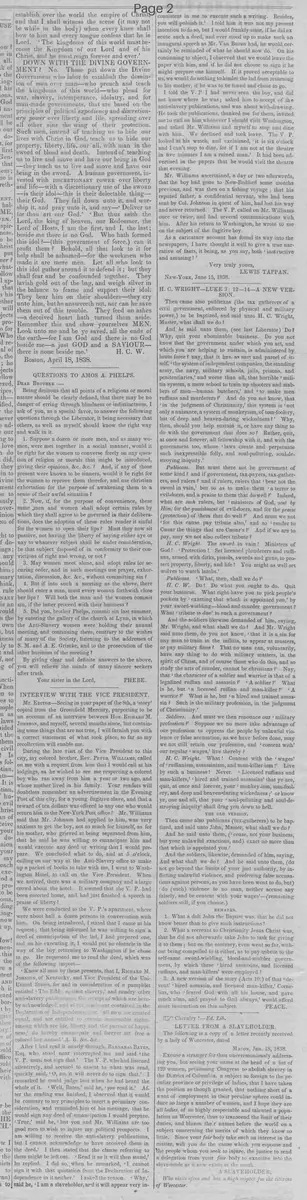
Mr. Editor—Seeing in your paper of the 5th, a 'story copied from the Greenfield Mercury, purporting to be an account of an interview between Hon. Richard M. Johnson, and myself, several months since, but containing some things that are not true, I will furnish you with a correct statement of what took place, so far as my recollection will enable me.
During the late visit of the Vice President to this city, my colored brother, Rev. Peter Williams, called on me with a request from him that I would call at his lodgings, as he wished to see me respecting a colored boy who ran away from him a year or two ago, and whose mother lived in his family. Your readers will doubtless remember an advertisement in the Evening Post of this city, for a young fugitive slave, and that a reward of ten dollars was offered to any one who would return him to the New-York Post office! Mr. Williams said that Mr. Johnson had applied to him, was very anxious to get the boy, not so much for himself, as for his mother, who grieved at being separated from him, that he said he was willing to emancipate him and would execute any deed or writing that I would prepare. We concluded what to do, and at 5 o'clock, calling on our way at the Anti-Slavery office to make up a packet of books to take with me, I went to Washington Hotel, to call on the Vice President. When we arrived, there was a military company and a large crowd about the hotel. It seemed that the V. P. had been escorted home, and had just finished a speech in praise of liberty
We were conducted to the V. P.'s apartment, where were about half a dozen persons in conversation with him. On being introduced, I stated that I came at his request; that being informed he was willing to sign a deed of emancipation of the lad, I had prepared one, and on his executing it, I would put no obstacle in the way of the boy returning to Washington if he chose to go. He requested me to read the deed, which was of the following import—
Know all men by these presents, that I, Richard M. Johnson, of Kentucky, and Vice President of the United States, for and in consideration of a pamphlet entitled 'The Bible against slavery,' and sundry other anti-slavery publications the receipt of which are hereby acknowledged, and of the sentiment contained in the Declaration of Independence, that all men are created equal, and are entitled to certain inalienable rights, among which are life, liberty and the pursuit of happiness,' do hereby emancipate and forever set free a colored boy named 'A. B. &c. &c.
After I had read it nearly through, Barnabas Bates, Esq. who stood near interrupted me and said 'the V. P. must not sign that.' The V. P. who had listened attentively, and seemed to assent to what was read, quickly said, 'O, no, it will never do to sign that.' I remarked he could judge best when he had heard the whole of it. 'Well, Bates,' said he, 'you read it.' After the reading was finished, I observed that it would be contrary to my principles to insert a pecuniary consideration, and reminded him of his message, that he would sign any deed of emancipation I would prepare.
'True,' said he, 'but you and Mr. Williams are too good men to wish to injure my political prospects. I am willing to receive the anti-slavery publications, but I cannot acknowledge to have received them in the deed.' I then stated that the clause referring to them might be left out. 'Read it as it will then stand,' he replied. I did so, when he remarked, 'I cannot sign it with that quotation from the Declaration of Independence in it neither.' I asked the reason. 'Why,' said he, 'I am a slaveholder, and it will appear very inconsistent in me to execute such a writing. Besides you will publish it.' I told him it was not my present intention to do so, but I would frankly state, if he did execute such a deed, and ever stood up to make such an inaugural speech as Mr. Van Buren had, he would certainly be reminded of what he should now do. On his continuing to object, I observed that we would leave the paper with him, and if he did not choose to sign it he might prepare one himself. If it proved acceptable to us, we would do nothing to hinder the lad from returning to his mother, if he was to be found and chose to go.
I told the V. P. I had never seen the boy, and did not know where he was; asked him to accept of the anti-slavery publications, and was about withdrawing. He took the publications, thanked me for them, invited me to call on him whenever I should visit Washington, and asked Mr. Williams and myself to stop and dine with him. We declined and took leave. The V. P. looked at his watch, and exclaimed, 'it is six o'clock and I can't stop to dine, for if I am not at the theatre in five minutes I am a ruined man.' It had been advertised in the papers that he would visit the theatre that evening.
Mr. Williams ascertained, a day or two afterwards, that the boy had gone to New-Bedford some months previous, and was then on a fishing voyage ; that his reputed father, a confidential servant, who had been sent by Col. Johnson in quest of him, had lost his way and never returned. The V. P. called on Mr. Williams once or twice, and had several communications with him. After his return to Washington, he wrote to me on the subject of the fugitive boy.
As a caricature account has found its way into the newspapers, I have thought it well to give a true narrative of facts, it being, as you say, both ' instructive and amusing!
Very truly yours,
LEWIS TAPPAN.
New-York. June 15. 1838
Mr. Editor—Seeing in your paper of the 5th, a 'story copied from the Greenfield Mercury, purporting to be an account of an interview between Hon. Richard M. Johnson, and myself, several months since, but containing some things that are not true, I will furnish you with a correct statement of what took place, so far as my recollection will enable me.
During the late visit of the Vice President to this city, my colored brother, Rev. Peter Williams, called on me with a request from him that I would call at his lodgings, as he wished to see me respecting a colored boy who ran away from him a year or two ago, and whose mother lived in his family. Your readers will doubtless remember an advertisement in the Evening Post of this city, for a young fugitive slave, and that a reward of ten dollars was offered to any one who would return him to the New-York Post office! Mr. Williams said that Mr. Johnson had applied to him, was very anxious to get the boy, not so much for himself, as for his mother, who grieved at being separated from him, that he said he was willing to emancipate him and would execute any deed or writing that I would prepare. We concluded what to do, and at 5 o'clock, calling on our way at the Anti-Slavery office to make up a packet of books to take with me, I went to Washington Hotel, to call on the Vice President. When we arrived, there was a military company and a large crowd about the hotel. It seemed that the V. P. had been escorted home, and had just finished a speech in praise of liberty
We were conducted to the V. P.'s apartment, where were about half a dozen persons in conversation with him. On being introduced, I stated that I came at his request; that being informed he was willing to sign a deed of emancipation of the lad, I had prepared one, and on his executing it, I would put no obstacle in the way of the boy returning to Washington if he chose to go. He requested me to read the deed, which was of the following import—
Know all men by these presents, that I, Richard M. Johnson, of Kentucky, and Vice President of the United States, for and in consideration of a pamphlet entitled 'The Bible against slavery,' and sundry other anti-slavery publications the receipt of which are hereby acknowledged, and of the sentiment contained in the Declaration of Independence, that all men are created equal, and are entitled to certain inalienable rights, among which are life, liberty and the pursuit of happiness,' do hereby emancipate and forever set free a colored boy named 'A. B. &c. &c.
After I had read it nearly through, Barnabas Bates, Esq. who stood near interrupted me and said 'the V. P. must not sign that.' The V. P. who had listened attentively, and seemed to assent to what was read, quickly said, 'O, no, it will never do to sign that.' I remarked he could judge best when he had heard the whole of it. 'Well, Bates,' said he, 'you read it.' After the reading was finished, I observed that it would be contrary to my principles to insert a pecuniary consideration, and reminded him of his message, that he would sign any deed of emancipation I would prepare.
'True,' said he, 'but you and Mr. Williams are too good men to wish to injure my political prospects. I am willing to receive the anti-slavery publications, but I cannot acknowledge to have received them in the deed.' I then stated that the clause referring to them might be left out. 'Read it as it will then stand,' he replied. I did so, when he remarked, 'I cannot sign it with that quotation from the Declaration of Independence in it neither.' I asked the reason. 'Why,' said he, 'I am a slaveholder, and it will appear very inconsistent in me to execute such a writing. Besides you will publish it.' I told him it was not my present intention to do so, but I would frankly state, if he did execute such a deed, and ever stood up to make such an inaugural speech as Mr. Van Buren had, he would certainly be reminded of what he should now do. On his continuing to object, I observed that we would leave the paper with him, and if he did not choose to sign it he might prepare one himself. If it proved acceptable to us, we would do nothing to hinder the lad from returning to his mother, if he was to be found and chose to go.
I told the V. P. I had never seen the boy, and did not know where he was; asked him to accept of the anti-slavery publications, and was about withdrawing. He took the publications, thanked me for them, invited me to call on him whenever I should visit Washington, and asked Mr. Williams and myself to stop and dine with him. We declined and took leave. The V. P. looked at his watch, and exclaimed, 'it is six o'clock and I can't stop to dine, for if I am not at the theatre in five minutes I am a ruined man.' It had been advertised in the papers that he would visit the theatre that evening.
Mr. Williams ascertained, a day or two afterwards, that the boy had gone to New-Bedford some months previous, and was then on a fishing voyage ; that his reputed father, a confidential servant, who had been sent by Col. Johnson in quest of him, had lost his way and never returned. The V. P. called on Mr. Williams once or twice, and had several communications with him. After his return to Washington, he wrote to me on the subject of the fugitive boy.
As a caricature account has found its way into the newspapers, I have thought it well to give a true narrative of facts, it being, as you say, both ' instructive and amusing!
Very truly yours,
LEWIS TAPPAN.
New-York. June 15. 1838
What sub-type of article is it?
Historical Event
Biography
What themes does it cover?
Moral Virtue
Justice
Deception
What keywords are associated?
Vice President
Emancipation
Fugitive Slave
Anti Slavery
Richard M. Johnson
Lewis Tappan
Political Prospects
What entities or persons were involved?
Lewis Tappan
Richard M. Johnson
Rev. Peter Williams
Barnabas Bates
A. B.
Where did it happen?
New York
Story Details
Key Persons
Lewis Tappan
Richard M. Johnson
Rev. Peter Williams
Barnabas Bates
A. B.
Location
New York
Event Date
1838
Story Details
Lewis Tappan recounts his meeting with Vice President Johnson, who sought to emancipate a fugitive slave boy but refused to sign a prepared deed due to political concerns over anti-slavery references.