Thank you for visiting SNEWPapers!
Sign up free
Literary
January 4, 1839
Western Enquirer
Lewisburg, Greenbrier County, West Virginia
What is this article about?
This essay recounts accidental origins of scientific discoveries like the telescope, glass, gunpowder, Newton's laws, and lithography. It then details human and animal endurance without food, citing shipwreck survivors, Captain Bligh's voyage, and records of animals fasting from days to years.
Clipping
OCR Quality
98%
Excellent
Full Text
RESULTS OF ACCIDENT.
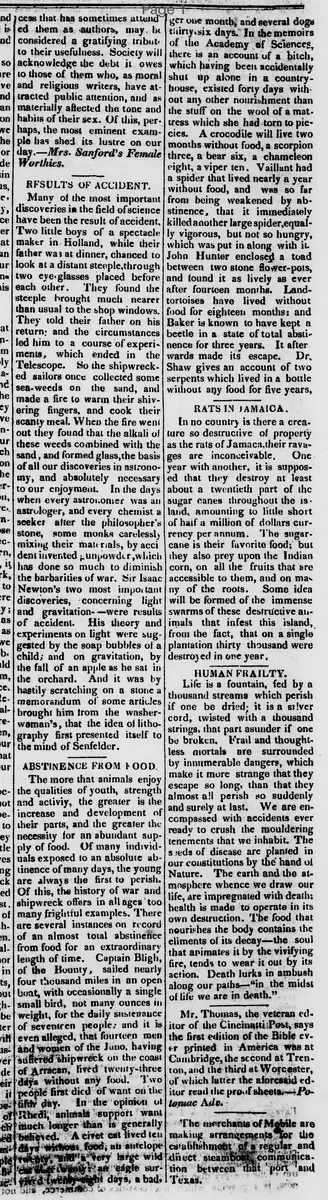
Many of the most important discoveries in the field of science have been the result of accident. Two little boys of a spectacle maker in Holland, while their father was at dinner, chanced to look at a distant steeple, through two eye-glasses placed before each other. They found the steeple brought much nearer than usual to the shop windows. They told their father on his return: and the circumstances led him to a course of experiments, which ended in the Telescope. So the shipwrecked sailors once collected some sea-weeds on the sand, and made a fire to warm their shivering fingers, and cook their scanty meal. When the fire went out they found that the alkali of these weeds combined with the sand, and formed glass, the basis of all our discoveries in astronomy, and absolutely necessary to our enjoyment. In the days when every astronomer was an astrologer, and every chemist a seeker after the philosopher's stone, some monks carelessly mixing their materials, by accident invented gunpowder, which has done so much to diminish the barbarities of war. Sir Isaac Newton's two most important discoveries, concerning light and gravitation—were results of accident. His theory and experiments on light were suggested by the soap bubbles of a child; and on gravitation, by the fall of an apple as he sat in the orchard. And it was by hastily scratching on a stone a memorandum of some articles brought him from the washer-woman's, that the idea of lithography first presented itself to the mind of Senefelder.
The more that animals enjoy the qualities of youth, strength and activity, the greater is the increase and development of their parts, and the greater the necessity for an abundant supply of food. Of many individuals exposed to an absolute abstinence of many days, the young are always the first to perish. Of this, the history of war and shipwreck offers in all ages too many frightful examples. There are several instances on record of an almost total abstinence from food or an extraordinary length of time. Captain Bligh, of the Bounty, sailed nearly four thousand miles in an open boat, with occasionally a single small bird, not many ounces in weight, for the daily sustenance of seventeen people: and it is even alleged, that fourteen men and women of the Juno, having suffered shipwreck on the coast of Arracan, lived twenty-three days without any food. Two people first died of want on the fifth day. In the opinion of Richeri, animals support want much longer than is generally believed. A civet cat lived ten days without food; an antelope twenty, and a very large wild cat twenty-eight, an eagle survived twenty-eight days, a badger one month, and several dogs thirty-six days. In the memoirs of the Academy of Sciences there is an account of a bitch, which having been accidentally shut up alone in a country-house, existed forty days without any other nourishment than the stuff on the wool of a mattress which she had torn to pieces. A crocodile will live two months without food, a scorpion three, a bear six, a chameleon eight, a viper ten. Vaillant had a spider that lived nearly a year without food, and was so far from being weakened by abstinence, that it immediately killed another large spider, equally vigorous, but not so hungry, which was put in along with it. John Hunter enclosed a toad between two stone flower-pots, and found it as lively as ever after fourteen months. Land-tortoises have lived without food for eighteen months: and Baker is known to have kept a beetle in a state of total abstinence for three years. It afterwards made its escape. Dr. Shaw gives an account of two serpents which lived in a bottle without any food for five years.
Many of the most important discoveries in the field of science have been the result of accident. Two little boys of a spectacle maker in Holland, while their father was at dinner, chanced to look at a distant steeple, through two eye-glasses placed before each other. They found the steeple brought much nearer than usual to the shop windows. They told their father on his return: and the circumstances led him to a course of experiments, which ended in the Telescope. So the shipwrecked sailors once collected some sea-weeds on the sand, and made a fire to warm their shivering fingers, and cook their scanty meal. When the fire went out they found that the alkali of these weeds combined with the sand, and formed glass, the basis of all our discoveries in astronomy, and absolutely necessary to our enjoyment. In the days when every astronomer was an astrologer, and every chemist a seeker after the philosopher's stone, some monks carelessly mixing their materials, by accident invented gunpowder, which has done so much to diminish the barbarities of war. Sir Isaac Newton's two most important discoveries, concerning light and gravitation—were results of accident. His theory and experiments on light were suggested by the soap bubbles of a child; and on gravitation, by the fall of an apple as he sat in the orchard. And it was by hastily scratching on a stone a memorandum of some articles brought him from the washer-woman's, that the idea of lithography first presented itself to the mind of Senefelder.
The more that animals enjoy the qualities of youth, strength and activity, the greater is the increase and development of their parts, and the greater the necessity for an abundant supply of food. Of many individuals exposed to an absolute abstinence of many days, the young are always the first to perish. Of this, the history of war and shipwreck offers in all ages too many frightful examples. There are several instances on record of an almost total abstinence from food or an extraordinary length of time. Captain Bligh, of the Bounty, sailed nearly four thousand miles in an open boat, with occasionally a single small bird, not many ounces in weight, for the daily sustenance of seventeen people: and it is even alleged, that fourteen men and women of the Juno, having suffered shipwreck on the coast of Arracan, lived twenty-three days without any food. Two people first died of want on the fifth day. In the opinion of Richeri, animals support want much longer than is generally believed. A civet cat lived ten days without food; an antelope twenty, and a very large wild cat twenty-eight, an eagle survived twenty-eight days, a badger one month, and several dogs thirty-six days. In the memoirs of the Academy of Sciences there is an account of a bitch, which having been accidentally shut up alone in a country-house, existed forty days without any other nourishment than the stuff on the wool of a mattress which she had torn to pieces. A crocodile will live two months without food, a scorpion three, a bear six, a chameleon eight, a viper ten. Vaillant had a spider that lived nearly a year without food, and was so far from being weakened by abstinence, that it immediately killed another large spider, equally vigorous, but not so hungry, which was put in along with it. John Hunter enclosed a toad between two stone flower-pots, and found it as lively as ever after fourteen months. Land-tortoises have lived without food for eighteen months: and Baker is known to have kept a beetle in a state of total abstinence for three years. It afterwards made its escape. Dr. Shaw gives an account of two serpents which lived in a bottle without any food for five years.
What sub-type of article is it?
Essay
What themes does it cover?
Nature
War Peace
Moral Virtue
What keywords are associated?
Accidental Discoveries
Telescope Invention
Gunpowder Origin
Newton Gravitation
Animal Fasting
Shipwreck Survival
Bligh Voyage
Literary Details
Title
Results Of Accident.
Key Lines
Two Little Boys Of A Spectacle Maker In Holland, While Their Father Was At Dinner, Chanced To Look At A Distant Steeple, Through Two Eye Glasses Placed Before Each Other.
Sir Isaac Newton's Two Most Important Discoveries, Concerning Light And Gravitation—Were Results Of Accident.
Captain Bligh, Of The Bounty, Sailed Nearly Four Thousand Miles In An Open Boat, With Occasionally A Single Small Bird, Not Many Ounces In Weight, For The Daily Sustenance Of Seventeen People:
Vaillant Had A Spider That Lived Nearly A Year Without Food, And Was So Far From Being Weakened By Abstinence, That It Immediately Killed Another Large Spider, Equally Vigorous, But Not So Hungry, Which Was Put In Along With It.