Thank you for visiting SNEWPapers!
Sign up free
Editorial
July 6, 1927
Keowee Courier
Walhalla, Pickens, Oconee County, Pickens County, South Carolina
What is this article about?
Editorial critiques rising costs of South Carolina public schools, citing doubled expenditures per pupil in seven years, potential fraud like padded rolls and improper payments, and calls for grand jury investigation into efficiency and reform of salary structures and funding laws like the '6-0-1 law'.
Clipping
OCR Quality
95%
Excellent
Full Text
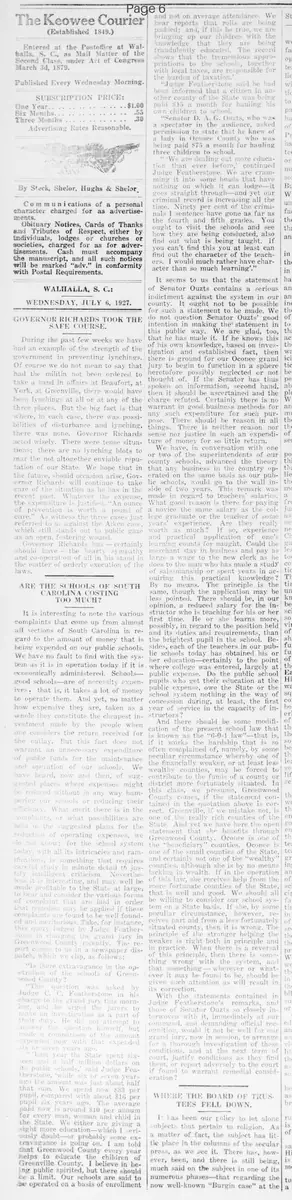
ARE THE SCHOOLS OF SOUTH CAROLINA COSTING TOO MUCH?
It is interesting to note the various complaints that come up from almost all sections of South Carolina in regard to the amount of money that is being expended on our public schools. We have no fault to find with the system as it is in operation today if it is economically administered. Schools-good schools-are of necessity expensive, that is, it takes a lot of money to operate them. And yet, no matter how expensive they are, taken as a whole they constitute the cheapest investment made by the people when one considers the return received for the outlay. But this fact does not warrant an unnecessary expenditure of public funds for the maintenance and operation of our schools. We have heard, now and then, of suggested places where expenses might be reduced without in any way hampering our schools or reducing their efficiency. What merit there is in the complaints, or what possibilities are held in the suggested plans for the reduction of operating expenses, we do not know; for the school system today with all its intricacies and ramifications, is something that requires careful study in minute detail to justify intelligent criticism. Nevertheless it is interesting, and may well be made profitable to the State at large, to hear and consider the various forms of complaint that are laid in order that remedies may be applied if these complaints are found to be well founded and meritorious. Take, for instance, this query lodged by Judge Featherstone in charging the grand jury in Greenwood County recently. The report comes to us in a newspaper dispatch, which we clip, as follows:
"Is there extravagance in the operation of the schools of Greenwood County?"
"This question was asked by Judge C. C. Featherstone in his charge to the grand jury this morning and he urged the Jurors to make an investigation as a part of their duties. He did not attempt to answer the question himself but made a comparison of the amount expended now with that expended seven years ago. Last year the State spent sixteen and a half million dollars on its public schools, said Judge Featherstone, while six or seven years ago the amount was just about half that sum. We spend now $33 per pupil, compared with about $16 per pupil six years ago. The average paid now is around $10 per annum for every man, woman and child in the State. We either are giving a sight more education-which I seriously doubt-or probably some extravagance is going on. I am told that Greenwood County every year helps to educate the children of Greenville County. I believe in being public spirited, but there should be a limit. Our schools are said to operated on a basis of enrollment and not on average attendance. We hear reports that rolls are being padded; and, if this be true, we are bringing up our children with the knowledge that they are being fraudulently educated. The record shows that the tremendous appropriations to the schools, together with local taxes, are responsible for the burden of taxation."
Judge Featherstone said he had been informed that a citizen in another county of the State was being paid $5 a month for hauling his own children to school.
Senator D. A. G. Ouzts, who was a spectator in the audience, asked permission to state that he knew of a lady in Oconee County who was being paid $75 a month for hauling three children to school.
"We are dealing out more education than ever before," continued Judge Featherstone. "We are cramming it into some heads that have nothing on which it can lodge-it goes straight through-and yet our criminal record is increasing all the time. Ninety per cent of the criminals I sentence have gone as far as the fourth and fifth grades. You ought to visit the schools and see how they are being conducted, also find out what is being taught. If you can't find this you at least can find out the character of the teachers. I would much rather have character than so much learning."
It seems to us that the statement of Senator Ouzts contains a serious indictment against the system in our county. It ought not to be possible for such a statement to be made. We do not question Senator Ouzts' good intention in making the statement in this public way. We are glad, too, that he has made it. If he knows this of his own knowledge, based on investigation and established fact, then there is ground for our Oconee grand jury to begin to function in a sphere heretofore possibly neglected or not thought of. If the Senator has thus spoken on information, second hand, then it should be ascertained and the charge refuted. Certainly there is no warrant in good business methods for any such expenditure for such purpose. There should be reason in all things. There is neither reason nor sense nor justice in such an expenditure of money for so little return.
We have, in conversation with one or two of the superintendents of our county schools, advanced the theory that any business in the country operated on the same basis as our public schools, would go to the wall inside of two years. This remark was made in regard to teachers' salaries. What good reason is there for paying a novice the same salary as the college graduate or the teacher of some years' experience. Are they really worth as much? If so, experience and practical application of one's learning counts for naught. Could the merchant stay in business and pay as large a wage to the new clerk as he does to the man who has made a study of salesmanship or spent years in acquiring this practical knowledge? By no means. The principle is the same, though the application may be less pointed. There should be, in our opinion, a reduced salary for the instructor who is teaching for his or her first time. He or she learns more, possibly, in regard to the position held and its duties and requirements, than the brightest pupil in the school. Besides, each of the teachers in our public schools today has obtained his or her education-certainly to the point where college was entered-largely at public expense. Do the public school pupils who get their education at the public expense, owe the State or the school system nothing in the way of concession during, at least, the first year of service in the capacity of instructors?
And there should be some modification of the present school law that is known as the "6-0-1 law"-that is, if it works the hardship that is so often complained of, namely, by some peculiar circumstance whereby one of the financially weaker, or at least less wealthy counties, may be forced to contribute to the funds of a county or district more fortunately situated. In this class, we presume, Greenwood County comes, if the statement contained in the quotation above is correct. Greenville, if we mistake not, is one of the really rich counties of the State. And yet we have here the open statement that she benefits through Greenwood County. Oconee is one of the "beneficiary" counties. Oconee is one of the small counties of the State, and certainly not one of the "wealthy" counties, although she is by no means lacking in wealth. If in the operation of this law, she receives help from the more fortunate counties of the State, that is well and good. We should all be willing to consider our school system on a State basis. If she, by some peculiar circumstance, however, receives part aid from a less fortunately situated county, then it is wrong. The principle of the stronger helping the weaker is right both in principle and in practice. When there is a reversal of this principle, then there is something wrong with the system, and that something-wherever or whatever it may be found to be, should be given such attention as will result in its correction.
With the statements contained in Judge Featherstone's remarks, and those of Senator Ouzts so closely interwoven with it, immediately at our command, and demanding official recognition, would it not be well for our grand jury, now in session, to arrange for a thorough investigation of these conditions, and at the next term of court, justify conditions as they find them, or report adversely to the court if found to warrant remedial consideration?
It is interesting to note the various complaints that come up from almost all sections of South Carolina in regard to the amount of money that is being expended on our public schools. We have no fault to find with the system as it is in operation today if it is economically administered. Schools-good schools-are of necessity expensive, that is, it takes a lot of money to operate them. And yet, no matter how expensive they are, taken as a whole they constitute the cheapest investment made by the people when one considers the return received for the outlay. But this fact does not warrant an unnecessary expenditure of public funds for the maintenance and operation of our schools. We have heard, now and then, of suggested places where expenses might be reduced without in any way hampering our schools or reducing their efficiency. What merit there is in the complaints, or what possibilities are held in the suggested plans for the reduction of operating expenses, we do not know; for the school system today with all its intricacies and ramifications, is something that requires careful study in minute detail to justify intelligent criticism. Nevertheless it is interesting, and may well be made profitable to the State at large, to hear and consider the various forms of complaint that are laid in order that remedies may be applied if these complaints are found to be well founded and meritorious. Take, for instance, this query lodged by Judge Featherstone in charging the grand jury in Greenwood County recently. The report comes to us in a newspaper dispatch, which we clip, as follows:
"Is there extravagance in the operation of the schools of Greenwood County?"
"This question was asked by Judge C. C. Featherstone in his charge to the grand jury this morning and he urged the Jurors to make an investigation as a part of their duties. He did not attempt to answer the question himself but made a comparison of the amount expended now with that expended seven years ago. Last year the State spent sixteen and a half million dollars on its public schools, said Judge Featherstone, while six or seven years ago the amount was just about half that sum. We spend now $33 per pupil, compared with about $16 per pupil six years ago. The average paid now is around $10 per annum for every man, woman and child in the State. We either are giving a sight more education-which I seriously doubt-or probably some extravagance is going on. I am told that Greenwood County every year helps to educate the children of Greenville County. I believe in being public spirited, but there should be a limit. Our schools are said to operated on a basis of enrollment and not on average attendance. We hear reports that rolls are being padded; and, if this be true, we are bringing up our children with the knowledge that they are being fraudulently educated. The record shows that the tremendous appropriations to the schools, together with local taxes, are responsible for the burden of taxation."
Judge Featherstone said he had been informed that a citizen in another county of the State was being paid $5 a month for hauling his own children to school.
Senator D. A. G. Ouzts, who was a spectator in the audience, asked permission to state that he knew of a lady in Oconee County who was being paid $75 a month for hauling three children to school.
"We are dealing out more education than ever before," continued Judge Featherstone. "We are cramming it into some heads that have nothing on which it can lodge-it goes straight through-and yet our criminal record is increasing all the time. Ninety per cent of the criminals I sentence have gone as far as the fourth and fifth grades. You ought to visit the schools and see how they are being conducted, also find out what is being taught. If you can't find this you at least can find out the character of the teachers. I would much rather have character than so much learning."
It seems to us that the statement of Senator Ouzts contains a serious indictment against the system in our county. It ought not to be possible for such a statement to be made. We do not question Senator Ouzts' good intention in making the statement in this public way. We are glad, too, that he has made it. If he knows this of his own knowledge, based on investigation and established fact, then there is ground for our Oconee grand jury to begin to function in a sphere heretofore possibly neglected or not thought of. If the Senator has thus spoken on information, second hand, then it should be ascertained and the charge refuted. Certainly there is no warrant in good business methods for any such expenditure for such purpose. There should be reason in all things. There is neither reason nor sense nor justice in such an expenditure of money for so little return.
We have, in conversation with one or two of the superintendents of our county schools, advanced the theory that any business in the country operated on the same basis as our public schools, would go to the wall inside of two years. This remark was made in regard to teachers' salaries. What good reason is there for paying a novice the same salary as the college graduate or the teacher of some years' experience. Are they really worth as much? If so, experience and practical application of one's learning counts for naught. Could the merchant stay in business and pay as large a wage to the new clerk as he does to the man who has made a study of salesmanship or spent years in acquiring this practical knowledge? By no means. The principle is the same, though the application may be less pointed. There should be, in our opinion, a reduced salary for the instructor who is teaching for his or her first time. He or she learns more, possibly, in regard to the position held and its duties and requirements, than the brightest pupil in the school. Besides, each of the teachers in our public schools today has obtained his or her education-certainly to the point where college was entered-largely at public expense. Do the public school pupils who get their education at the public expense, owe the State or the school system nothing in the way of concession during, at least, the first year of service in the capacity of instructors?
And there should be some modification of the present school law that is known as the "6-0-1 law"-that is, if it works the hardship that is so often complained of, namely, by some peculiar circumstance whereby one of the financially weaker, or at least less wealthy counties, may be forced to contribute to the funds of a county or district more fortunately situated. In this class, we presume, Greenwood County comes, if the statement contained in the quotation above is correct. Greenville, if we mistake not, is one of the really rich counties of the State. And yet we have here the open statement that she benefits through Greenwood County. Oconee is one of the "beneficiary" counties. Oconee is one of the small counties of the State, and certainly not one of the "wealthy" counties, although she is by no means lacking in wealth. If in the operation of this law, she receives help from the more fortunate counties of the State, that is well and good. We should all be willing to consider our school system on a State basis. If she, by some peculiar circumstance, however, receives part aid from a less fortunately situated county, then it is wrong. The principle of the stronger helping the weaker is right both in principle and in practice. When there is a reversal of this principle, then there is something wrong with the system, and that something-wherever or whatever it may be found to be, should be given such attention as will result in its correction.
With the statements contained in Judge Featherstone's remarks, and those of Senator Ouzts so closely interwoven with it, immediately at our command, and demanding official recognition, would it not be well for our grand jury, now in session, to arrange for a thorough investigation of these conditions, and at the next term of court, justify conditions as they find them, or report adversely to the court if found to warrant remedial consideration?
What sub-type of article is it?
Education
Economic Policy
What keywords are associated?
South Carolina Schools
Education Costs
School Funding
Extravagance
Grand Jury Investigation
Teachers Salaries
School Law Reform
Public Education Efficiency
What entities or persons were involved?
Judge C. C. Featherstone
Senator D. A. G. Ouzts
Greenwood County
Oconee County
Greenville County
South Carolina Public Schools
Editorial Details
Primary Topic
Critique Of Public School Expenditures And Administration In South Carolina
Stance / Tone
Critical Of Potential Extravagance And Calls For Investigation And Reform
Key Figures
Judge C. C. Featherstone
Senator D. A. G. Ouzts
Greenwood County
Oconee County
Greenville County
South Carolina Public Schools
Key Arguments
Schools Are Expensive But Provide Good Return On Investment
Complaints About Unnecessary Expenditures Warrant Investigation
Costs Have Doubled In Seven Years, From $16 To $33 Per Pupil
Possible Extravagance, Such As Paying For Hauling Own Children To School
Rolls May Be Padded Based On Enrollment Rather Than Attendance
Teachers' Salaries Should Differentiate Between Novices And Experienced Educators
Novice Teachers Owe Concession To The State For Their Public Education
The '6 0 1 Law' May Unfairly Burden Weaker Counties To Aid Richer Ones
Grand Jury Should Investigate School Operations For Fraud Or Inefficiency
More Education Has Not Reduced Crime, Emphasizing Character Over Learning