Thank you for visiting SNEWPapers!
Sign up free
The New Hampshire Gazette
Portsmouth, Rockingham County, New Hampshire
What is this article about?
Detailed account of the 1758 assassination attempt on King Joseph I of Portugal by the Duke d'Aveiro and Távora family conspirators, the plot's discovery via an eavesdropper, arrests, torture, and brutal public executions in Lisbon.
Merged-components note: Continuation across pages of the detailed narrative account of the conspiracy and execution in Portugal; relabeled to story as it is a full investigative-style narrative on a scandal.
Clippings
1 of 2
OCR Quality
Full Text
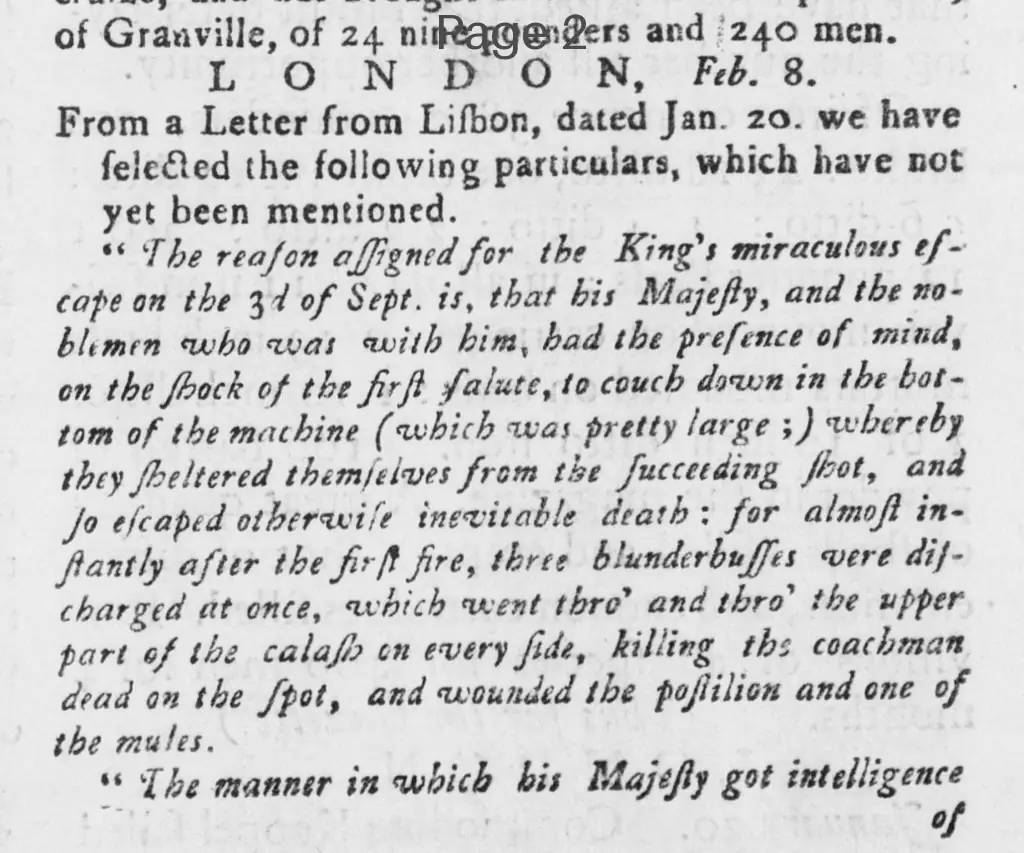
From a Letter from Lisbon, dated Jan. 20. we have selected the following particulars, which have not yet been mentioned.
"The reason assigned for the King's miraculous escape on the 3d of Sept. is, that his Majesty, and the nobleman who was with him, had the presence of mind, on the shock of the first salute, to couch down in the bottom of the machine (which was pretty large;) whereby they sheltered themselves from the succeeding shot, and so escaped otherwise inevitable death: for almost instantly after the first fire, three blunderbusses were discharged at once, which went through and through the upper part of the calash on every side, killing the coachman dead on the spot, and wounding the postillion and one of the mules.
The manner in which his Majesty got intelligence
of this conspiracy is something romantic ; but the following is certainly very true. The Duke d' Aveiro and his two bravoes (one of whom has escaped) who ray laid the King. Having, as they thought, executed their horrid design, immediately made off towards Lisbon, where they came to the house of one of the ruffians. His wife seeing the Duke, and having her brother (a Glover in the town) with her at that moment, thrust him into the closet of the room, where she then was, and on her going out the conspirators immediately entered. Her hurry and fright was so great, for it seems this had been the usual place of meeting (tho' 'tis said that she was totally ignorant of their secrets) that the poor woman did not know what she was doing. The Glover remained in the closet during the rest of the night ; and to this insignificant fellow was owing the discovery of the conspirators : for the Duke began to talk of their exploit with the utmost freedom. He said, particularly, 'that his mind misgave him, they had not dispatched the King quite ;' but the other two said, 'they were sure he could not escape.' Aye, (answered the Duke with an oath) but we should not have left the place till we had ocular demonstration of his being dead.' They remained here for some time, 'till they thought every thing was hushed and quiet, and then departed, without searching the house for eaves droppers, which, doubtless, saved the poor Glover's life. The fellow thought that the discourse he had heard was very extraordinary : yet he did not know what to make of it. But when he heard the rumour that flew about of his Majesty's being assaulted, &c. he put all things together, and went to the Secretary of State with an information : and this evidence being corroborated by some advice the King received from other hands, every thing was regulated accordingly.
While the people could not help observing, that all the troops were drawing down towards the metropolis, and that a total change was making in the officers of the army, it is indeed very surprising that the conspirators themselves did not take the hint to abscond upon those proceedings ; yet so far were they from it, that it was remarked the Duke d'Aveiro was oftener at court than any other nobleman; nor did they seem to perceive the gathering thunder, till the bolt fell upon them. It is said that the Dutchess d' Aveiro, on being apprehended, immediately confessed ; but that the Duke persisted in his innocence till he and his son were put to the torture, when they two laid open the whole conspiracy.
The principal of the conspirators were allowed nothing but bread and water during their imprisonment, and they were each of them put to the torture six times.
On the day of execution, the Marchioness de Tavora (tho' the castle was but a little way off) was brought to the scaffold in a covered waggon. She was reported to have lost her senses, and it seemed to be truth. Her arms were tied down with a common rope. She was a very tall woman, and appeared to be about fifty. She had a kind of white hood on her head, very much soiled, a black mantle over her shoulders, and her gown was of a reddish colour.
Joseph Maria, her son, was about sixteen years of age, and a very beautiful youth : he was in regimentals.
The Count d' Attouguia had been in a fever some days ; and when he appeared with the young Marquis de Tavora, a very handsome well made man, he was not able to stand up. The young Marquis behaved with great intrepidity : but the servants, who afterwards suffered, behaved in a frantic manner, struggling with the officers, (tho' they were all strangled before they were broke) and making a great noise.
The old Marquis de Tavora had received the rack so often, that he was hardly able to get up the stairs of the scaffold. He was brought thither in an open cart with the Duke d' Aveiro, who remained in it, at the foot of the scaffold, while the other was dispatched before his eyes. After they had taken the ropes from the Marquis's arms, and the irons from his legs, in order to fix him to the wheel, he went towards the sail cloths (which covered the bodies of those already executed) and lifted up every one without being hindered ; but when he came to his younger son's body, he kneeled down, kissed the corpse, and wept aloud ; he then said something to the executioner, and took hold of the iron crow with which he was to be broke. The executioner seemed to show him some respect. He was then tied to the engine, and they broke his right arm, upon which a herald proclaimed his crime : but his shrieks must have pierced the hardest heart ; nor did they cease (for near a quarter of an hour) till he got the coup de grace.
Then mounted the Duke, who was treated worse than any of them. His hands were instantly chopped off on the supposition that he fired one of the blunderbusses at the King. Then, bleeding as he was, he was tied to the wheel, where he languished an hour and a quarter, receiving eight strokes. In about half an hour his face became totally black, and his screams at every stroke were terrible. With the last stroke they broke his belly and his bowels came out. But this is a scene which will not bear description.
During the time of the execution, all the conspirators houses were pulled down to the ground."
What sub-type of article is it?
What themes does it cover?
What keywords are associated?
What entities or persons were involved?
Where did it happen?
Story Details
Key Persons
Location
Lisbon
Event Date
3d Of Sept.
Story Details
King escapes assassination attempt by Duke d'Aveiro and Távora conspirators due to quick thinking; plot discovered by eavesdropping glover; conspirators arrested, tortured, and executed brutally on scaffold with breaking wheel and dismemberment; their houses demolished.