Thank you for visiting SNEWPapers!
Sign up free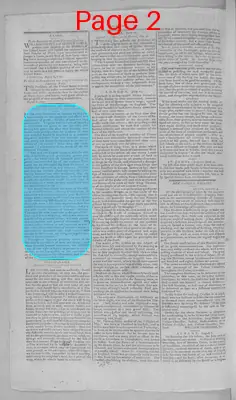
Editorial
August 20, 1791
Gazette Of The United States
New York, New York County, New York
What is this article about?
Extract from Judge Wilson's speech on failures of communal property in early Virginia and Plymouth colonies, where joint labor led to inefficiency, laziness, and hardship; advocates private property as natural and vital for civilized society.
Clipping
OCR Quality
98%
Excellent
Full Text
COMMUNITY OF GOODS.
[EXTRACT FROM A SPEECH OF JUDGE WILSON.]
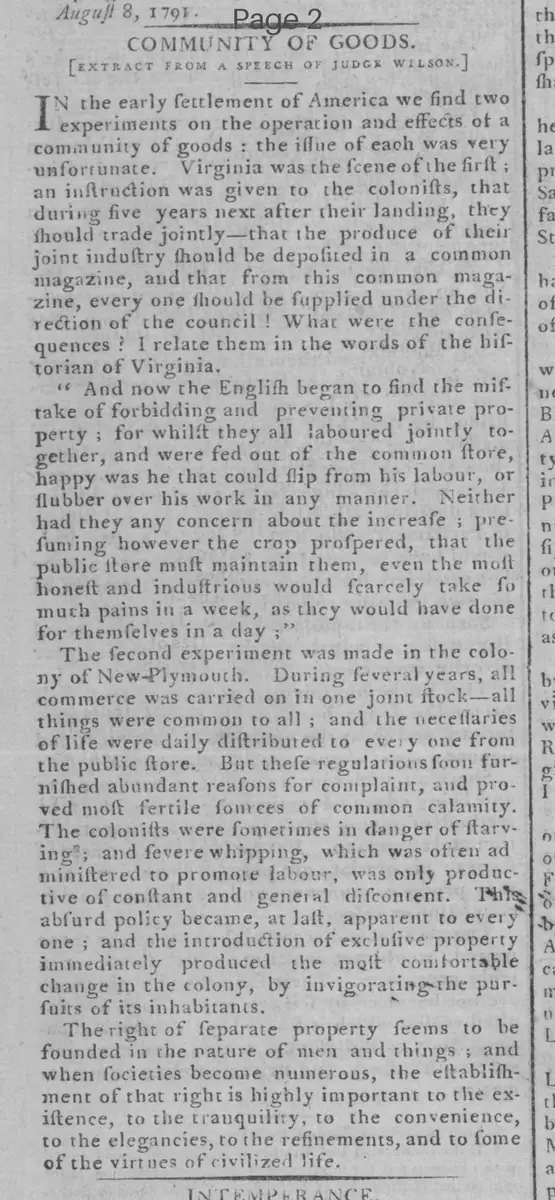
In the early settlement of America we find two experiments on the operation and effects of a community of goods: the issue of each was very unfortunate. Virginia was the scene of the first; an instruction was given to the colonists, that during five years next after their landing, they should trade jointly—that the produce of their joint industry should be deposited in a common magazine, and that from this common magazine, every one should be supplied under the direction of the council! What were the consequences? I relate them in the words of the historian of Virginia.
"And now the English began to find the mistake of forbidding and preventing private property; for whilst they all laboured jointly together, and were fed out of the common store, happy was he that could slip from his labour, or slubber over his work in any manner. Neither had they any concern about the increase; presuming however the crop prospered, that the public store must maintain them, even the most honest and industrious would scarcely take so much pains in a week, as they would have done for themselves in a day;"
The second experiment was made in the colony of New-Plymouth. During several years, all commerce was carried on in one joint stock—all things were common to all; and the necessaries of life were daily distributed to every one from the public store. But these regulations soon furnished abundant reasons for complaint, and proved most fertile sources of common calamity. The colonists were sometimes in danger of starving; and severe whipping, which was often administered to promote labour, was only productive of constant and general discontent. This absurd policy became, at last, apparent to every one; and the introduction of exclusive property immediately produced the most comfortable change in the colony, by invigorating the pursuits of its inhabitants.
The right of separate property seems to be founded in the nature of men and things; and when societies become numerous, the establishment of that right is highly important to the existence, to the tranquility, to the convenience, to the elegancies, to the refinements, and to some of the virtues of civilized life.
[EXTRACT FROM A SPEECH OF JUDGE WILSON.]
In the early settlement of America we find two experiments on the operation and effects of a community of goods: the issue of each was very unfortunate. Virginia was the scene of the first; an instruction was given to the colonists, that during five years next after their landing, they should trade jointly—that the produce of their joint industry should be deposited in a common magazine, and that from this common magazine, every one should be supplied under the direction of the council! What were the consequences? I relate them in the words of the historian of Virginia.
"And now the English began to find the mistake of forbidding and preventing private property; for whilst they all laboured jointly together, and were fed out of the common store, happy was he that could slip from his labour, or slubber over his work in any manner. Neither had they any concern about the increase; presuming however the crop prospered, that the public store must maintain them, even the most honest and industrious would scarcely take so much pains in a week, as they would have done for themselves in a day;"
The second experiment was made in the colony of New-Plymouth. During several years, all commerce was carried on in one joint stock—all things were common to all; and the necessaries of life were daily distributed to every one from the public store. But these regulations soon furnished abundant reasons for complaint, and proved most fertile sources of common calamity. The colonists were sometimes in danger of starving; and severe whipping, which was often administered to promote labour, was only productive of constant and general discontent. This absurd policy became, at last, apparent to every one; and the introduction of exclusive property immediately produced the most comfortable change in the colony, by invigorating the pursuits of its inhabitants.
The right of separate property seems to be founded in the nature of men and things; and when societies become numerous, the establishment of that right is highly important to the existence, to the tranquility, to the convenience, to the elegancies, to the refinements, and to some of the virtues of civilized life.
What sub-type of article is it?
Economic Policy
Constitutional
What keywords are associated?
Community Of Goods
Private Property
Virginia Colony
Plymouth Colony
Colonial Experiments
What entities or persons were involved?
Judge Wilson
Virginia Colonists
New Plymouth Colonists
Editorial Details
Primary Topic
Critique Of Community Of Goods In Early American Colonies
Stance / Tone
Advocacy For Private Property Rights
Key Figures
Judge Wilson
Virginia Colonists
New Plymouth Colonists
Key Arguments
Communal Trading In Virginia Led To Laziness And Poor Work Ethic As People Relied On Common Store
In Plymouth, Joint Stock System Caused Complaints, Starvation Risks, And Discontent Despite Whippings
Introduction Of Exclusive Property In Plymouth Improved Conditions And Invigorated Inhabitants
Right Of Separate Property Is Founded In Nature And Essential For Society's Existence, Tranquility, And Virtues