Thank you for visiting SNEWPapers!
Sign up free
The News And Views
Jacksonville, Onslow County, North Carolina
What is this article about?
In Panmunjom, Korea, Communists objected to Allied POW exchange plan on seven points and rejected U.N. appeal for sick/wounded swap. Allies raised concerns over North Korean arms shipments and cadre formation. No armistice progress; next session Saturday.
Merged-components note: Continuation of the Communist objections to Allied POW plan story from page 1 to page 4.
Clippings
1 of 2
OCR Quality
Full Text
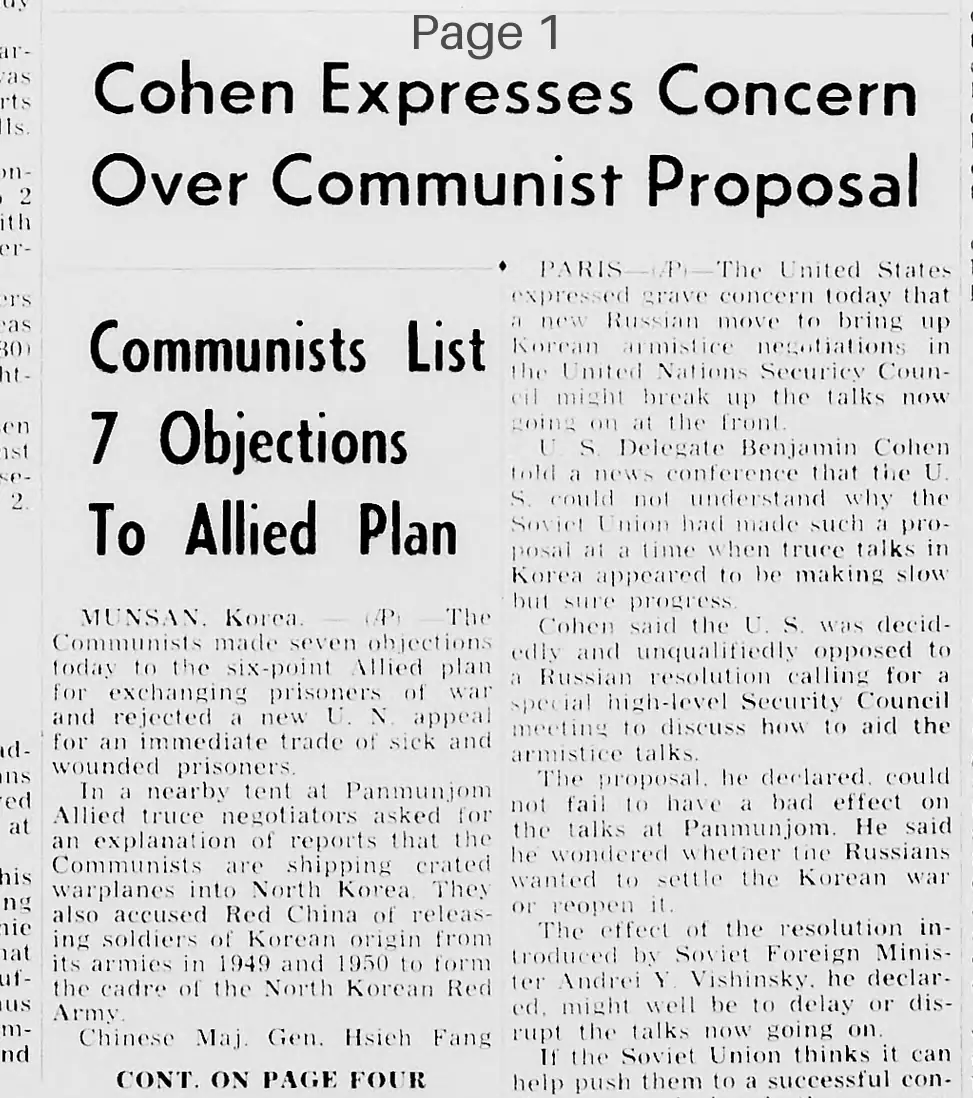
MUNSAN, Korea—The Communists made seven objections today to the six-point Allied plan for exchanging prisoners of war and rejected a new U. N. appeal for an immediate trade of sick and wounded prisoners.
In a nearby tent at Panmunjom Allied truce negotiators asked for an explanation of reports that the Communists are shipping crated warplanes into North Korea. They also accused Red China of releasing soldiers of Korean origin from its armies in 1949 and 1950 to form the cadre of the North Korean Red Army.
Chinese Maj. Gen. Hsieh Fang
Communist
CONTINUED FROM PAGE ONE
said there was nothing wrong in this. He labeled the crated plane report a "ridiculous rumor."
Hsieh, in turn, accused the Allies of holding behind their lines through intimidation with the atom bomb some 50,000 North Koreans.
Both subcommittees reported no progress toward an armistice. Both agreed to try again Saturday at 11 a.m. (10 p.m. EST Friday) in Panmunjom.
The prisoner exchange subcommittee held a marathon session lasting four hours and 20 minutes. Afterwards Rear Adm. R. E. Libby said "It looks to me as if we are in for a long struggle."
The Reds rejected the Allied exchange plan Thursday, but Libby asked them to study it further. Friday they specifically objected to:
1. Exchanging prisoners of war for civilians.
2. Differentiating between the release and repatriation of prisoners.
3. Neutral supervision by the Red Cross to make sure prisoners or civilians wanted to be exchanged.
4. Any form of paroles for prisoners.
5. Using a prisoner's pre-war address to determine whether he is a North or South Korean.
The Reds also
6. Charged that the Allied plan would not speed up the exchange of prisoners.
7. Denied that thousands of South Koreans had been impressed into the Red Army.
What sub-type of article is it?
What keywords are associated?
What entities or persons were involved?
Where did it happen?
Foreign News Details
Primary Location
Panmunjom, Korea
Event Date
Friday
Key Persons
Outcome
no progress toward armistice; communists rejected allied prisoner exchange plan with seven objections; next meeting scheduled for saturday at 11 a.m. (10 p.m. est friday)
Event Details
At Panmunjom truce talks, Communists listed seven objections to the Allied six-point plan for exchanging prisoners of war and rejected a U.N. appeal for immediate exchange of sick and wounded. Allies questioned reports of crated warplanes shipped to North Korea and accused Red China of releasing Korean soldiers in 1949-1950 to form North Korean cadre. Hsieh Fang denied the plane report as a rumor and accused Allies of holding 50,000 North Koreans behind lines via atomic intimidation. Prisoner exchange subcommittee session lasted four hours and 20 minutes with no progress; Libby predicted a long struggle. Specific objections included exchanging POWs for civilians, differentiating release and repatriation, neutral Red Cross supervision, paroles, using pre-war address for Korean origin, plan not speeding exchange, and denying impressed South Koreans in Red Army.