Thank you for visiting SNEWPapers!
Sign up free
United Automobile Worker
Detroit, Wayne County, Michigan
What is this article about?
This editorial highlights the decline in real wages for manufacturing workers from January 1945 ($47.50/week) to last month ($44/week), exacerbated by rising costs of living (down 16.3% purchasing power). It warns of an impending labor crisis and urges government and industry to adjust wage-price relationships to maintain economic balance, reprinting data from Business Week to support labor's call for wage increases and price controls.
Merged-components note: Headline merged with body text; relabeled to editorial due to opinionated reprint and commentary on wages and economic crisis.
Clipping
OCR Quality
Full Text
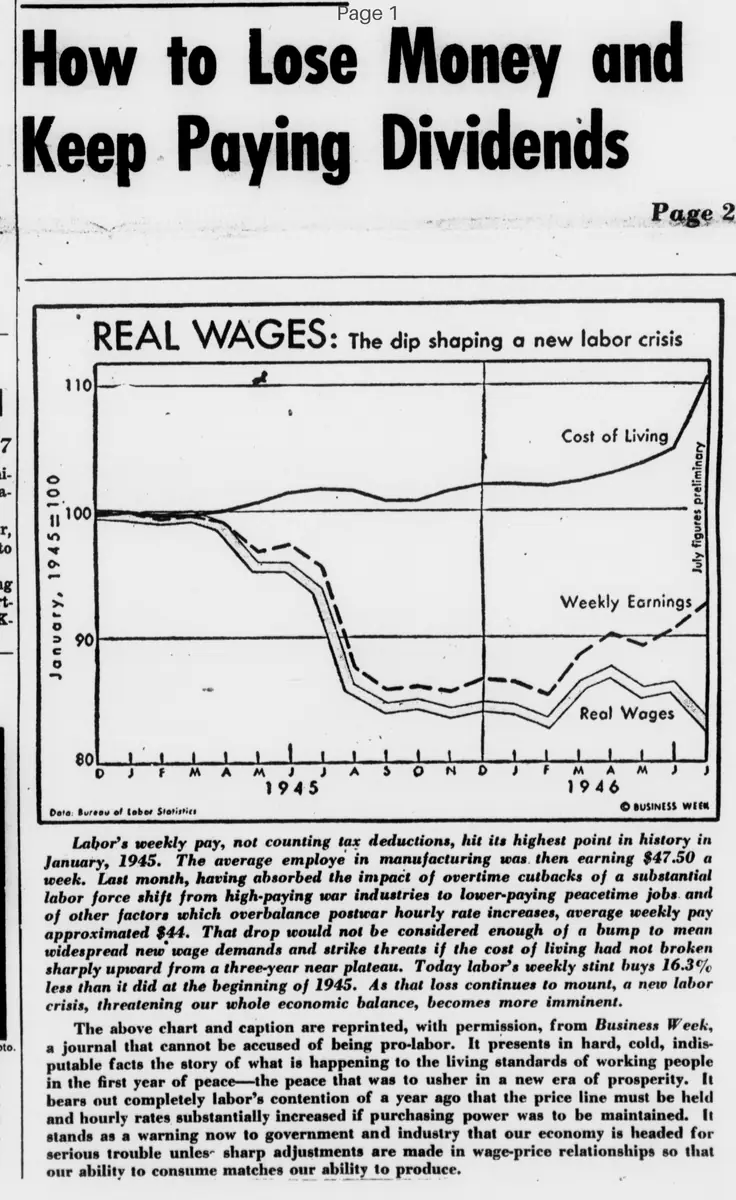
REAL WAGES: The dip shaping a new labor crisis
Labor's weekly pay, not counting tax deductions, hit its highest point in history in January, 1945. The average employee in manufacturing was then earning $47.50 a week. Last month, having absorbed the impact of overtime cutbacks of a substantial labor force shift from high-paying war industries to lower-paying peacetime jobs, and of other factors which overbalance postwar hourly rate increases, average weekly pay approximated $44. That drop would not be considered enough of a bump to mean widespread new wage demands and strike threats if the cost of living had not broken sharply upward from a three-year near plateau. Today labor's weekly stint buys 16.3% less than it did at the beginning of 1945. As that loss continues to mount, a new labor crisis, threatening our whole economic balance, becomes more imminent.
The above chart and caption are reprinted, with permission, from Business Week, a journal that cannot be accused of being pro-labor. It presents in hard, cold, indisputable facts the story of what is happening to the living standards of working people in the first year of peace—the peace that was to usher in a new era of prosperity. It bears out completely labor's contention of a year ago that the price line must be held and hourly rates substantially increased if purchasing power was to be maintained. It stands as a warning now to government and industry that our economy is headed for serious trouble unless sharp adjustments are made in wage-price relationships so that our ability to consume matches our ability to produce.
What sub-type of article is it?
What keywords are associated?
What entities or persons were involved?
Editorial Details
Primary Topic
Decline In Real Wages And Impending Labor Crisis Post Wwii
Stance / Tone
Pro Labor Warning To Government And Industry
Key Figures
Key Arguments