Thank you for visiting SNEWPapers!
Sign up free
Alexandria Daily Gazette, Commercial & Political
Alexandria, Virginia
What is this article about?
Opinion piece unveiling President Madison's diplomatic policy through analysis of British envoy David Erskine's 1809 arrangement with the US, its rejection by Britain under Canning, and resulting accusations of perfidy, exacerbating tensions over trade, impressment, and the Chesapeake affair.
Merged-components note: Merged as continuation of the same article on U.S.-British diplomatic policy from the Boston Gazette.
Clipping
OCR Quality
Full Text
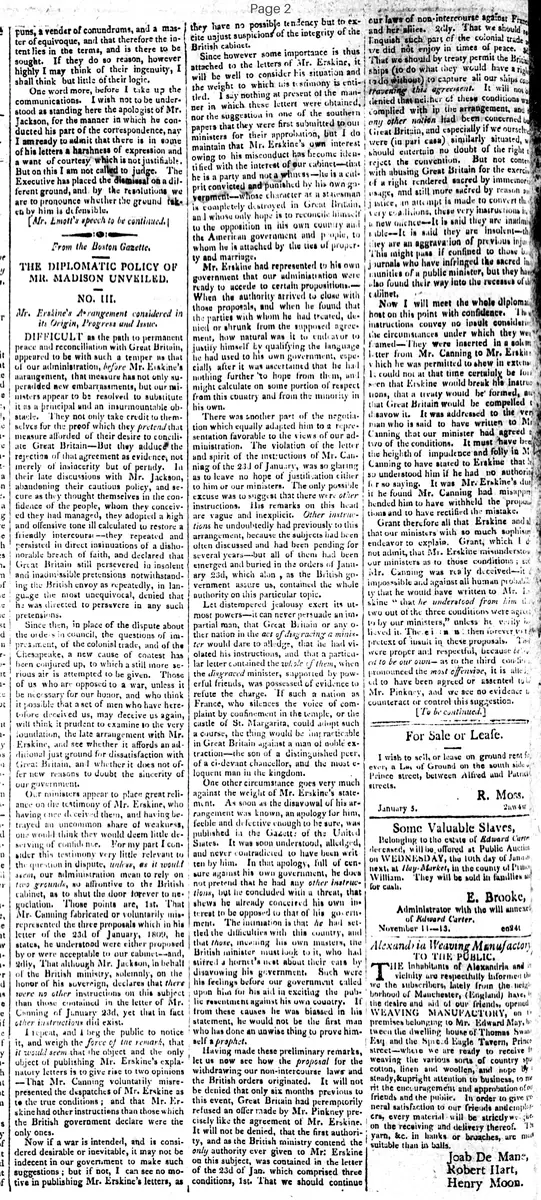
THE DIPLOMATIC POLICY OF
MR. MADISON UNVEILED.
NO. III.
Mr. Erskine's Arrangement considered in
its Origin, Progress and Issue.
DIFFICULT as the path to permanent
peace and reconciliation with Great Britain,
appeared to be with such a temper as that
of our administration, before Mr. Erskine's
arrangement, that measure has not only su-
peradded new embarrassments, but our mi-
nisters appear to be resolved to substitute
it as a principal and an insurmountable ob-
stacle. They not only take credit to them-
selves for the proof which they pretend that
measure afforded of their desire to concili-
ate Great Britain—But they adduce the
rejection of that agreement as evidence, not
merely of insincerity but of perfidy. In
their late discussions with Mr. Jackson,
abandoning their cautious policy, and se-
secure as they thought themselves in the con-
fidence of the people, whom they conceiv-
ed they had managed, they adopted a high
and offensive tone ill calculated to restore a
friendly intercourse—they repeated and
persisted in direct insinuations of a disho-
norable breach of faith, and declared that
Great Britain still persevered in insolent
and inadmissible pretensions notwithstand-
ing the British envoy as repeatedly, in lan-
guage the most unequivocal, denied that
he was directed to persevere in any such
pretensions.
Since then, in place of the dispute about
the orders in council, the questions of im-
pressment, of the colonial trade, and of the
Chesapeake, a new cause of contest has
been conjured up, to which a still more se-
rious air is attempted to be given. Those
of us who are opposed to a war, unless it
be necessary for our honor, and who think
it possible that a set of men who have here-
to fore deceived us, may deceive us again.
will think it prudent to examine to the very
foundation, the late arrangement with Mr.
Erskine, and see whether it affords an ad-
ditional just ground for dissatisfaction with
Great Britain, and whether it does not of-
fer new reasons to doubt the sincerity of
our government.
Our ministers appear to place great reli-
ance on the testimony of Mr. Erskine, who
having once deceived them, and having be-
trayed an uncommon share of weakness.
one would think they would deem little de-
serving of confidence. For my part I con-
sider this testimony very little relevant to
the question in dispute, unless, as it would
seem, our administration mean to rely on
two grounds, not alternative to the British
cabinet, as to shut the door forever to ne-
gotiation. Those points are, 1st. That
Mr. Canning fabricated or voluntarily mis-
represented the three proposals which in his
letter of the 23d of January, 1809, he
states, he understood were either proposed
by or were acceptable to our cabinet—and,
2dly, That although Mr. Jackson, in behalf
of the British ministry, solemnly, on the
honor of his sovereign, declares that there
were no other instructions on this subject
than those contained in the letter of Mr.
Canning of January 23d, yet that in fact
other instructions did exist.
I repeat, and I beg the public to notice
it, and weigh the force of the remark, that
it would seem that the object and the only
object of publishing Mr. Erskine's expla-
natory letters is to give rise to two opinions
—That Mr. Canning voluntarily misre-
presented the despatches of Mr. Erskine as
to the true conditions; and that Mr. Er.
skine had other instructions than those which
the British government declare were the
only ones.
Now if a war is intended, and is consi-
dered desirable or inevitable, it may not be
indecent in our government to make such
suggestions; but if not, I can see no mo-
tive in publishing Mr. Erskine's letters, as
they have no possible tendency but to ex-
cite unjust suspicions of the integrity of the
British cabinet.
Attached to the letters of Mr. Erskine. it
Since however some importance is thus
will be well to consider his situation and
the weight to which his testimony is enti-
tled. I say nothing at present of the man-
ner in which these letters were obtained.
nor the suggestion in one of the southern
papers that they were first submitted to our
ministers for their approbation, but I do
maintain that Mr. Erskine's own interest
owing to his misconduct has become iden-
ti fied with the interest of our cabinet—that
he is a party and not a witness—he is a cul-
prit convicted and punished by his own go.
vernment—whose character as a statesman
is completely destroyed in Great Britain,
and whose only hope is to reconcile himself
to the opposition in his own country and
the American government and people, to
whom he is attached by the ties of proper-
ty and marriage.
Mr. Erskine had represented to his own
government that our administration were
ready to accede to certain propositions.—
When the authority arrived to close with
those proposals, and when he found that
the parties with whom he had treated, de-
ied or shrunk from the supposed agree-
ment, how natural was it to endeavor to
justify himself by qualifying the language
he had used to his own government, espe-
cially after it was ascertained that he had
nothing further to hope from them, and
might calculate on some portion of respect
from this country and from the minority in
his own.
There was another part of the negotia-
tion which equally adapted him to a repre-
sentation favorable to the views of our ad-
ministration. The violation of the letter
and spirit of the instructions of Mr. Can-
ning of the 23d of January, was so glaring
as to leave no hope of justification either
to him or our ministers. The only possible
excuse was to suggest that there were other
instructions. His remarks on this head
are vague and inexplicit. Other instruc-
tions he undoubtedly had previously to this
arrangement, because the subjects had been
often discussed and had been pending for
several years—but all of them had been
merged and buried in the orders of Janu-
ary 23d, which alone, as the British go.
vernment assure us, contained the whole
authority on this particular topic.
Let distempered jealousy exert its ut-
most powers—it can never persuade an im-
partial man, that Great Britain or any other
nation in the act of disgracing a minis-
ter would dare to allege, that he had vi-
olated his instructions, and that a particu-
lar letter contained the whole of them, when
the disgraced minister, supported by pow-
erful friends, was possessed of evidence to
refute the charge. If such a nation as
France, who silences the voice of com-
plaint by confinement in the temple, or the
castle of St. Margaret, could adopt such
a course, the thing would be impracticable
in Great Britain against a man of noble ex-
traction—the son of a distinguished peer.
of a ci-devant chancellor, and the most e-
loquent man in the kingdom.
One other circumstance goes very much
against the weight of Mr. Erskine's state-
ment. As soon as the disavowal of his ar-
rangement was known, an apology for him,
feeble and defective enough to be sure, was
published in the Gazette of the United
States. It was soon understood, alleged,
and never contradicted to have been writ-
ten by him. In that apology, full of cen-
sure against his own government, he does
not pretend that he had any other instruc-
tions, but he concluded with a threat. that
shews he already conceived his own in-
terest to be opposed to that of his govern-
ment. The intimation is that he had set-
tled the difficulty with this country, and
that those, meaning his own masters, the
British minister must look to it, who had
stirred a hornet's nest about their ears by
disavowing his arrangement. Such were
his feelings before our government called
upon him for his aid in exciting the pub-
lic resentment against his own country. It
from these causes he was biassed in his
statement, he would not be the first man
who has done an unwise thing to prove him-
self a prophet.
Having made these preliminary remarks,
let us now see how the proposal for the
withdrawing our non-intercourse laws and
the British orders originated. It will not
be denied that only six months previous to
this event, Great Britain had peremptorily
refused an offer made by Mr. Pinkney pre-
cisely like the agreement of Mr. Erskine.
It will not be denied, that the first authori-
ty, and as the British ministry contend the
only authority ever given to Mr. Erskine
on this subject, was contained in the letter
of the 23d of Jan. which comprised three
conditions, 1st. That we should continue
our laws of non-intercourse against France
and her allies. 2dly. That we should
relinquish such part of the colonial trade:
we did not enjoy in times of peace. 3d
That we should by treaty permit the British
ships (to do what they would have a right
to do without) to capture all our ships con-
travening this agreement. It will not be
denied that neither of these conditions was
complied with in the arrangement, and
if any other nation had been concerned but
Great Britain, and especially if we ourselves
were (in pari causa) similarly situated, we
should entertain no doubt of the right
to reject the convention. But not content
with abusing Great Britain for the exercise
of a right rendered sacred by immemorial
usage, and still more sacred by reason and
justice, an attempt is made to convert these
very cautions, these very instructions into
a new offence—It is said they are inadmis-
sible—It is said they are insolent—they
are an aggravation of previous injury.
This might pass if confined to those news-
papers who have infringed the sacred in-
munities of a public minister, but they have
also found their way into the recesses of the
cabinet.
Now I will meet the whole diplomatic
host on this point with confidence. Those
instructions convey no insult considering
the circumstances under which they were
framed—They were inserted in a solemn
letter from Mr. Canning to Mr. Erskine:
which he was permitted to shew in exten-
so. It could not at that time certainly be fore-
seen that Erskine would break his instruc-
tions, that a treaty would be formed, and
that Great Britain would be compelled to
disavow it. It was addressed to the very
man who is said to have written to Mr.
Canning that our minister had agreed to
two of the conditions. It must have been
the height of impudence and folly in Mr.
Canning to have stated to Erskine that he
so understood him if he had no authority
for so saying. It was Mr. Erskine's duty
if he found Mr. Canning had misapprehen-
ded him to have withheld the "proposi-
tions and to have rectified the mistake.
Grant therefore all that Erskine and all
that our ministers with so much sophistry
endeavor to explain. Grant, which I do
not admit, that Mr. Erskine misunderstood
our ministers as to those conditions; since
Mr. Canning was really deceived—it
is impossible and against all human probabil-
ity that he would have written to Mr. Er-
skine "that he understood from him that
two out of the three conditions were agreed
to by our ministers," unless he verily be-
lieved it. There is an end then forever to
the pretext of insult in these proposals. They
were proper and respectful, because meant
to be our own—as to the third condition,
pronounced the most offensive, it is alleged
to have been agreed or assented to by
Mr. Pinkney, and we see no evidence to
counteract or control this suggestion.
[To be continued.]
What sub-type of article is it?
What keywords are associated?
What entities or persons were involved?
Where did it happen?
Foreign News Details
Primary Location
Great Britain
Event Date
1809
Key Persons
Outcome
rejection of erskine's arrangement by british government; heightened diplomatic tensions and accusations of perfidy between us and britain over trade conditions, non-intercourse laws, and orders in council.
Event Details
Article critiques US administration's handling of diplomatic arrangement with British envoy Mr. Erskine, which proposed revoking US non-intercourse laws and British orders in council under three conditions not met; arrangement disavowed by Britain via Mr. Canning's instructions of January 23, 1809; US ministers accuse Britain of bad faith, while author defends British position and questions Erskine's reliability.