Thank you for visiting SNEWPapers!
Sign up free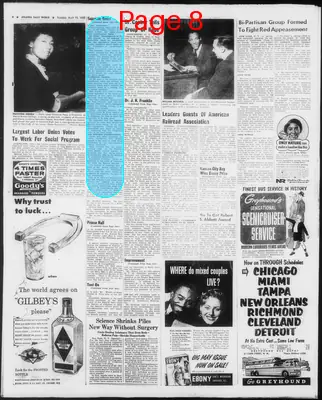
Story
April 12, 1955
Atlanta Daily World
Atlanta, Fulton County, Georgia
What is this article about?
Attorneys argue before the U.S. Supreme Court on implementing the May 17, 1954, desegregation ruling in Topeka, Kansas schools. NAACP's Carter urges immediate integration, while AG Fatzer advocates gradualism by local courts. Part of five cases, with overflow crowds attending.
Clipping
OCR Quality
95%
Excellent
Full Text
Supreme Court
(Continued From Page One)
termed "gradualism."
Carter told the court that 85 per cent of the Negro children in Topeka's schools are being denied their constitutional rights.
He added: Desegregation in Topeka schools is an example of gradualism based on conjecture, fear and speculation about community opposition which might delay completion of desegregation forever.
The Supreme Court ruled in a historic decision last May 17 that segregated schools are unconstitutional. The present series of arguments are devoted to the question of how the court should implement its decision.
When the marble court was opened to the public at 11 a.m., it was immediately filled to capacity by spectators who began gathering before the court building two hours earlier.
OVERFLOW CROWD
All 300 seats in the chamber were immediately taken and another 100 found standing room when the far-reaching debate began. Another 300 hopefully stood in a waiting line in outside corridors.
The Topeka, Kas., case, in which Fatzer appeared, is the least controversial of five cases on which the court ruled last May.
The State Attorney General told the high tribunal that the nine Kansas cities in which segregation existed are already moving to integrate their schools.
Fatzer proposed, however, that District courts be given leeway as to what steps should be taken and to determine the time in which the transition is to take place.
He suggested that the Supreme Court do no more than reverse the District Court ruling in his state that segregation violates the 14th amendment and leave all details of complying with the integration order to the local courts.
ASK SPECIFIC INSTRUCTIONS
Carter and other attorneys opposing segregation have mapped appeals to the court to order racial integration in the non-complying schools "forthwith."
They contend that the implementing order of the Supreme Court should contain specific instructions and the decree should set September, 1956, as the deadline for abolishing segregation.
Arguments revolving about segregation in the state of Delaware will follow the Kansas hearing.
The District of Columbia case is third on the docket although the fast compliance of Washington schools with the order ending segregation is expected to pose no real controversy.
Last to be heard are South Carolina and Virginia cases where state officials are making an all-out plea for a decree permitting a long delay before segregation must end.
The U. S. Government and Attorneys General for six Southern states will be permitted one hour of argument at the close of the hearings on the five specific cases.
(Continued From Page One)
termed "gradualism."
Carter told the court that 85 per cent of the Negro children in Topeka's schools are being denied their constitutional rights.
He added: Desegregation in Topeka schools is an example of gradualism based on conjecture, fear and speculation about community opposition which might delay completion of desegregation forever.
The Supreme Court ruled in a historic decision last May 17 that segregated schools are unconstitutional. The present series of arguments are devoted to the question of how the court should implement its decision.
When the marble court was opened to the public at 11 a.m., it was immediately filled to capacity by spectators who began gathering before the court building two hours earlier.
OVERFLOW CROWD
All 300 seats in the chamber were immediately taken and another 100 found standing room when the far-reaching debate began. Another 300 hopefully stood in a waiting line in outside corridors.
The Topeka, Kas., case, in which Fatzer appeared, is the least controversial of five cases on which the court ruled last May.
The State Attorney General told the high tribunal that the nine Kansas cities in which segregation existed are already moving to integrate their schools.
Fatzer proposed, however, that District courts be given leeway as to what steps should be taken and to determine the time in which the transition is to take place.
He suggested that the Supreme Court do no more than reverse the District Court ruling in his state that segregation violates the 14th amendment and leave all details of complying with the integration order to the local courts.
ASK SPECIFIC INSTRUCTIONS
Carter and other attorneys opposing segregation have mapped appeals to the court to order racial integration in the non-complying schools "forthwith."
They contend that the implementing order of the Supreme Court should contain specific instructions and the decree should set September, 1956, as the deadline for abolishing segregation.
Arguments revolving about segregation in the state of Delaware will follow the Kansas hearing.
The District of Columbia case is third on the docket although the fast compliance of Washington schools with the order ending segregation is expected to pose no real controversy.
Last to be heard are South Carolina and Virginia cases where state officials are making an all-out plea for a decree permitting a long delay before segregation must end.
The U. S. Government and Attorneys General for six Southern states will be permitted one hour of argument at the close of the hearings on the five specific cases.
What sub-type of article is it?
Historical Event
What themes does it cover?
Justice
What keywords are associated?
School Desegregation
Supreme Court
Topeka
Gradualism
Integration
Brown V Board
What entities or persons were involved?
Carter
Fatzer
Where did it happen?
Supreme Court, Topeka, Kansas
Story Details
Key Persons
Carter
Fatzer
Location
Supreme Court, Topeka, Kansas
Event Date
Last May 17
Story Details
Attorneys debate implementation of Supreme Court desegregation ruling in Topeka schools; Carter pushes for immediate integration by September 1956, Fatzer for gradual local court handling.