Thank you for visiting SNEWPapers!
Sign up free
Editorial
June 2, 1937
The Bismarck Tribune
Bismarck, Mandan, Burleigh County, Morton County, North Dakota
What is this article about?
In this 1937 editorial, Frank R. Kent analyzes the Republican Party's post-1936 election woes, noting its lack of direction despite a major Democratic split over Roosevelt's New Deal. Anti-New Deal Democrats criticize the administration but hesitate to align openly with Republicans, fearing it would damage their primaries. Kent suggests the GOP needs coherent principles and leadership to rebound or should dissolve.
Clipping
OCR Quality
88%
Good
Full Text
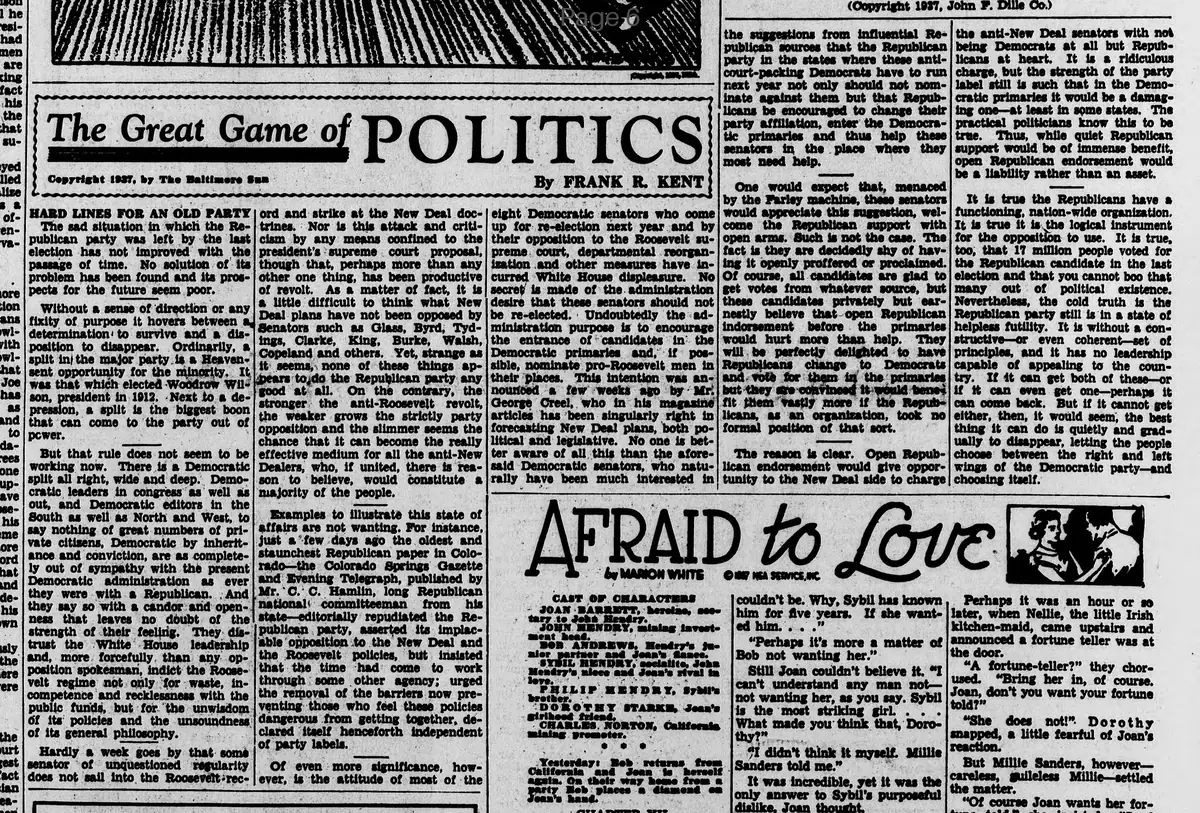
The Great Game of POLITICS
Copyright 1937, by The Baltimore Sun
By FRANK R. KENT
Hard Lines for an Old Party
The sad situation in which the Republican party was left by the last election has not improved with the passage of time. No solution of its problem has been found and its prospects for the future seem poor.
Without a sense of direction or any fixity of purpose it hovers between a determination to survive and a disposition to disappear. Ordinarily, a split in the major party is a Heaven-sent opportunity for the minority. It was that which elected Woodrow Wilson president in 1912. Next to a depression, a split is the biggest boon that can come to the party out of power.
But that rule does not seem to be working now. There is a Democratic split all right, wide and deep. Democratic leaders in congress as well as out, and Democratic editors in the South as well as North and West, to say nothing of great numbers of private citizens, Democratic by inheritance and conviction, are as completely out of sympathy with the present Democratic administration as ever they were with a Republican. And they say so with a candor and openness that leaves no doubt of the strength of their feeling. They distrust the White House leadership and, more forcefully than any opposition spokesman, indict the Roosevelt regime not only for waste, incompetence and recklessness with the public funds, but for the unwisdom of its policies and the unsoundness of its general philosophy.
Hardly a week goes by that some senator of unquestioned regularity does not sail into the Roosevelt record and strike at the New Deal doctrines. Nor is this attack and criticism by any means confined to the president's supreme court proposal, though that, perhaps more than any other one thing, has been productive of revolt. As a matter of fact, it is a little difficult to think what New Deal plans have not been opposed by Senators such as Glass, Byrd, Tydings, Clarke, King, Burke, Walsh, Copeland and others. Yet, strange as it seems, none of these things appears to do the Republican party any good at all. On the contrary, the stronger the anti-Roosevelt revolt, the weaker grows the strictly party opposition and the slimmer seems the chance that it can become the really effective medium for all the anti-New Dealers, who, if united, there is reason to believe, would constitute a majority of the people.
Examples to illustrate this state of affairs are not wanting. For instance, just a few days ago the oldest and staunchest Republican paper in Colorado, the Colorado Springs Gazette and Evening Telegraph, published by Mr. C. C. Hamlin, long Republican national committeeman from his state, editorially repudiated the Republican party, asserted its implacable opposition to the New Deal and the Roosevelt policies, but insisted that the time had come to work through some other agency; urged the removal of the barriers now preventing those who feel these policies dangerous from getting together, declared itself henceforth independent of party labels.
Of even more significance, however, is the attitude of most of the eight Democratic senators who come up for re-election next year and by their opposition to the Roosevelt supreme court, departmental reorganization and other measures have incurred White House displeasure. No secret is made of the administration desire that these senators should not be re-elected. Undoubtedly the administration purpose is to encourage the entrance of candidates in the Democratic primaries and, if possible, nominate pro-Roosevelt men in their places. This intention was announced a few weeks ago by Mr. George Creel, who in his magazine articles has been singularly right in forecasting New Deal plans, both political and legislative. No one is better aware of all this than the aforesaid Democratic senators, who naturally have been much interested in the suggestions from influential Republican sources that the Republican party in the states where these anti-court-packing Democrats have to run next year not only should not nominate against them but that Republicans be encouraged to change their party affiliation, enter the Democratic primaries and thus help these senators in the place where they most need help.
One would expect that, menaced by the Farley machine, these senators would appreciate this suggestion, welcome the Republican support with open arms. Such is not the case. The fact is they are decidedly shy of having it openly proffered or proclaimed. Of course, all candidates are glad to get votes from whatever source, but these candidates privately but earnestly believe that open Republican endorsement before the primaries would hurt more than help. They will be perfectly delighted to have Republicans change to Democrats and vote for them in the primaries but they are convinced it would benefit them vastly more if the Republicans, as an organization, took no formal position of that sort.
The reason is clear. Open Republican endorsement would give opportunity to the New Deal side to charge the anti-New Deal senators with not being Democrats at all but Republicans at heart. It is a ridiculous charge, but the strength of the party label still is such that in the Democratic primaries it would be a damaging one--at least in some states. The practical politicians know this to be true. Thus, while quiet Republican support would be of immense benefit, open Republican endorsement would be a liability rather than an asset.
It is true the Republicans have a functioning, nationwide organization. It is true it is the logical instrument for the opposition to use. It is true, too, that 17 million people voted for the Republican candidate in the last election and that you cannot boot that many out of political existence.
Nevertheless, the cold truth is the Republican party still is in a state of helpless futility. It is without a constructive--or even coherent--set of principles, and it has no leadership capable of appealing to the country. If it can get both of these--more if it can even get one--perhaps it can come back. But if it cannot get either, then, it would seem, the best thing it can do is quietly and gradually to disappear, letting the people choose between the right and left wings of the Democratic party--and choosing itself.
Copyright 1937, by The Baltimore Sun
By FRANK R. KENT
Hard Lines for an Old Party
The sad situation in which the Republican party was left by the last election has not improved with the passage of time. No solution of its problem has been found and its prospects for the future seem poor.
Without a sense of direction or any fixity of purpose it hovers between a determination to survive and a disposition to disappear. Ordinarily, a split in the major party is a Heaven-sent opportunity for the minority. It was that which elected Woodrow Wilson president in 1912. Next to a depression, a split is the biggest boon that can come to the party out of power.
But that rule does not seem to be working now. There is a Democratic split all right, wide and deep. Democratic leaders in congress as well as out, and Democratic editors in the South as well as North and West, to say nothing of great numbers of private citizens, Democratic by inheritance and conviction, are as completely out of sympathy with the present Democratic administration as ever they were with a Republican. And they say so with a candor and openness that leaves no doubt of the strength of their feeling. They distrust the White House leadership and, more forcefully than any opposition spokesman, indict the Roosevelt regime not only for waste, incompetence and recklessness with the public funds, but for the unwisdom of its policies and the unsoundness of its general philosophy.
Hardly a week goes by that some senator of unquestioned regularity does not sail into the Roosevelt record and strike at the New Deal doctrines. Nor is this attack and criticism by any means confined to the president's supreme court proposal, though that, perhaps more than any other one thing, has been productive of revolt. As a matter of fact, it is a little difficult to think what New Deal plans have not been opposed by Senators such as Glass, Byrd, Tydings, Clarke, King, Burke, Walsh, Copeland and others. Yet, strange as it seems, none of these things appears to do the Republican party any good at all. On the contrary, the stronger the anti-Roosevelt revolt, the weaker grows the strictly party opposition and the slimmer seems the chance that it can become the really effective medium for all the anti-New Dealers, who, if united, there is reason to believe, would constitute a majority of the people.
Examples to illustrate this state of affairs are not wanting. For instance, just a few days ago the oldest and staunchest Republican paper in Colorado, the Colorado Springs Gazette and Evening Telegraph, published by Mr. C. C. Hamlin, long Republican national committeeman from his state, editorially repudiated the Republican party, asserted its implacable opposition to the New Deal and the Roosevelt policies, but insisted that the time had come to work through some other agency; urged the removal of the barriers now preventing those who feel these policies dangerous from getting together, declared itself henceforth independent of party labels.
Of even more significance, however, is the attitude of most of the eight Democratic senators who come up for re-election next year and by their opposition to the Roosevelt supreme court, departmental reorganization and other measures have incurred White House displeasure. No secret is made of the administration desire that these senators should not be re-elected. Undoubtedly the administration purpose is to encourage the entrance of candidates in the Democratic primaries and, if possible, nominate pro-Roosevelt men in their places. This intention was announced a few weeks ago by Mr. George Creel, who in his magazine articles has been singularly right in forecasting New Deal plans, both political and legislative. No one is better aware of all this than the aforesaid Democratic senators, who naturally have been much interested in the suggestions from influential Republican sources that the Republican party in the states where these anti-court-packing Democrats have to run next year not only should not nominate against them but that Republicans be encouraged to change their party affiliation, enter the Democratic primaries and thus help these senators in the place where they most need help.
One would expect that, menaced by the Farley machine, these senators would appreciate this suggestion, welcome the Republican support with open arms. Such is not the case. The fact is they are decidedly shy of having it openly proffered or proclaimed. Of course, all candidates are glad to get votes from whatever source, but these candidates privately but earnestly believe that open Republican endorsement before the primaries would hurt more than help. They will be perfectly delighted to have Republicans change to Democrats and vote for them in the primaries but they are convinced it would benefit them vastly more if the Republicans, as an organization, took no formal position of that sort.
The reason is clear. Open Republican endorsement would give opportunity to the New Deal side to charge the anti-New Deal senators with not being Democrats at all but Republicans at heart. It is a ridiculous charge, but the strength of the party label still is such that in the Democratic primaries it would be a damaging one--at least in some states. The practical politicians know this to be true. Thus, while quiet Republican support would be of immense benefit, open Republican endorsement would be a liability rather than an asset.
It is true the Republicans have a functioning, nationwide organization. It is true it is the logical instrument for the opposition to use. It is true, too, that 17 million people voted for the Republican candidate in the last election and that you cannot boot that many out of political existence.
Nevertheless, the cold truth is the Republican party still is in a state of helpless futility. It is without a constructive--or even coherent--set of principles, and it has no leadership capable of appealing to the country. If it can get both of these--more if it can even get one--perhaps it can come back. But if it cannot get either, then, it would seem, the best thing it can do is quietly and gradually to disappear, letting the people choose between the right and left wings of the Democratic party--and choosing itself.
What sub-type of article is it?
Partisan Politics
What keywords are associated?
Republican Party
Democratic Split
New Deal Opposition
Roosevelt Administration
Party Politics
1936 Election
Supreme Court Packing
Political Primaries
What entities or persons were involved?
Republican Party
Democratic Party
Franklin D. Roosevelt
New Deal
Carter Glass
Harry Byrd
Millard Tydings
James Clarke
William King
Edward Burke
David Walsh
Royal Copeland
James Farley
George Creel
C. C. Hamlin
Colorado Springs Gazette And Evening Telegraph
Woodrow Wilson
Editorial Details
Primary Topic
Republican Party's Post 1936 Struggles Amid Democratic New Deal Split
Stance / Tone
Critical Analysis Of Republican Futility
Key Figures
Republican Party
Democratic Party
Franklin D. Roosevelt
New Deal
Carter Glass
Harry Byrd
Millard Tydings
James Clarke
William King
Edward Burke
David Walsh
Royal Copeland
James Farley
George Creel
C. C. Hamlin
Colorado Springs Gazette And Evening Telegraph
Woodrow Wilson
Key Arguments
Republican Party Lacks Direction And Purpose After 1936 Election Defeat.
Deep Democratic Split Over Roosevelt's New Deal Policies, With Many Democrats Openly Criticizing Administration For Waste, Incompetence, And Unsound Philosophy.
Gop Fails To Benefit From Democratic Dissent Due To Its Own Weaknesses.
Example: Colorado Republican Newspaper Repudiates Party And Declares Independence To Oppose New Deal.
Anti New Deal Democratic Senators Oppose Court Packing And Other Measures But Avoid Open Republican Support To Prevent Being Labeled As Republicans In Primaries.
Quiet Republican Crossover Votes Helpful, But Formal Endorsement Damaging.
Republicans Have Organization And Voter Base But Need Coherent Principles And Appealing Leadership To Recover, Or Should Fade Away.