Thank you for visiting SNEWPapers!
Sign up free
The Virginia Gazette
Williamsburg, Virginia
What is this article about?
Andrew Ronald defends his reputation against accusations in the Old Whig's letter of August 14, 1778, claiming his conduct during the American Revolutionary War was cleared in court and refuting charges of disloyalty and unworthiness of professional confidence in Williamsburg, Virginia.
Merged-components note: Merging the two components as they form a single continuous letter to the editor, with the text flowing directly from one to the next across pages.
Clippings
1 of 2
OCR Quality
Full Text
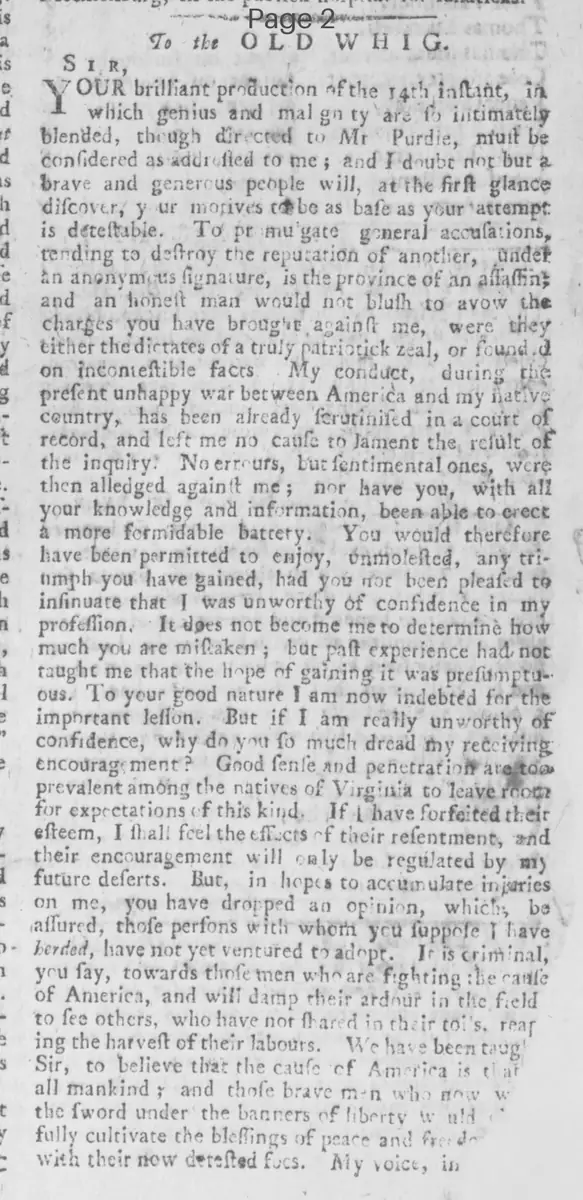
SIR,
Your brilliant production of the 14th instant, in which genius and malignity are so intimately blended, though directed to Mr. Purdie, must be considered as addressed to me; and I doubt not but a brave and generous people will, at the first glance, discover, your motives to be as base as your attempt is detestable. To promulgate general accusations, tending to destroy the reputation of another, under an anonymous signature, is the province of an assassin; and an honest man would not blush to avow the charges you have brought against me, were they either the dictates of a truly patriotick zeal, or founded on incontestable facts. My conduct, during the present unhappy war between America and my native country, has been already scrutinised in a court of record, and left me no cause to lament the result of the inquiry: No errors, but sentimental ones, were then alledged against me; nor have you, with all your knowledge and information, been able to erect a more formidable battery. You would therefore have been permitted to enjoy, unmolested, any triumph you have gained, had you not been pleased to insinuate that I was unworthy of confidence in my profession. It does not become me to determine how much you are mistaken; but past experience had not taught me that the hope of gaining it was presumptuous. To your good nature I am now indebted for the important lesson. But if I am really unworthy of confidence, why do you so much dread my receiving encouragement? Good sense and penetration are too prevalent among the natives of Virginia to leave room for expectations of this kind. If I have forfeited their esteem, I shall feel the effects of their resentment, and their encouragement will only be regulated by my future deserts. But, in hopes to accumulate injuries on me, you have dropped an opinion, which, be assured, those persons with whom you suppose I have herded, have not yet ventured to adopt. It is criminal, you say, towards those men who are fighting the cause of America, and will damp their ardour in the field to see others, who have not shared in their toils, reaping the harvest of their labours. We have been taught, Sir, to believe that the cause of America is that of all mankind; and those brave men who now wield the sword under the banners of liberty would surely cultivate the blessings of peace and freedom with their now detested foes. Any voice, in From official and unreserved moments, has always applauded many who were actuated by principle in this great cause. The few, whom interest alone prompted to unite in it, have ever been the object of universal contempt; and I have ever considered an intolerant zeal, and a spirit of persecution, as the distinguishing characteristics of such people. How far these marks are applicable to you, I leave your own heart and the public to determine. But I wish not to encroach too much on either the printer or his readers. The subject is to me a most interesting one, and therefore I hope to stand excused for this reply. Yet, before I conclude, let me assure you, that in point of law, as well as in several of your supposed facts, you are mistaken; and where I have erred I dare rely on the humanity and benevolence of a people who extend the exercise of these virtues even to their most inveterate enemies. And therefore I trust will never reject their returning friends. Nay, what you will perhaps deem still more audacious, your mean and dastardly attempt, unprovoked by injury, to reduce a worthy family to want and ruin, I dare forgive. Here our correspondence ends; and I am, while you remain unknown,
Your very humble servant,
ANDREW RONALD.
WILLIAMSBURG, AUGUST 17, 1778.
What sub-type of article is it?
What themes does it cover?
What keywords are associated?
What entities or persons were involved?
Letter to Editor Details
Author
Andrew Ronald
Recipient
To The Old Whig
Main Argument
andrew ronald refutes anonymous accusations against his loyalty and professional worthiness during the american war, asserting his conduct was cleared in court and forgiving the attacker's base motives.
Notable Details