Thank you for visiting SNEWPapers!
Sign up free
Alexandria Gazette
Alexandria, Alexandria County, District Of Columbia
What is this article about?
In Baltimore, William Stewart stands trial for the brutal murder of his father Benjamin on June 22. Prosecutors present circumstantial evidence including a purchased hatchet, matching pistols, bloodied clothing, and suspicious behavior tied to inheritance. Defense argues lack of direct proof and good character.
Clipping
OCR Quality
Full Text
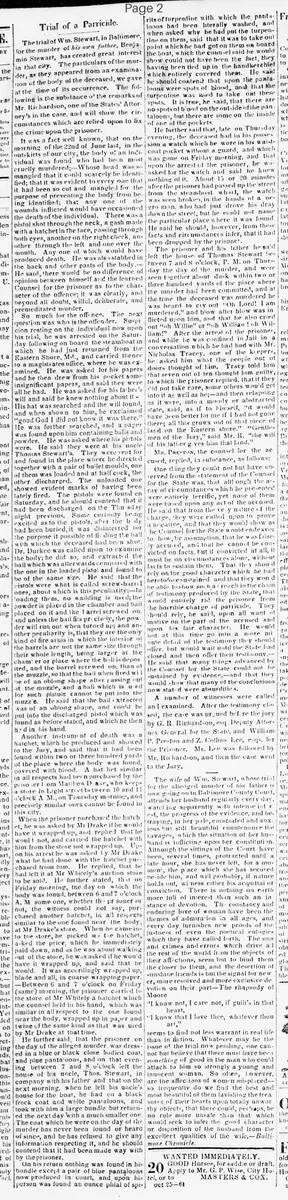
The trial of Wm. Stewart, in Baltimore, for the murder of his own father, Benjamin Stewart, has created great interest in that city.
The particulars of the murder, as they appeared from an examination of the body of the deceased, we gave at the time of its occurrence. The following is the substance of the remarks of Mr. Richardson, one of the State's Attorneys in the case, and will show the circumstances which are relied upon to fix the crime upon the prisoner.
It was a fact well known, that on the morning of the 22nd of June last, in the outskirts of our city, the body of an individual was found who had been most cruelly murdered;—Whose head was so mangled that it could scarcely be identified; that it was evident to every one that it had been so cut and mangled for the purpose of preventing the body from being identified; that any one of the wounds inflicted would have occasioned the death of the individual. There was a pistol shot through the neck, a gash made with a hatchet in the face, passing through both eyes, another on the right cheek, another through the left and one over the mouth. Any one of which would have produced death. He was also stabbed in the back and other parts of the body.—
He said, there would be no difference of opinion between himself and the learned Counsel for the prisoner as to the character of the offence; it was clearly, and beyond all doubt, wilful, deliberate, and premeditated murder.
So much for the offence. The next question was who is the offender. Suspicion resting on the individual now upon his trial, he was arrested on the Saturday following on board the steamboat in which he had just returned from the Eastern Shore, Md., and carried thence to a magistrate's office, where he was examined. He was asked for his papers and he then drew from his pocket some insignificant papers, and said they were all he had. He was asked for his father's will and said he knew nothing about it— His hat was searched and the will found. and when shown to him, he exclaimed "good God I did not know it was there."
He was further searched, and a paper was found upon him containing balls and powder. He was asked where his pistols were. He said they were at his uncle Thomas Stewart's. They were sent for and found in the place where he directed together with a pair of bullet moulds, one of them was loaded and at halfcock, the other discharged. The unloaded one showed evident marks of having been lately fired. The pistols were found on Saturday, and he should contend that it had been discharged on the Thursday night previous. Some curiosity being excited as to the pistols, after the body had been buried, it was disinterred for the purpose if possible of finding the ball with which the deceased had been shot
Dr. Durkee was called upon to examine the body; he did so, and extracted the ball which was afterwards compared with the one in the loaded pistol and found to be of the same size. He said: that the pistols were what is called screw-barrel ones, about which is this peculiarity;—In loading them, no wadding is used; the powder is placed in the chamber and ball placed on it and the barrel screwed on. and unless the ball fits precisely, the powder will run out when turned up; and another peculiarity is, that they are the only kind of fire arms in which the interior of the barrels are not the same size through their whole length, being larger at the chamber or place where the ball is deposited, and the barrel screwed on. than at the muzzle, so that the ball when fired will be of an oblong shape after passing out at the muzzle, and a ball which is used for such pistols cannot be put into the muzzle. He said that the ball extracted was of an oblong shape, and could be put into the discharged pistol which was found as before stated, and which he then held in his hand.
Another instrument of death was a hatchet, which he produced and showed to the Jury, and said that it had been found within two or three hundred yards of the place where the body was found. covered with blood. A hatchet similar in all respects had been purchased by the prisoner from Matthew Drake, who keeps a store in Light street between 10 and 11 o'clock A. M., on Thursday morning, and precisely similar ones cannot be found in this city.
When the prisoner purchased the hatchet, he was asked by Mr. Drake if he would have it wrapped up, and replied that he would not, and carried the hatchet with him from the store not wrapped up. Upon his arrest he was asked by Mr. Drake what he had done with the hatchet purchased from him. He replied, that he had left it at Mr. Whitelv's auction store to be sold. He further stated, that on Friday morning, the day on which the body was found, between 6 and 7 o'clock A. M. some one, whether the prisoner or not, the witness could not say, purchased another hatchet, in all respects similar to the one found near the body. at Mr. Drake's store. When he came into the store, he picked up the hatchet. asked the price, which he immediately paid down, and as he was about walking out of the store, he was asked if he would have it wrapped up, and said that he would. It was accordingly wrapped up. blade and all, in coarse wrapping paper.
—Between 6 and 7 o'clock on Friday (same) morning, the prisoner carried to the store of Mr. Whitley a hatchet which the counsel held in his hand, which was similar in all respect to the one found near the body, wrapped up in paper and twine of the same kind as that was used by Mr. Drake at that time.
He further said, that the prisoner on the day of the alleged murder. was dressed in a blue or black close bodied coat, and blue pantaloons, and on that evening between 7 and 8 o'clock left the house of his uncle, Thos. Stewart, in company with his father and that on the next morning, when he left his uncle's house for the boat, he had on a black frock coat and white pantaloons, and took with him a large bundle but returned the next day with a much smaller one
The coat which he wore on the day of the murder has never been found or heard of since. and he has refused to give any information respecting it. and he should contend that it had been made way with by the prisoner.
On his return nothing was found in his bundle except a pair of blue pantaloons now produced in court, and upon his person was found an ounce phial of spirits of turpentine with which the pantaloons had been literally washed, and when asked why he had put the turpentine on them, said that it was to take out paint which he had got on them on board the boat, which the counsel said he would show could not have been the fact. they having been tied up in the handkerchief which entirely covered them. He said he should contend that upon the pantaloons were spots of blood, and that the turpentine was used to take out these spots. It is true. he said. that there are no spots of blood on the outside of the pantaloons, but there are some on the inside of one of the pockets
He further said that late on Thursday evening, the deceased had in his possession a watch which he wore in his waistcoat pocket without a guard. and which was gone on Friday morning. and that upon the arrest of the prisoner, he was asked for the watch and said he knew nothing of it. About 15 or 20 minutes after the prisoner had passed up the street from the steamboat wharf, the watch was seen broken, in the hands of a negro man, who had just drove his dray down the street, but he could not name the particular place where it was found
He said he should. however. from these facts and circumstances infer, that it had been dropped by the prisoner.
The prisoner and his father he said left the house of Thomas Stewart between 7 and 8 o'clock. P. M. on Thursday the day of the murder, and were seen together about dusk within two or three hundred yards of the place where the murder had been committed, and at the time the deceased was murdered he was heard to cry out "Oh Lord! I am murdered," and blow after blow was inflicted upon him. and that he also cried out "oh Willie" or "oh William! oh William!" After the arrest of the prisoner. and while he was confined in Jail in a conversation which he had had with Mr. Nicholas Tracey, one of the keepers. he asked him what the people out of doors thought of him. Tracy told him that seven out of ten thought him guilty. to which the prisoner replied, that if they did not take care, some others would get into it as well as he;—and then relapsing as it were, into a moody or abstracted state, said, as if to himself. "it would have been better for me if I had not gone there; all this grows out of that piece of land on the Eastern shore." "Gentlemen of the Jury," said Mr. R. "the will of his father gives him that land."
Mr. Preston. the counsel for the accused, replied, in substance, as follows:
One thing they could not but have observed from the statement of the Counsel for the State was, that although the array of circumstances which he presented were entirely terrific, yet none of them were based upon any act of the accused
He said that from the very nature of the charge, they were called upon to prove a negative, and that they would show as the Counsel for the State would endeavor to show, by assumption, that he was falsely accused, and that he cannot be convicted on facts. but if convicted at all, it must be on circumstances alone, without facts to sustain them. That they should rely on the good character which he had heretofore sustained and that they would be able to show such a breach in the chain of testimony produced by the State, that would entirely rid the prisoner from the horrible charge of parricide. They should rely, he said, upon all want of motive on the part of the accused and upon his fair character. He would not at this time go into a more minute detail of the testimony they should offer. but would wait until the State had closed and then offer their testimony.—
He said that many things advanced by the Counsel for the State could not be sustained by evidence,—and that they would show that many of the conclusions now stated were absurdities.
A number of witnesses were called and examined. After the testimony closed, the case was argued before the jury by G. R. Richardson, esq Deputy Attorney General for the State, and William P. Preston and Z. Collins Lee, esqs. for the Prisoner. Mr. Lee was followed by Mr. Richardson, and then the case went to the Jury.
What sub-type of article is it?
What themes does it cover?
What keywords are associated?
What entities or persons were involved?
Where did it happen?
Story Details
Key Persons
Location
Baltimore
Event Date
22nd Of June Last
Story Details
William Stewart is on trial in Baltimore for the premeditated murder of his father Benjamin Stewart. Evidence includes the mutilated body found with hatchet wounds and a pistol shot, a bloodied hatchet purchased by Stewart, matching pistols with an extracted ball, suspicious clothing changes, blood spots on pantaloons treated with turpentine, a missing watch, and Stewart's incriminating statements about land inheritance.