Thank you for visiting SNEWPapers!
Sign up free
Letter to Editor
December 31, 1863
The Nashville Daily Union
Nashville, Davidson County, Tennessee
What is this article about?
A letter to the editor commends actor Mr. Adams as a rising dramatic genius, praising his sympathetic acting style and detailed performance of a key line in Macbeth, contrasting it with inferior ranting styles.
Clipping
OCR Quality
70%
Good
Full Text
Sir,
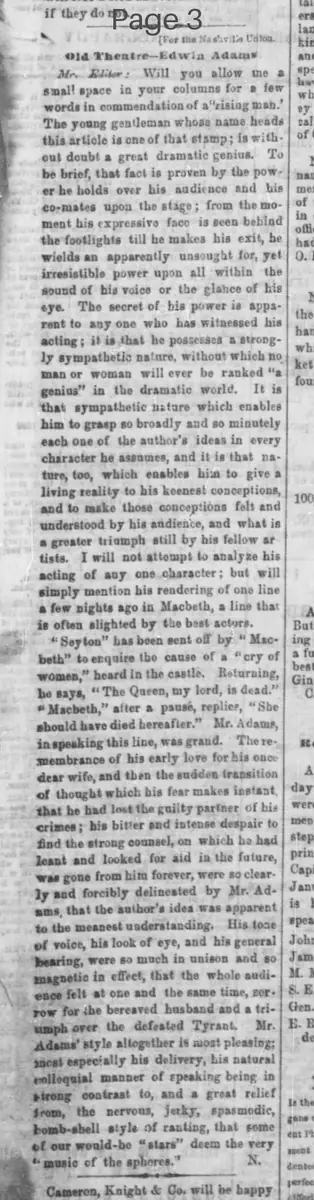
Will you allow me small space in your columns for words in commendation of a "rising man." The young gentleman whose name heads this article is one of that stamp; is without doubt a great dramatic genius. To be brief, the fact is proven by the power he holds over his audience and his co-mates upon the stage; from the moment his expressive face is seen behind the footlights till he makes his exit, he wields an apparently unsought for, yet irresistible power upon all within the sound of his voice or the glance of his eye. The secret of his power is apparent to any one who has witnessed his acting: it is that he possesses a strongly sympathetic nature, without which no man or woman will ever be ranked "a genius" in the dramatic world. It is that sympathetic nature which enables him to grasp so broadly and so minutely each one of the author's ideas in every character he assumes, and it is that nature too, which enables him to give a living reality to his keenest conceptions and to make those conceptions felt and understood by his audience, and what is a greater triumph still by his fellow artists.
I will not attempt to analyze his acting of any one character; but will simply mention his rendering of one line a few nights ago in Macbeth, a line that is often slighted by the best actors. L. "Boyton" has been sent off by "Macbeth" to enquire the cause of the "cry of women heard in the castle." Returning, he says "The guard, my lord, is dead." "Macbeth," after a pause, replies, "She should have died hereafter."
Mr. Adams in speaking this line, was grand. The remembrance of his early love for his once dear wife, and then the sudden transition of thought which his fear makes instant, that he had lost the guilty partner of his crimes; his bitter and intense despair to find the strong coadjutor, on which he had leaned and looked for aid in the future, was gone from him forever, were so clearly and forcibly delineated by Mr. Adams, that the author's idea was apparent to the meanest understanding. His tone of voice, his look of eye, and his general bearing, were so much in unison and so magnetic in effect, that the whole audience felt at one and the same time, sorrow for the bereaved husband and a triumph over the defeated Tyrant.
Mr. Adams' style altogether is most pleasing; and especially his delivery, the natural colloquial manner of speaking being in strong contrast to, and a great relief from, the nervous, jerky, spasmodic, bomb-shell style of ranting, that some of our would-be "stars" deem the very 'music of the spheres.'
N.
Will you allow me small space in your columns for words in commendation of a "rising man." The young gentleman whose name heads this article is one of that stamp; is without doubt a great dramatic genius. To be brief, the fact is proven by the power he holds over his audience and his co-mates upon the stage; from the moment his expressive face is seen behind the footlights till he makes his exit, he wields an apparently unsought for, yet irresistible power upon all within the sound of his voice or the glance of his eye. The secret of his power is apparent to any one who has witnessed his acting: it is that he possesses a strongly sympathetic nature, without which no man or woman will ever be ranked "a genius" in the dramatic world. It is that sympathetic nature which enables him to grasp so broadly and so minutely each one of the author's ideas in every character he assumes, and it is that nature too, which enables him to give a living reality to his keenest conceptions and to make those conceptions felt and understood by his audience, and what is a greater triumph still by his fellow artists.
I will not attempt to analyze his acting of any one character; but will simply mention his rendering of one line a few nights ago in Macbeth, a line that is often slighted by the best actors. L. "Boyton" has been sent off by "Macbeth" to enquire the cause of the "cry of women heard in the castle." Returning, he says "The guard, my lord, is dead." "Macbeth," after a pause, replies, "She should have died hereafter."
Mr. Adams in speaking this line, was grand. The remembrance of his early love for his once dear wife, and then the sudden transition of thought which his fear makes instant, that he had lost the guilty partner of his crimes; his bitter and intense despair to find the strong coadjutor, on which he had leaned and looked for aid in the future, was gone from him forever, were so clearly and forcibly delineated by Mr. Adams, that the author's idea was apparent to the meanest understanding. His tone of voice, his look of eye, and his general bearing, were so much in unison and so magnetic in effect, that the whole audience felt at one and the same time, sorrow for the bereaved husband and a triumph over the defeated Tyrant.
Mr. Adams' style altogether is most pleasing; and especially his delivery, the natural colloquial manner of speaking being in strong contrast to, and a great relief from, the nervous, jerky, spasmodic, bomb-shell style of ranting, that some of our would-be "stars" deem the very 'music of the spheres.'
N.
What sub-type of article is it?
Persuasive
Informative
What keywords are associated?
Mr Adams
Macbeth
Dramatic Genius
Sympathetic Nature
Acting Praise
Theater Performance
What entities or persons were involved?
N.
The Printer
Letter to Editor Details
Author
N.
Recipient
The Printer
Main Argument
the young gentleman mr. adams is a great dramatic genius due to his sympathetic nature, which allows him to powerfully portray characters and engage audiences, as demonstrated in his rendering of a line in macbeth.
Notable Details
Power Over Audience From Expressive Face And Voice
Analysis Of Macbeth Line 'She Should Have Died Hereafter' Showing Remembrance Of Love, Fear, And Despair
Contrast To 'Nervous, Jerky, Spasmodic' Ranting Style Of Other Actors