Thank you for visiting SNEWPapers!
Sign up free
Daily National Intelligencer
Washington, District Of Columbia
What is this article about?
James M. Garnett writes a satirical response to Mathew Carey, defending delays in replying to his economic pamphlet on tariffs and agriculture protection, clarifying misunderstandings, and mocking Carey's anger and self-importance with literary allusions and quotes from Burton's Anatomy of Melancholy.
Clipping
OCR Quality
Full Text
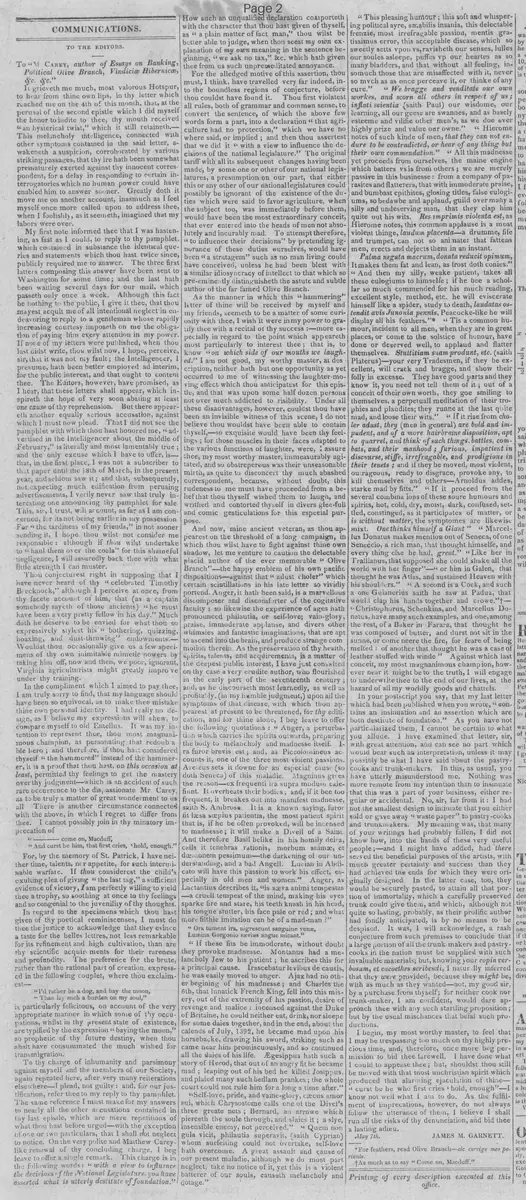
TO THE EDITORS.
To "V Carey, author of Essays on Banking: Political Olive Branch, Vindiciæ Hibernicæ &c. &c."
It grieveth me much, most valorous Hotspur, to hear from thine own lips, in thy letter which reached me on the 4th of this month, that, at the perusal of the second epistle which I did myself the honor to indite to thee, thy mouth received "an hysterical twist," which it still retaineth.—
This melancholy intelligence, connected with other symptoms contained in the said letter, awakeneth a suspicion, corroborated by various striking passages, that thy ire hath been somewhat prematurely exerted against thy innocent correspondent, for a delay in responding to certain interrogatories which no human power could have enabled him to answer sooner. Greatly doth it move me on another account, inasmuch as I feel myself once more called upon to address thee, when I foolishly, as it seemeth, imagined that my labors were over.
My first note informed thee that I was hastening, as fast as I could, to reply to thy pamphlet, which contained in substance the identical queries and statements which thou hast twice since, publicly required me to answer. The three first letters composing this answer have been sent to Washington for some time; and the last hath been waiting several days for our mail, which passeth only once a week. Although this fact be nothing to the public, I give it thee, that thou mayest acquit me of all intentional neglect in endeavoring to reply to a gentleman whose rapidly increasing courtesy imposeth on me the obligation of paying him every attention in my power.
If none of my letters were published, when thou last didst write, thou wilt now, I hope, perceive, sir, that it was not my fault; the Intelligencer, I presume, hath been better employed ad interim, for the public interest, and that ought to content thee. The Editors, however, have promised, as I hear, that these letters shall appear, which inspireth the hope of very soon abating at least one cause of thy reprehension. But there appeareth another equally serious accusation, against which I must now plead. That I did not see the pamphlet with which thou hast honored me, "advertised in the Intelligencer about the middle of February," is literally and most lamentably true; and the only excuse which I have to offer, is-- that, in the first place, I was not a subscriber to that paper until the 18th of March, in the present year, and seldom saw it; and that, subsequently, not expecting much edification from perusing advertisements, I verily never saw that truly interesting one announcing thy pamphlet for sale.
This, sir, I trust, will account, as far as I am concerned, for its not being earlier in my possession. For "the tardiness of my friends," in not sooner sending it, I hope thou wilt not consider me responsible: although if thou wilt undertake to "haul them over the coals" for this shameful negligence, I will assuredly back thee with what little strength I can muster.
Thou conjecturest right in supposing that I have never heard of thy "celebrated Timothy Brecknock," although I perceive at once, from thy facete account of him, that (as a captain somebody sayeth of those ancients) "he must have been a very pretty fellow in his day." Much doth he deserve to be envied for what thou so expressively stylest his "bothering, quizzing, hoaxing, and dust-throwing" endowments.—
Wouldst thou occasionally give us a few specimens of thy own inimitable mimetic powers by taking him off, now and then, we poor, ignorant Virginia agriculturists might greatly improve under thy training.
In the compliment which I aimed to pay thee, I am truly sorry to find, that my language should have been so equivocal, as to make thee mistake thine own personal identity. I had really no design, as I believe my expressions will shew, to compare myself to old Entellus. It was my intention to represent thee, thou most magnanimous champion, as personating that redoubtable hero; and therefore, if thou hast considered thyself "the hammered" instead of the hammerer, it is a proof that thou hast, on this occasion at least, permitted thy feelings to get the mastery over thy judgment—which is an accident of such rare occurrence to the dispassionate Mr Carey as to be truly a matter of great wonderment to us all. There is another circumstance connected with the above, in which I regret to differ from thee. I cannot possibly join in thy minatory imprecation of
come on, Macduff
"And curst be him, that first cries, hold, enough."
For, by the memory of St. Patrick, I have neither time, talents, nor appetite, for such interminable warfare. If thou considerest the child's exulting plea of giving "the last tag," a sufficient evidence of victory, I am perfectly willing to yield thee a trophy, so soothing at once to thy feelings and so congenial to the juvenility of thy thoughts.
In regard to the specimens which thou hast given of thy poetical reminiscences, I must do thee the justice to acknowledge that they evince a taste for the belles lettres, not less remarkable for its refinement and high cultivation, than are thy scientific acquirement for their rareness and profundity. The preference for the brute, rather than the rational part of creation, expressed in the following couplet, where thou exclaimest
"I'd rather be a dog, and bay the moon,
Than lay such a burden on my soul,"
is particularly felicitous, on account of the very appropriate manner in which some of thy occupations, whilst in thy present state of existence, are typified by the expression "baying the moon," so prophetic of thy future destiny, when thou shalt have consummated the much wished for transmigration.
To thy charge of inhumanity and parsimony against myself and the members of our Society, again repeated here, after very many reiterations elsewhere—I plead, not guilty: and, for our justification, refer thee to my reply to thy pamphlet. The same reference I must make for my answers to nearly all the other accusations contained in thy last epistle, which are mere repetitions of what thou hast before urged—with the exception of one or two particulars, that I shall not neglect to notice. On the very polite and Matthew Carey-like renewal of thy concluding charge, I beg leave to offer a single remark. This charge is in the following words: "with a view to influence the decisions of the National Legislature, you have asserted what is utterly destitute of foundation."
How such an unqualified declaration comporteth with the character that thou hast given of thyself, as "a plain matter of fact man," thou wilt be better able to judge, when thou seest my own explanation of my own meaning in the sentence beginning, "we ask no tax," &c. which hath given thee from us such unpremeditated annoyance.
For the alleged motive of this assertion, thou must, I think, have travelled very far indeed, into the boundless regions of conjecture, before thou couldst have found it. Thou first violatest all rules, both of grammar and common sense, to convert the sentence, of which the above few words form a part, into a declaration "that agriculture had no protection," which we have no where said, or implied; and then thou assertest that we did it "with a view to influence the decisions of the national legislature." The original tariff with all its subsequent changes having been made, by some one or other of our national legislatures, a presumption on our part, that either this or any other of our national legislatures could possibly be ignorant of the existence of the duties which were said to favor agriculture, when the subject too, was immediately before them, would have been the most extraordinary conceit, that ever entered into the heads of men not absolutely and incurably mad. To attempt therefore, "to influence their decisions" by pretending ignorance of these duties ourselves, would have been "a stratagem" such as no man living could have conceived, unless he had been blest with a similar idiosyncracy of intellect to that which so pre-eminently distinguisheth the astute and subtle author of the far famed Olive Branch.
As the manner in which this "hammering" letter of thine will be received by myself and my friends, seemeth to be a matter of some curiosity with thee, I wish it were in my power to gratify thee with a recital of thy success:—more especially in regard to the point which appeareth most particularly to interest thee; that is, to know "on which side of our mouths we laughed." I am not good, my worthy master, at description, neither hath but one opportunity as yet occurred to me of witnessing the laughter-moving effect which thou anticipatest for this epistle, and that was upon some half dozen persons not over much addicted to risibility. Under all these disadvantages, however, couldst thou have been an invisible witness of this scene, I do not believe thou wouldst have been able to contain thyself,—so exquisite would have been thy feelings; for those muscles in their faces adapted to the various functions of laughter, were, I assure thee, my most worthy master, inmeasurably agitated, and so obstreperous was their unseasonable mirth, as quite to disconcert thy much abashed correspondent, because, without doubt, this rudeness to me must have proceeded from a belief that thou thyself wished them to laugh, and writhed and contorted thyself in divers glee-full and comic gesticulations for this especial purpose.
And now, mine ancient veteran, as thou appearest on the threshold of a long campaign, in which thou wilt have to fight against thine own shadow, let me venture to caution the delectable placid author of the ever memorable Olive Branch'—the happy emblem of his own pacific dispositions—against that "adust choler" which certain scintillations in his late letter so vividly portend. Anger, it hath been said, is a marvellous discomposer and discomforter of the cogitative faculty: so likewise the experience of ages hath pronounced philautia, or self-love; vain-glory, praise, immoderate applause, and divers other whimsies and fantastic imaginations, that are apt to ascend into the brain, and produce strange commotion therein. As the preservation of thy health, spirits, talents, and acquirements, is a matter of the deepest public interest, I have just consulted on thy case a very erudite author, who flourished in the early part of the seventeenth century; and, as he discourseth most learnedly, as well as profitably, (in my humble judgment,) upon all the symptoms of that disease, with which thou appearest at present to be threatened, for thy edification, and for thine alone, I beg leave to offer the following quotations: "Anger, a perturbation which carries the spirits outwards, preparing the body to melancholy and madness itself. Ira furor brevis est; and, as Piccolomineus accounts it, one of the three most violent passions. Aretaeus sets it down for an especial cause (so doth Seneca) of this malady. Magninus gives the reason—ex frequenti ira supra modum calefiunt. It overheats their bodies; and, if it be too frequent, it breaks out into manifest madness, saith S. Ambrose. It is a known saying, furor fit læsa saepius patientia, the most patient spirit that is, if he be often provoked, will be incensed to madness; it will make a Devil of a Saint. And therefore Basil belike in his homily de ira, calls it tenebras rationis, morbum animae, et daemonem pessimum—the darkening of our understanding, and a bad Angel. Lucian in Abdicato will have this passion to work his effect, especially in old men and women." Anger, as Lactantius describes it, "is sava animi tempestas—a cruel tempest of the mind, making his eyes sparkle fire and stare, his teeth gnash in his head, his tongue stutter, his face pale or red; and what more filthy imitation can be of a mad-man?"
"Ora tument ira, nigrescunt sanguine venae,
Lumina Gorgonio saevior angue micant."
"If these fits be immoderate, without doubt they provoke madness. Montanus had a melancholy Jew to his patient; he ascribes this for a principal cause. Irascebatur levibus de causis, he was easily moved to anger. Ajax had no other beginning of his madness; and Charles the 6th, that lunatic French King, fell into this misery, out of the extremity of his passion, desire of revenge and malice: incensed against the Duke of Britaine, he could neither eat, drink, nor sleep for some days together, and in the end, about the calends of July, 1392, he became mad upon his horseback, drawing his sword, striking such as came near him promiscuously, and so continued all the days of his life. Egesippus hath such a story of Herod, that out of an angry fit he became mad; leaping out of his bed he killed Josippus, and played many such bedlam pranks; the whole court could not rule him for a long time after."
"Self-love, pride, and vain-glory, cæcus amor sui, which Chrysostom calls one of the Devil's three great nets; Bernard, an arrow which pierceth the soul through, and slays it; a sly, insensible enemy, not perceived." "Quem non gula vicit, philautia superavit, (saith Cyprian) whom surfeiting could not overtake, self-love hath overcome. A great assault and cause of our present malady, although we do most part neglect, take no notice of it, yet this is a violent batterer of our souls, causeth melancholy and dotage."
"This pleasing humour; this soft and whispering political ayre, amabilis insania, this delectable frenzie, most irrefragable passion, mentis gratissimus error, this acceptable disease, which so sweetly sets upon us, ravishes our senses, lulls our souls asleep, puffs up our hearts as so many bladders, and that without all feeling, insomuch those that are misaffected with it, never so much as once perceive it, or think of any cure." "We brag and venditate our own works, and scorn all others in respect of us; inflati scientia (saith Paul) our wisdom, our learning, all our geese are swans, and as basely esteem and vilify other men's, as we do ever highly prize and value our own." "Hierome notes of such kind of men, that they can not endure to be contradicted, or hear of any thing but their own commendation." "All this madness yet proceeds from ourselves, the main engine which batters us is from others; we are merely passive in this business: from a company of parasites and flatterers, that with immoderate praise, and bumbast epithets, glozing titles, false eulogiums, so bedawb and applaud, guild over many a silly and undeserving man, that they clap him quite out his wits. Res prima vis violenta est, as Hierome notes, this common applause is a most violent thing, laudum placenta—a drum, fife and trumpet, can not so animate: that fattens men, erects and dejects them in an instant.
Palma negata macrum, donata reducit opimum,
It makes them fat and lean, as frost doth conies."
"And then my silly, weak patient, takes all these eulogiums to himself; if he be a scholar so much commended for his much reading, excellent style, method, etc. he will eviscerate himself like a spider, study to death, laudatas ostendit avis Junonia pennis, Peacock-like he will display all his feathers."* "Tis a common humour, incident to all men, when they are in great places, or come to the solstice of honour, have done or deserved well, to applaud and flatter themselves. Stultitiam suam produnt, etc. (saith Platerus)—your very Tradesmen, if they be excellent, will crack and brag, and show their folly in excess. They have good parts and they know it, you need not tell them of it; out of a conceit of their own worth, they go smiling to themselves, a perpetual meditation of their trophies and plaudites; they run at the last quite mad, and lose their wits." "If it rise from choler adust, they (men in general) are bold and impudent, and of a more hairbrain disposition, apt to quarrel, and think of such things, battles, combats, and their manhood; furious, impatient in discourse, stiff, irrefragable, and prodigious in their tenets; and if they be moved, most violent, outrageous, ready to disgrace, provoke any, to kill themselves and others—Arnoldus adds, stark mad by fits." "If it proceed from the several combinations of these sour humours and spirits, hot, cold, dry, moist, dark, confused, settled, constinged, as it participates of matter, or is without matter, the symptoms are likewise mixt. One thinks himself a Giant." "Marcel-lus Donatus makes mention out of Seneca, of one Seneccio, a rich man, that thought himself, and every thing else he had, great." "Like her in Trallianus, that supposed she could shake all the world with her finger"—"or him in Galen, that thought he was Atlas, and sustained Heaven with his shoulders." "A second is a Cock, and such a one Guianerius saith he saw at Padua, that would clap his hands together and crow."—
"Christophorus, Schenkens, and Marcellus Donatus, have many such examples, and one, among the rest, of a Baker in Ferrara, that thought he was composed of butter, and durst not sit in the sunne, or come near the fire, for fear of being melted: of another that thought he was a case of leather stuffed with wind." Against which last conceit, my most magnanimous champion, how-ever near it might be to the truth, I will engage to underwrite thee to the end of our lives, at the hazard of all my worldly goods and chattels.
In your postscript you say, that my last letter which had been published when you wrote, "contains an insinuation and an assertion which are both destitute of foundation." As you have not particularized them, I cannot be certain to what you allude. I have examined that letter, sir, with great attention, and can see no part which would bear such an interpretation, unless it may possibly be what I have said about the pastry-cooks and trunk-makers. In this, as usual, you have utterly misunderstood me. Nothing was more remote from my intention than to insinuate that this was a part of your business, either regular or accidental. No, sir, far from it: I had not the smallest design to intimate that you either sold or gave away "waste paper" to pastry-cooks and trunkmakers. My meaning was, that many of your writings had probably fallen, I did not know how, into the hands of these very useful people;—and I might have added, had there served the beneficial purposes of the artists, with much greater certainty and success than they had achieved the ends for which they were originally designed. In the latter case, too, they would be securely pasted, to attain all that portion of immortality, which a carefully preserved trunk could give them, and which, although not quite so lasting, probably, as their prolific author had fondly anticipated, is by no means to be despised. It was, I will acknowledge, a rash conjecture from such premises to conclude that a large portion of all the trunk-makers and pastry-cooks in the nation must be supplied with such invaluable materials; but, knowing your copia verborum, et cacoethes scribendi, I naturally inferred that they were provided, because they might be, with as much as they wanted—not, my good sir, by a purchase from thyself; for neither cook nor trunk-maker, I am confident, would dare approach thee with any such startling proposition; but by the usual mischances that befall such productions.
I begin, my most worthy master, to feel that I may be trespassing too much on thy highly precious time, and, therefore, once more beg permission to bid thee farewell. I have done what I could to appease thee; but, shouldst thou still be moved with that most unchristian spirit which produced that alarming ejaculation of thine— "curst be he who first cries 'hold, enough'"—I know not well what I am to do. As the fulfilment of imprecations, however, do not always follow the utterance of them, I believe I shall run all the risks of thy denunciation, and bid thee a lasting adieu.
JAMES M. GARNETT.
*For feathers, read Olive Branch—sic corrige meo periculo.
†As much as to say "Come on, Macduff."
Printing of every description executed at this office.
What sub-type of article is it?
What themes does it cover?
What keywords are associated?
What entities or persons were involved?
Letter to Editor Details
Author
James M. Garnett
Recipient
V Carey, Author Of Essays On Banking: Political Olive Branch, Vindiciæ Hibernicæ &C. &C.
Main Argument
garnett defends against carey's accusations of delay and misrepresentation in economic debates on tariffs and agriculture protection, clarifying his statements and satirically critiquing carey's anger and motives to end the exchange.
Notable Details