Thank you for visiting SNEWPapers!
Sign up free
Editorial
October 4, 1942
Imperial Valley Press
El Centro, Imperial County, California
What is this article about?
Editorial warns of censorship dangers using President Roosevelt's secret wartime tour as example, arguing that voluntary press cooperation hid his travels, but compulsory censorship could enable dictatorial control over news, opinion, and democracy, as seen in Germany.
Clipping
OCR Quality
98%
Excellent
Full Text
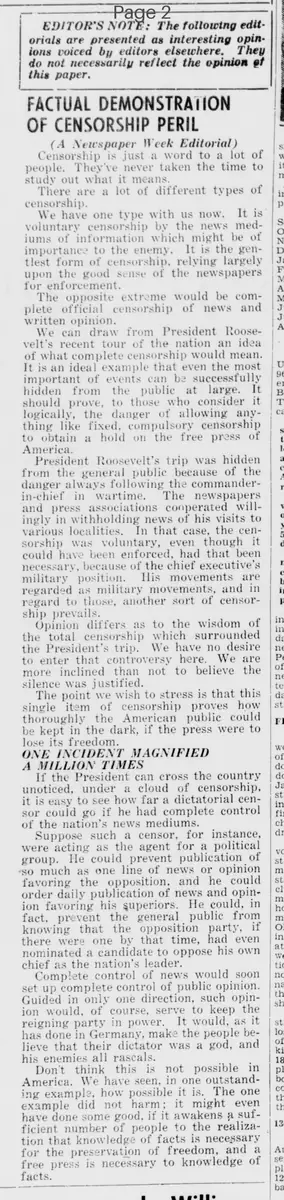
EDITOR'S NOTE: The following editorials are presented as interesting opinions voiced by editors elsewhere. They do not necessarily reflect the opinion of this paper.
FACTUAL DEMONSTRATION
OF CENSORSHIP PERIL
(A Newspaper Week Editorial)
Censorship is just a word to a lot of people. They've never taken the time to study out what it means.
There are a lot of different types of censorship.
We have one type with us now. It is voluntary censorship by the news mediums of information which might be of importance to the enemy. It is the gentlest form of censorship, relying largely upon the good sense of the newspapers for enforcement.
The opposite extreme would be complete official censorship of news and written opinion.
We can draw from President Roosevelt's recent tour of the nation an idea of what complete censorship would mean. It is an ideal example that even the most important of events can be successfully hidden from the public at large. It should prove, to those who consider it logically, the danger of allowing anything like fixed, compulsory censorship to obtain a hold on the free press of America.
President Roosevelt's trip was hidden from the general public because of the danger always following the commander-in-chief in wartime. The newspapers and press associations cooperated willingly in withholding news of his visits to various localities. In that case, the censorship was voluntary, even though it could have been enforced, had that been necessary, because of the chief executive's military position. His movements are regarded as military movements, and in regard to those, another sort of censorship prevails.
Opinion differs as to the wisdom of the total censorship which surrounded the President's trip. We have no desire to enter that controversy here. We are more inclined than not to believe the silence was justified.
The point we wish to stress is that this single item of censorship proves how thoroughly the American public could be kept in the dark, if the press were to lose its freedom.
ONE INCIDENT MAGNIFIED
A MILLION TIMES
If the President can cross the country unnoticed, under a cloud of censorship, it is easy to see how far a dictatorial censor could go if he had complete control of the nation's news mediums.
Suppose such a censor, for instance, were acting as the agent for a political group. He could prevent publication of so much as one line of news or opinion favoring the opposition, and he could order daily publication of news and opinion favoring his superiors. He could, in fact, prevent the general public from knowing that the opposition party, if there were one by that time, had even nominated a candidate to oppose his own chief as the nation's leader.
Complete control of news would soon set up complete control of public opinion. Guided in only one direction, such opinion would, of course, serve to keep the reigning party in power. It would, as it has done in Germany, make the people believe that their dictator was a god, and his enemies all rascals.
Don't think this is not possible in America. We have seen, in one outstanding example, how possible it is. The one example did not harm; it might even have done some good, if it awakens a sufficient number of people to the realization that knowledge of facts is necessary for the preservation of freedom, and a free press is necessary to knowledge of facts.
FACTUAL DEMONSTRATION
OF CENSORSHIP PERIL
(A Newspaper Week Editorial)
Censorship is just a word to a lot of people. They've never taken the time to study out what it means.
There are a lot of different types of censorship.
We have one type with us now. It is voluntary censorship by the news mediums of information which might be of importance to the enemy. It is the gentlest form of censorship, relying largely upon the good sense of the newspapers for enforcement.
The opposite extreme would be complete official censorship of news and written opinion.
We can draw from President Roosevelt's recent tour of the nation an idea of what complete censorship would mean. It is an ideal example that even the most important of events can be successfully hidden from the public at large. It should prove, to those who consider it logically, the danger of allowing anything like fixed, compulsory censorship to obtain a hold on the free press of America.
President Roosevelt's trip was hidden from the general public because of the danger always following the commander-in-chief in wartime. The newspapers and press associations cooperated willingly in withholding news of his visits to various localities. In that case, the censorship was voluntary, even though it could have been enforced, had that been necessary, because of the chief executive's military position. His movements are regarded as military movements, and in regard to those, another sort of censorship prevails.
Opinion differs as to the wisdom of the total censorship which surrounded the President's trip. We have no desire to enter that controversy here. We are more inclined than not to believe the silence was justified.
The point we wish to stress is that this single item of censorship proves how thoroughly the American public could be kept in the dark, if the press were to lose its freedom.
ONE INCIDENT MAGNIFIED
A MILLION TIMES
If the President can cross the country unnoticed, under a cloud of censorship, it is easy to see how far a dictatorial censor could go if he had complete control of the nation's news mediums.
Suppose such a censor, for instance, were acting as the agent for a political group. He could prevent publication of so much as one line of news or opinion favoring the opposition, and he could order daily publication of news and opinion favoring his superiors. He could, in fact, prevent the general public from knowing that the opposition party, if there were one by that time, had even nominated a candidate to oppose his own chief as the nation's leader.
Complete control of news would soon set up complete control of public opinion. Guided in only one direction, such opinion would, of course, serve to keep the reigning party in power. It would, as it has done in Germany, make the people believe that their dictator was a god, and his enemies all rascals.
Don't think this is not possible in America. We have seen, in one outstanding example, how possible it is. The one example did not harm; it might even have done some good, if it awakens a sufficient number of people to the realization that knowledge of facts is necessary for the preservation of freedom, and a free press is necessary to knowledge of facts.
What sub-type of article is it?
Press Freedom
What keywords are associated?
Censorship
Free Press
Roosevelt Tour
Wartime Secrecy
Public Opinion Control
Dictatorship
What entities or persons were involved?
President Roosevelt
American Press
Dictatorial Censor
Germany
Editorial Details
Primary Topic
Dangers Of Censorship Illustrated By Roosevelt's Secret Tour
Stance / Tone
Cautionary Warning Against Compulsory Censorship
Key Figures
President Roosevelt
American Press
Dictatorial Censor
Germany
Key Arguments
Censorship Can Effectively Hide Major Events From The Public, As Demonstrated By Roosevelt's Unnoticed Wartime Tour
Voluntary Censorship Relies On Press Goodwill But Could Be Enforced Militarily
Compulsory Censorship Would Allow Total Control Over News And Opinion, Suppressing Opposition
Control Of News Leads To Manipulated Public Opinion And Perpetuation Of Dictatorial Power
Free Press Is Essential For Factual Knowledge And Preserving Freedom