Thank you for visiting SNEWPapers!
Sign up free
Daily National Intelligencer
Washington, District Of Columbia
What is this article about?
Newspaper article presents letters: William Cobbett defends Commodore David Porter against a slanderous attack in the British Quarterly Review on Porter's conduct during the USS Essex cruise in the War of 1812; Porter replies, explaining his experiences and countering British naval criticisms.
Clipping
OCR Quality
Full Text
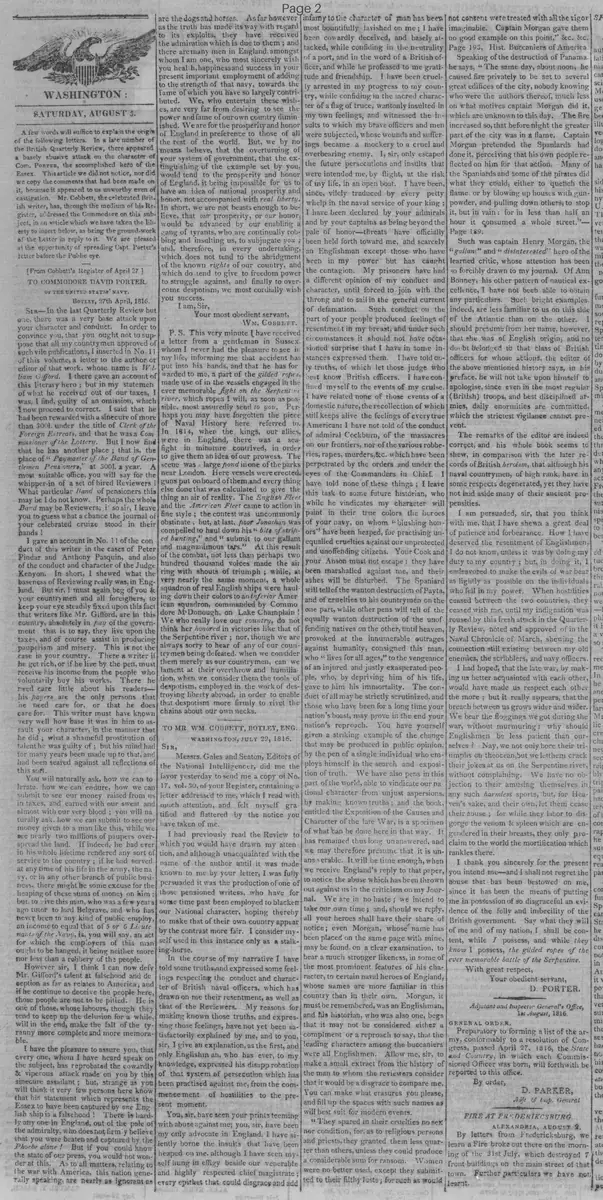
A few words will suffice to explain the origin of the following letters. In a late number of the British Quarterly Review, there appeared a basely abusive attack on the character of Com. Porter, the accomplished hero of the Essex. This article we did not notice, nor did we copy the comments that had been made on it, because it appeared to us unworthy even of castigation. Mr. Cobbett, the celebrated British writer, has, through the medium of his Register, addressed the Commodore on this subject, in an article which we have taken the liberty to insert below, as being the ground-work of the Letter in reply to it. We are pleased at the opportunity of spreading Capt. Porter's letter before the Public eye.
[From Cobbett's Register of April 27]
TO COMMODORE DAVID PORTER OF THE UNITED STATES' NAVY.
BOTLEY, 27th April, 1816.
SIR--In the last Quarterly Review but one, there was a very base attack upon your character and conduct. In order to convince you, that you ought not to suppose that all my countrymen approved of such vile publications, I inserted in No. 11 of this volume, a letter to the author or editor of that work, whose name is William Gifford. I there gave an account of this literary hero; but in my statement of what he received out of our taxes, I was, I find, guilty of an omission, which I now proceed to correct. I said that he had been rewarded with a sinecure of more than £300 under the title of Clerk of the Foreign Estreats, and that he was a Commissioner of the Lottery. But I now find that he has another place; that is, the place of "Paymaster of the Band of Gentlemen Pensioners," at £500 a year. A most suitable office, you will say for the whipper-in of a set of hired Reviewers! What particular Band of pensioners this may be I do not know. Perhaps the whole Band may be Reviewers; if so sir, I leave you to guess what a chance the journal of your celebrated cruize stood in their hands!
I gave an account in No. 11 of the conduct of this writer in the cases of Peter Pindar and Anthony Pasquin, and also of the conduct and character of the Judge Kenyon. In short, I shewed what the baseness of Reviewing really was, in England. But sir, I must again beg of you & your countrymen and all foreigners, to keep your eye steadily fixed upon this fact that writers like Mr. Gifford, are in this country, absolutely in pay of the government, that is to say, they live upon the taxes, and of course assist in producing pauperism and misery. This is not the case in your country. There a writer if he get rich, or if he live by the pen, must receive his income from the people who voluntarily buy his works. There he need care little about his readers--his buyers are the only persons that he need care for, or that he does care for. This writer must have known very well how base it was in him to assault your character, in the manner that he did; what a shameful prostitution of talent he was guilty of; but his mind had for many years been made up to that, and had been seared against all reflections of this sort.
You will naturally ask, how we can tolerate, how we can endure, how we can submit to see our money raised from us in taxes, and earned with our sweat and almost with our very blood; you will naturally ask, how we can submit to see our money given to a man like this, while we see nearly two millions of paupers overspread the land. If indeed, he had ever in his whole lifetime rendered any sort of service to the country: if he had served, at any time of his life in the army, the navy, or in any other branch of public business, there might be some excuse for the heaping of these sums of money on him; but, to give this man, who was a few years ago tutor to lord Belgrave, and who has never been in any kind of public employ, an income to equal that of 5 or 6 Lieutenants of the Navy, is, you will say, an act for which the employers of this man ought to be hanged, it being neither more nor less than a robbery of the people.
However sir, I think I can now defy Mr. Gifford's talent at falsehood and deception as far as relates to America; and if he continue to deceive the people here, those people are not to be pitied. He is one of those, whose labours, though they tend to keep up the delusion for a while, will in the end, make the fall of the tyranny more complete and more memorable.
I have the pleasure to assure you, that every one, whom I have heard speak on the subject, has reprobated the cowardly & viperous attack made on you by this sinecure assailant; but, strange as you will think it very few persons here know that his statement which represents the Essex to have been captured by one English ship is a falsehood! There is hardly any one in England, out of the pale of the admiralty, who does not firmly believe that you were beaten and captured by the Phoebe alone! But if you could know the state of our press, you would not wonder at this. As to all matters, relating to the war with America, this nation generally speaking, are nearly as ignorant as are the dogs and horses. As far however as the truth has made its way with regard to its exploits, they have received the admiration which is due to them; and there are many men in England, amongst whom I am one, who most sincerely wish you health, happiness and success in your present important employment of adding to the strength of that navy, towards the fame of which you have so largely contributed. We, who entertain these wishes, are very far from desiring to see the power and fame of our own country diminished. We are for the prosperity and honor of England in preference to those of all the rest of the world. But, we by no means believe, that the overturning of your system of government, that the extinguishing of the example set by you, would tend to the prosperity and honor of England, it being impossible for us to have an idea of national prosperity and honor, not accompanied with real liberty.
In short, we are not beasts enough to believe, that our prosperity, or our honor would be advanced by our enabling a gang of tyrants, who are continually robbing and insulting us, to subjugate you; and, therefore, in every undertaking, which does not tend to the abridgment of the known rights of our country, and which do tend to give to freedom power to struggle against, and finally to overcome despotism, we most cordially wish you success.
I am, Sir,
Your most obedient servant,
WM. COBBETT.
P. S. This very minute I have received a letter from a gentleman in Sussex whom I never had the pleasure to see in my life, informing me that accident has put into his hands, and that he has forwarded to me, a part of the gilded ropes made use of in the vessels engaged in the ever memorable fight on the Serpentine river, which ropes I will, as soon as possible, most assuredly send to you. Perhaps you may have forgotten the piece of Naval History here referred to. In 1814, when the kings, our allies, were in England, there was a sea-fight in miniature contrived, in order to give them an idea of our prowess. The scene was a large pond in one of the parks near London. Here vessels were erected, guns put onboard of them, and every thing else done that was calculated to give the thing an air of reality. The English Fleet and the American Fleet came to action in fine style; the contest was uncommonly obstinate: but, at last, poor Jonathan was compelled to haul down his "bite of striped bunting," and "submit to our gallant and magnanimous tars." At this result of the combat, not less than perhaps two hundred thousand voices made the air ring with shouts of triumph: while, at very nearly the same moment, a whole squadron of real English ships were hauling down their colors to an inferior American squadron, commanded by Commodore M'Donough, on Lake Champlain!
We who really love our country, do not think her honored in victories like that of the Serpentine river; nor, though we are always sorry to hear of any of our countrymen being defeated, when we consider them merely as our countrymen, can we lament at their overthrow and humiliation, when we consider them the tools of despotism, employed in the work of destroying liberty abroad, in order to enable that despotism more firmly to rivet the chains about our own necks.
TO MR WM. COBBETT. BOTLEY. ENG.
WASHINGTON. JULY 29, 1816.
SIR,
Messrs. Gales and Seaton, Editors of the National Intelligencer, did me the favor yesterday to send me a copy of No. 17, vol. 30, of your Register, containing a letter addressed to me, which I read with much attention, and felt myself gratified and flattered by the notice you have taken of me.
I had previously read the Review to which you would have drawn my attention, and although unacquainted with the name of the author until it was made known to me by your letter, I was fully persuaded it was the production of one of those pensioned writers, who have for some time past been employed to blacken our National character, hoping thereby to make that of their own country appear by the contrast more fair. I consider myself used in this instance only as a stalking-horse.
In the course of my narrative I have told some truths, and expressed some feelings respecting the conduct and character of British naval officers, which has drawn on me their resentment, as well as that of the Reviewers. My reasons for making known those truths, and expressing those feelings, have not yet been satisfactorily explained by me, and to you, sir, I give an explanation, as the first, and only Englishman, who has ever, to my knowledge, expressed his disapprobation of that system of persecution which has been practised against me, from the commencement of hostilities to the present moment.
You, sir, have seen your prints teeming with abuse against me; you, sir, have been my only advocate in England. I have silently borne the insults that have been heaped on me, although I have seen myself hung in effigy beside our venerable and highly respected chief magistrate; every epithet that could disgrace and add infamy to the character of man has been most bountifully lavished on me; I have been cowardly deceived, and basely attacked, while confiding in the neutrality of a port, and in the word of a British officer, and while he professed to me gratitude and friendship. I have been cruelly arrested in my progress to my country, while confiding in the sacred character of a flag of truce, wantonly insulted in my own feelings, and witnessed the insults to which my brave officers and men were subjected, whose wounds and sufferings became a mockery to a cruel and overbearing enemy. I, sir, only escaped the future persecutions and insults that were intended me, by flight, at the risk of my life, in an open boat. I have been, since, vilely traduced by every petty whelp in the naval service of your king; I have been declared by your admirals and by your captains as being beyond the pale of honor--threats have officially been held forth toward me, and scarcely an Englishman except those who have been in my power but has caught the contagion. My prisoners have had a different opinion of my conduct and character, until forced to join with the throng and to sail in the general current of defamation. Such conduct on the part of your people produced feelings of resentment in my breast, and under such circumstances it should not have occasioned surprise that I have in some instances expressed them. I have told only truths, of which let those judge who best know British officers. I have confined myself to the events of my cruise. I have related none of those events of a domestic nature, the recollection of which still keeps alive the feelings of every true American: I have not told of the conduct of admiral Cockburn, of the massacres on our frontiers, nor of the various robberies, rapes, murders, &c. which have been perpetrated by the orders and under the eyes of the Commanders in Chief. I have told none of these things; I leave this task to some future historian, who while he vindicates my character will paint in their true colors the heroes of your navy, on whom "blushing honors" have been heaped, for practising unequalled cruelties against our unprotected and unoffending citizens. Your Cook and your Anson must not escape: they have been marshalled against me, and their ashes will be disturbed. The Spaniard will tell of the wanton destruction of Payta, and of cruelties to his countrymen on the one part, while other pens will tell of the equally wanton destruction of the unoffending natives on the other, until heaven, provoked at the innumerable outrages against humanity, consigned this man, who "lives for all ages," to the vengeance of an injured and justly exasperated people, who, by depriving him of his life, gave to him his immortality. The conduct of all may be strictly scrutinized, and those who have been for a long time your nation's boast, may prove in the end your nation's reproach. You have yourself given a striking example of the change that may be produced in public opinion, by the pen of a single individual who employs himself in the search and exposition of truth. We have also pens in this part of the world, able to vindicate our national character from unjust aspersions, by making known truths; and the book, entitled the Exposition of the Causes and Character of the late War, is a specimen of what can be done here in that way. It has remained thus long unanswered, and we may therefore presume that it is unanswerable. It will be time enough, when we receive England's reply to that paper, to notice the abuse which has been thrown out against us in the criticism on my Journal. We are in no haste; we intend to take our own time; and, should we reply, all your heroes shall have their share of notice; even Morgan, whose name has been placed on the same page with mine, may be found, on a clear examination, to bear a much stronger likeness, in some of the most prominent features of his character, to certain naval heroes of England, whose names are more familiar in this country than in their own. Morgan, it must be remembered, was an Englishman, and his historian, who was also one, begs that it may not be considered either a compliment or a reproach to say, that the leading characters among the buccaniers were all Englishmen. Allow me, sir, to make a small extract from the history of the man to whom the reviewers consider that it would be a disgrace to compare me. You can make what erasures you please, and fill up the spaces with such names as will best suit for modern events.
"They spared in their cruelties no sex nor condition, for, as to religious persons and priests, they granted them less quarter than others, unless they could produce a considerable sum for ransom. Women were no better used, except they submitted to their filthy lusts; or such as would not consent were treated with all the rigor imaginable. Captain Morgan gave them no good example on this point," &c. &c.
Page 193, Hist. Buccaniers of America.
Speaking of the destruction of Panama. he says; "The same day, about noon, he caused fire privately to be set to several great edifices of the city, nobody knowing who were the authors thereof, much less on what motives captain Morgan did it, which are unknown to this day. The fire increased so, that before night the greater part of the city was in a flame. Captain Morgan pretended the Spaniards had done it, perceiving that his own people reflected on him or that action. Many of the Spaniards and some of the pirates did what they could, either to quench the flame, or by blowing up houses with gunpowder, and pulling down others, to stop it, but in vain: for in less than half an hour it consumed a whole street."
Page 189
Such was captain Henry Morgan, the "gallant" and "disinterested" hero of the learned critic, whose attention has been so forcibly drawn to my journal. Of Ann Bonney; his other pattern of nautical excellence, I have not been able to obtain any particulars. Such bright examples, indeed, are less familiar to us on this side of the Atlantic than on the other. I should presume from her name, however, that she was of English origin, and no doubt belonged to that Class of British officers for whose actions, the editor of the above mentioned history says, in his preface, he will not take upon himself to apologise, since even in the most regular (British) troops, and best disciplined armies, daily enormities are committed, which the strictest vigilance cannot prevent.
The remarks of the editor are indeed correct, and his whole book seems to shew, in comparison with the later records of British heroism, that although his naval countrymen, of high rank, have in some respects degenerated, yet they have not laid aside many of their ancient propensities.
I am persuaded, sir, that you think with me, that I have shewn a great deal of patience and forbearance. How I have deserved the resentment of Englishmen, I do not know, unless it was by doing my duty to my country: but, in doing it, I endeavored to make the evils of war bear as lightly as possible on the individuals who fell in my power. When hostilities ceased between the two countries, they ceased with me, until my indignation was roused by this fresh attack in the Quarterly Review, noted and approved of in the Naval Chronicle of March, shewing the connection still existing between my old enemies, the scribblers, and navy officers. I had hoped, that the late war, by making us better acquainted with each other, would have made us respect each other the more; but it really appears, that the breach between us grows wider and wider. We bear the floggings we got during the war, without murmuring: why should Englishmen be less patient than ourselves? Nay, we not only bore their triumphs on the ocean, but we let them crack their jokes at us on the Serpentine river, without complaining. We have no objection to their amusing themselves in any such harmless sports, but, for Heaven's sake, and their own, let them cease their abuse; for while they labor to disgorge the venom & spleen which are engendered in their breasts, they only proclaim to the world the mortification which rankles there.
I thank you sincerely for the present you intend me--and I shall not regret the abuse that has been bestowed on me, since it has been the means of putting me in possession of so disgraceful an evidence of the folly and imbecility of the British government. Say what they will of me and of my nation, I shall be content, while I possess, and while they know I possess, the gilded ropes of the ever memorable battle of the Serpentine.
With great respect,
Your obedient servant,
D. PORTER.
What sub-type of article is it?
What themes does it cover?
What keywords are associated?
What entities or persons were involved?
Where did it happen?
Story Details
Key Persons
Location
England And Washington, D.C.
Event Date
1816
Story Details
William Cobbett writes to Commodore David Porter defending him against a slanderous article in the British Quarterly Review by William Gifford, criticizing Gifford's government patronage and misinformation about the USS Essex capture. Porter replies from Washington, thanking Cobbett, explaining his wartime experiences of British persecution, and countering with historical comparisons to British naval figures and buccaneers like Henry Morgan.