Thank you for visiting SNEWPapers!
Sign up free
Daily National Intelligencer
Washington, District Of Columbia
What is this article about?
An anonymous citizen argues against resuming specie payments amid economic expansion and proposes a federal-state banking system: select one bank per state for tax payments, create a national bank in Washington, and regulate private banks to restore bank notes to par value. Signed PELHAM.
Clipping
OCR Quality
Full Text
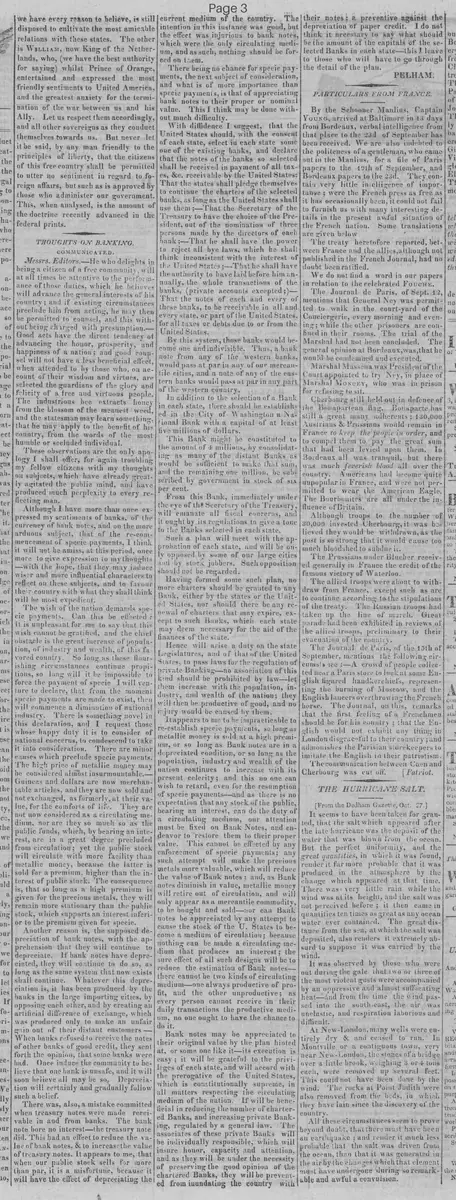
COMMUNICATED.
Messrs. Editors.—He who delights in being a citizen of a free community, will at all times be attentive to the performance of those duties, which he believes will advance the general interests of his country; and if existing circumstances preclude him from acting, he may then be permitted to counsel, and this without being charged with presumption.—Good acts have the direct tendency of advancing the honor, prosperity, and happiness of a nation; and good counsel will not have a less beneficial effect, when attended to by those who, on account of their wisdom and virtues, are selected the guardians of the glory and felicity of a free and virtuous people.
The industrious bee extracts honey from the blossom of the meanest weed, and the statesman may learn something that he may apply to the benefit of his country, from the words of the most humble or secluded individual.
These observations are the only apology I shall offer, for again troubling my fellow citizens with my thoughts on subjects, which have already greatly agitated the public mind, and have produced much perplexity to every reflecting man.
Although I have more than once expressed my sentiments of banks, of the currency of bank notes, and on the more arduous subject, that of the re-commencement of specie payments, I think it will not be amiss, at this period, once more to give expression to my thoughts—with the hope, that they may induce wiser and more influential characters to reflect on these subjects, and to favour their country with what they shall think will be most expedient.
The wish of the nation demands specie payments. Can this be effected? It is unpleasant for me to say that this wish cannot be gratified, and the chief obstacle is the great increase of population, of industry and wealth, of this favored country. So long as these flourishing circumstances continue propitious, so long will it be impossible to force the payment of specie. I will venture to declare, that from the moment specie payments are made to exist, then will commence a diminution of national industry. There is something novel in this declaration, and I request those whose happy duty it is to consider of national concerns, to condescend to take it into consideration. There are minor causes which preclude specie payments. The high price of metallic money may be considered almost insurmountable.—Guineas and dollars are now merchandize articles, and they are now sold and not exchanged, as formerly, at their value, for the comforts of life. They are not now considered as a circulating medium, nor are they so much so as the public funds, which, by bearing an interest, are in a great degree precluded from circulation; yet the public stock will circulate with more facility than metallic money, because the latter is sold for a premium higher than the interest of public stock. The consequence is, that so long as a high premium is given for the precious metals, they will remain more stationary than the public stock, which supports an interest inferior to the premium given for specie.
Another reason is, the supposed depreciation of bank notes, with the apprehension that they will continue to depreciate. If bank notes have depreciated, they will continue to do so, as long as the same system that now exists shall continue. Whatever this depreciation is, it has been produced by the banks in the large importing cities, by opposing each other, and by creating an artificial difference of exchange, which was produced only to make an unfair gain out of their distant customers—When banks refused to receive the notes of other banks of good credit, they sent forth the opinion, that some banks were bad. Once induce the community to believe that one bank is unsafe, and it will soon believe all may be so. Depreciation will certainly and gradually follow such a belief.
There was, also, a mistake committed when treasury notes were made receivable in and from banks. The bank note bore no interest; the treasury note did. This had an effect to reduce the value of bank notes, & to increase the value of treasury notes. It appears to me, that when our public stock sells for more than par, it is a misfortune, because it will have the effect of depreciating the current medium of the country. The intention in this instance was good, but the effect was injurious to bank notes, which were the only circulating medium, and as such, nothing should be forced on them.
There being no chance for specie payments, the next subject of consideration, and what is of more importance than specie payments, is that of appreciating bank notes to their proper or nominal value. This I think may be done without much difficulty.
With diffidence I suggest, that the United States should, with the consent of each state, select in each state some one of the existing banks, and declare that the notes of the banks so selected shall be received in payment of all taxes, &c. receivable by the United States: That the states shall pledge themselves to continue the charters of the selected banks, as long as the United States shall use them;—That the Secretary of the Treasury to have the choice of the President, out of the nomination of three persons made by the directors of each bank:—That he shall have the power to reject all bye laws, which he shall think inconsistent with the interest of the United States:—That he shall have the authority to have laid before him annually, the whole transactions of the banks, (private accounts excepted;)—That the notes of each and every of these banks, to be receivable in all and every state, or part of the United States, for all taxes or debts due to or from the United States.
By this system, those banks would become one and indivisible. Thus, a bank note from any of the western banks would pass at par in any of our mercantile cities, and a note of any of the eastern banks would pass at par in any part of the western country.
In addition to the selection of a Bank in each state, there should be established in the City of Washington a National Bank with a capital of at least five millions of dollars.
This Bank might be constituted to the amount of 4 millions, by consolidating as many of the distant Banks as would be sufficient to make that sum, and the remaining one million, be subscribed by government in stock of six per cent.
From this Bank, immediately under the eye of the Secretary of the Treasury, will emanate all fiscal concerns, and it ought by its regulations to give a tone to the Banks selected in each state.
Such a plan will meet with the approbation of each state, and will be only opposed by some of our large cities and by stock jobbers. Such opposition should not be regarded.
Having formed some such plan, no more charters should be granted to any Bank, either by the states or the United States, nor should there be any renewal of charters that may expire, except to such Banks, which each state may deem necessary for the aid of the finances of the state.
Hence will arise a duty on the state Legislatures, and of that of the United States, to pass laws for the regulation of private Banking—no association of this kind should be prohibited by law—let them increase with the population, industry, and wealth of the nation; they will then be productive of good, and no injury would be caused by them.
It appears to me to be impracticable to re-establish specie payments, so long as metallic money is sold at a high premium, or so long as Bank notes are in a depreciated condition, or so long as the population, industry and wealth of the nation continues to increase with its present celerity; and this no one can wish to retard, even for the resumption of specie payments—and as there is no expectation that any stock of the public, bearing an interest, can do the duty of a circulating medium, our attention must be fixed on Bank Notes, and endeavor to restore them to their proper value. This cannot be effected by any enforcement of specie payments; any such attempt will make the precious metals more valuable, which will reduce the value of Bank notes: and, as Bank notes diminish in value, metallic money will retire out of circulation, and will only appear as a mercantile commodity, to be bought and sold—nor can Bank notes be appreciated by any attempt to cause the stock of the U. States to become a medium of circulation; because nothing can be made a circulating medium that produces an interest; the sure effect of all such designs will be to reduce the estimation of Bank notes—there cannot be two kinds of circulating medium—one always productive of profit, and the other unproductive; as every person cannot receive in their daily transactions the productive medium, no one ought to have the chance to do it.
Bank notes may be appreciated to their original value by the plan hinted at, or some one like it—its execution is easy; it will be grateful to the privileges of each state, and will accord with the prerogative of the United States, which is constitutionally supreme, in all matters respecting the circulating medium of the nation. It will be beneficial in reducing the number of chartered Banks, and increasing private Banking, regulated by a general law. The associates of these private Banks will be individually responsible, which will insure honor, capacity and attention, and as they will be under the necessity of preserving the good opinion of the chartered Banks, they will be prevented from inundating the country with their notes: a preventive against the depreciation of paper credit. I do not think it necessary to say what should be the amount of the capitals of the selected Banks in each state—this I leave to those who will have to go through the detail of the plan.
PELHAM.
What sub-type of article is it?
What themes does it cover?
What keywords are associated?
What entities or persons were involved?
Letter to Editor Details
Author
Pelham.
Recipient
Messrs. Editors.
Main Argument
specie payments cannot be resumed due to increasing population, industry, and wealth making metallic money a premium commodity; instead, appreciate bank notes by selecting one bank per state for federal tax reception, establishing a national bank in washington, and regulating private banking to stabilize the currency.
Notable Details