Thank you for visiting SNEWPapers!
Sign up free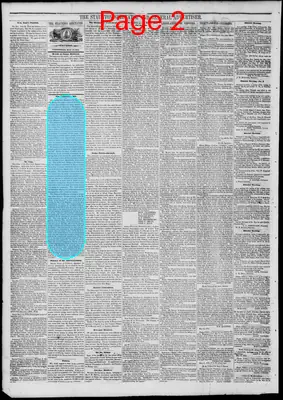
Staunton Spectator
Staunton, Virginia
What is this article about?
The Homestead Bill passed the U.S. House of Representatives on Wednesday with a 107-56 vote, granting 160 acres of public land free to citizen heads of families after five years' occupancy. Virginia reps Thompson and McMullen voted yes; Meade absent. Editorial decries it as harmful to old states, promoting agrarianism and risking public domain depletion.
Clipping
OCR Quality
Full Text
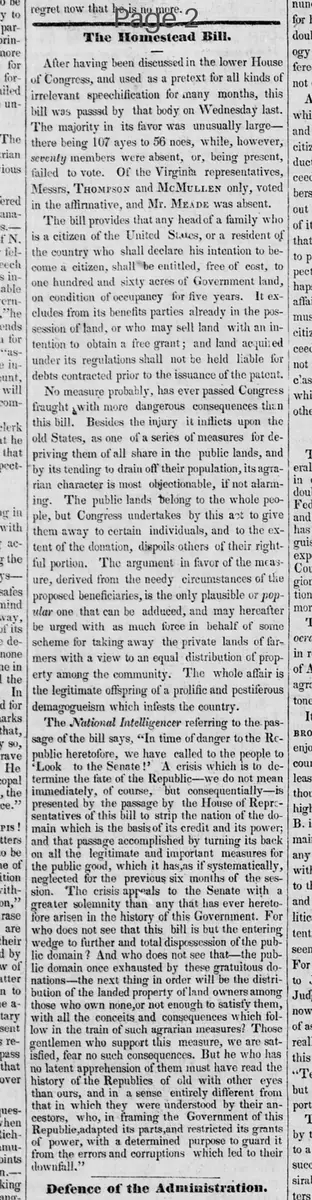
After having been discussed in the lower House of Congress, and used as a pretext for all kinds of irrelevant speechification for many months, this bill was passed by that body on Wednesday last. The majority in its favor was unusually large— there being 107 ayes to 56 noes, while, however, seventy members were absent, or, being present, failed to vote. Of the Virginia representatives, Messrs. Thompson and McMullen only, voted in the affirmative, and Mr. Meade was absent.
The bill provides that any head of a family who is a citizen of the United States, or a resident of the country who shall declare his intention to become a citizen, shall be entitled, free of cost, to one hundred and sixty acres of Government land, on condition of occupancy for five years. It excludes from its benefits parties already in the possession of land, or who may sell land with an intention to obtain a free grant; and land acquired under its regulations shall not be held liable for debts contracted prior to the issuance of the patent.
No measure probably, has ever passed Congress fraught with more dangerous consequences than this bill. Besides the injury it inflicts upon the old States, as one of a series of measures for depriving them of all share in the public lands, and by its tending to drain off their population, its agrarian character is most objectionable, if not alarming. The public lands belong to the whole people, but Congress undertakes by this act to give them away to certain individuals, and to the extent of the donation, despoils others of their rightful portion. The argument in favor of the measure, derived from the needy circumstances of the proposed beneficiaries, is the only plausible or popular one that can be adduced, and may hereafter be urged with as much force in behalf of some scheme for taking away the private lands of farmers with a view to an equal distribution of property among the community. The whole affair is the legitimate offspring of a prolific and pestiferous demagogueism which infests the country.
The National Intelligencer referring to the passage of the bill says, "In time of danger to the Republic heretofore, we have called to the people to Look to the Senate!' A crisis which is to determine the fate of the Republic-we do not mean immediately, of course, but consequentially-is presented by the passage by the House of Representatives of this bill to strip the nation of the domain which is the basis of its credit and its power; and that passage accomplished by turning its back on all the legitimate and important measures for the public good, which it has, as if systematically, neglected for the previous six months of the session. The crisis appeals to the Senate with a greater solemnity than any that has ever heretofore arisen in the history of this Government. For who does not see that this bill is but the entering wedge to further and total dispossession of the public domain? And who does not see that the public domain once exhausted by these gratuitous donations—the next thing in order will be the distribution of the landed property of land owners among those who own none, or not enough to satisfy them, with all the conceits and consequences which follow in the train of such agrarian measures? Those gentlemen who support this measure, we are satisfied, fear no such consequences. But he who has no latent apprehension of them must have read the history of the Republics of old with other eyes than ours, and in a sense entirely different from that in which they were understood by their ancestors, who, in framing the Government of this Republic, adapted its parts, and restricted its grants of power, with a determined purpose to guard it from the errors and corruptions which led to their downfall."
What sub-type of article is it?
What themes does it cover?
What keywords are associated?
What entities or persons were involved?
Where did it happen?
Story Details
Key Persons
Location
Lower House Of Congress
Event Date
Wednesday Last
Story Details
The Homestead Bill passed the House 107-56, allowing heads of families to claim 160 acres free after five years' occupancy, excluding those with land. Editorial criticizes it for harming old states, promoting agrarianism, and risking public domain loss, quoting National Intelligencer on Senate's role.