Thank you for visiting SNEWPapers!
Sign up free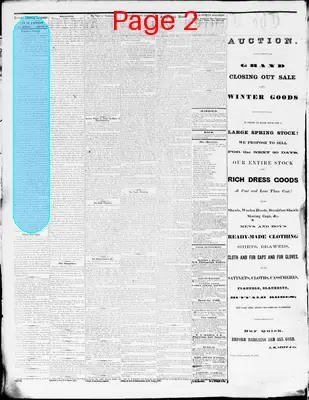
Editorial
January 29, 1866
Canton Weekly Register
Canton, Fulton County, Illinois
What is this article about?
Editorial celebrates the rapid progress of freedom in the US since the Civil War, from confining slavery to its abolition via constitutional amendment, and advancing toward suffrage for the colored race, advocating intelligence-based voting over color.
Clipping

OCR Quality
95%
Excellent
Full Text
Canton Weekly Register.
CITY OF CANTON
MONDAY MORNING, JANUARY 29
Progress of Freedom.
A few years ago the dark pall of slavery hung over four millions of human beings in our country, which we called free--it was to white men, but not to the unfortunate colored race--and their enslavement brought a curse not alone upon them, but upon the dominant or white race.
Freedom has made rapid strides since then. The "irrepressible conflict," so long dreaded, has at last ended in the triumph of freedom; and still the march is onward, and it must be to the end.
Let us look back a little, and see its rapid strides. Six, eight and ten years ago the advocates of freedom were content to demand that slavery should be confined to the limits it then occupied--fully confident that it would in a few years eat out its own vitals, and be no more. But their brightest anticipations of a really free country have been more than realized, though the price paid therefor has been a terrible and bloody one, and one which none anticipated. The advocates of slavery finding their schemes of slavery extension and self-aggrandizement thwarted and brought to naught, strove to bring about the destruction of the government under which they had enjoyed so much, and which had always given the fullest protection to all their legal rights; but instead of succeeding in their nefarious design they brought about the annihilation of the institution whose interests they sought to promote.
When the war first commenced, few, if any, had the remotest idea that slavery would so soon be driven from the length and breadth of the land. Even the Republican party, as a party, were slow in making any aggressive movements, their first and foremost object being to uphold the Government, without regard to the status of slavery, and runaway slaves were returned to their rebel masters.
But, as the contest progressed, and its magnitude became more and more apparent, the people and their ruler awoke to a full realization of the fact that slavery was the sole cause of the war, and was to be met as such.
First came the abolition of slavery in the District of Columbia, that our boasted freedom might no longer be put to shame by the clanking of the chains of the slave within the shadow of our capitol. The returning of escaped slaves was very soon ended; and as their number increased, the policy of using them in the army of the Union was next considered, and, little by little, fully adopted, and the freedom of all who served in the army guaranteed. Then appeared the necessity of aiming a death-blow at the power of the rebels, by proclaiming all slaves in insurrectionary districts free. A few months more and Congress proposed an amendment to the Constitution, utterly and forever abolishing slavery in all parts of the Union; and this too, has been adopted by the people and made a part of the fundamental law of the land. Next comes the question of the right of enfranchise for the colored race. That, too, has been adopted by the lower house of Congress for the District of Columbia, and undoubtedly will be by the Senate; and it is generally understood that the President will promptly affix his signature to the Bill, and thus make it a law in full force.
Thus, step by step, has the spirit of freedom, upon which our forefathers based this great government, been triumphing over the darkness of error and prejudice. Although we cannot say that we are fully committed to the doctrine of unrestricted universal suffrage, we nevertheless greatly rejoice at the general feeling--the desire to do equal justice to all--which is so rapidly gaining ground in all parts of the country. Our own choice would be to make intelligence, not color, the qualification for a voter--allow no man to vote who cannot read and write in the English language; and then make the voting population the basis of representation.
CITY OF CANTON
MONDAY MORNING, JANUARY 29
Progress of Freedom.
A few years ago the dark pall of slavery hung over four millions of human beings in our country, which we called free--it was to white men, but not to the unfortunate colored race--and their enslavement brought a curse not alone upon them, but upon the dominant or white race.
Freedom has made rapid strides since then. The "irrepressible conflict," so long dreaded, has at last ended in the triumph of freedom; and still the march is onward, and it must be to the end.
Let us look back a little, and see its rapid strides. Six, eight and ten years ago the advocates of freedom were content to demand that slavery should be confined to the limits it then occupied--fully confident that it would in a few years eat out its own vitals, and be no more. But their brightest anticipations of a really free country have been more than realized, though the price paid therefor has been a terrible and bloody one, and one which none anticipated. The advocates of slavery finding their schemes of slavery extension and self-aggrandizement thwarted and brought to naught, strove to bring about the destruction of the government under which they had enjoyed so much, and which had always given the fullest protection to all their legal rights; but instead of succeeding in their nefarious design they brought about the annihilation of the institution whose interests they sought to promote.
When the war first commenced, few, if any, had the remotest idea that slavery would so soon be driven from the length and breadth of the land. Even the Republican party, as a party, were slow in making any aggressive movements, their first and foremost object being to uphold the Government, without regard to the status of slavery, and runaway slaves were returned to their rebel masters.
But, as the contest progressed, and its magnitude became more and more apparent, the people and their ruler awoke to a full realization of the fact that slavery was the sole cause of the war, and was to be met as such.
First came the abolition of slavery in the District of Columbia, that our boasted freedom might no longer be put to shame by the clanking of the chains of the slave within the shadow of our capitol. The returning of escaped slaves was very soon ended; and as their number increased, the policy of using them in the army of the Union was next considered, and, little by little, fully adopted, and the freedom of all who served in the army guaranteed. Then appeared the necessity of aiming a death-blow at the power of the rebels, by proclaiming all slaves in insurrectionary districts free. A few months more and Congress proposed an amendment to the Constitution, utterly and forever abolishing slavery in all parts of the Union; and this too, has been adopted by the people and made a part of the fundamental law of the land. Next comes the question of the right of enfranchise for the colored race. That, too, has been adopted by the lower house of Congress for the District of Columbia, and undoubtedly will be by the Senate; and it is generally understood that the President will promptly affix his signature to the Bill, and thus make it a law in full force.
Thus, step by step, has the spirit of freedom, upon which our forefathers based this great government, been triumphing over the darkness of error and prejudice. Although we cannot say that we are fully committed to the doctrine of unrestricted universal suffrage, we nevertheless greatly rejoice at the general feeling--the desire to do equal justice to all--which is so rapidly gaining ground in all parts of the country. Our own choice would be to make intelligence, not color, the qualification for a voter--allow no man to vote who cannot read and write in the English language; and then make the voting population the basis of representation.
What sub-type of article is it?
Slavery Abolition
Suffrage
Constitutional
What keywords are associated?
Slavery Abolition
Civil War
Emancipation
Suffrage
Reconstruction
Universal Suffrage
Constitutional Amendment
What entities or persons were involved?
Republican Party
Congress
President
Rebels
Colored Race
Editorial Details
Primary Topic
Progress Of Freedom From Slavery To Enfranchisement
Stance / Tone
Triumphant Support For Abolition And Qualified Suffrage
Key Figures
Republican Party
Congress
President
Rebels
Colored Race
Key Arguments
Slavery's Abolition Triumphed Through Civil War
Initial Containment Of Slavery Evolved To Full Emancipation
Constitutional Amendment Ended Slavery Nationwide
Enfranchisement For Colored Race Advancing In Dc
Prefer Intelligence Based Voting Over Unrestricted Suffrage