Thank you for visiting SNEWPapers!
Sign up free
The Guard
Holly Springs, Marshall County, Mississippi
What is this article about?
US Senator Chalmers delivers a speech in the Senate on March 24, 1846, advocating for giving notice to Great Britain to abrogate the 1818/1827 convention on joint occupancy of Oregon territory. He defends President Polk's diplomatic efforts, urges compromise along the 49th parallel, and supports the notice to facilitate settlement and preserve peace. The debate concludes with adoption of Crittenden's modification authorizing the President to issue the notice.
Merged-components note: This is a continuation of the Senate speech by Mr. Chalmers on the Oregon question, spanning multiple components across pages 1 and 2.
Clippings
1 of 2
OCR Quality
Full Text
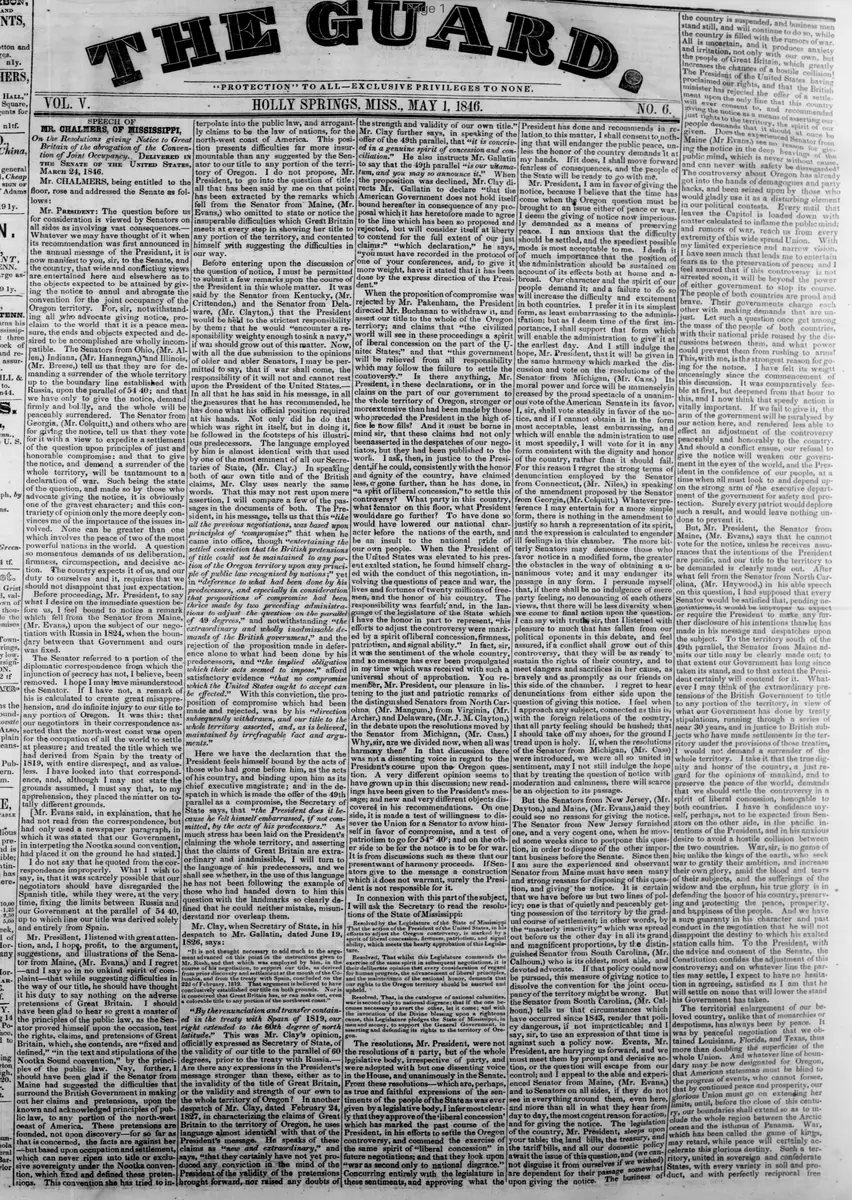
On the Resolutions giving Notice to Great
Britain of the abrogation of the Conven-
tion of Joint Occupancy.. Delivered In
THE SENATE OF THE UNITED STATES,
MARCH 24, 1846.
Mr. CHALMERS, being entitled to the
floor, rose and addressed the Senate as fol-
lows:
Mr. President: The question before us
for consideration is viewed by Senators on
all sides as involving vast consequences.-
Whatever we may have thought of it when
its recommendation was first announced in
the annual message of the President, it is
now manifest to you, sir, to the Senate, and
the country, that wide and conflicting views
are entertained here and elsewhere as to
the objects expected to be attained by giv-
ing the notice to annul and abrogate the
convention for the joint occupancy of the
Oregon territory. For, sir, notwithstand-
ing all who advocate giving notice, pro-
claim to the world that it is a peace mea-
sure, the ends and objects expected and de-
sired to be accomplished are wholly incom-
patible. The Senators from Ohio, (Mr. Al-
len,) Indiana, (Mr. Hannegan,) and Illinois,
(Mr. Breese,) tell us that they are for de-
manding a surrender of the whole territory
up to the boundary line established with
Russia, upon the parallel of 54 40; and that
we have only to give the notice, demand
firmly and boldly, and the whole will be
peaceably surrendered. The Senator from
Georgia, (Mr. Colquitt,) and others who are
for giving the notice, tell us that they vote
for it with a view to expedite a settlement
of the question upon principles of just and
honorable compromise; and that to give
the notice, and demand a surrender of the
whole territory, will be tantamount to a
declaration of war. Such being the state
of the question, and made so by those who
advocate giving the notice, it is obviously
one of the gravest character; and this con-
S
trariety of opinion only the more deeply con-
vinces me of the importance of the issues in-
volved. None can be greater than one
which involves the peace of two of the most
powerful nations in the world. A question
so momentous demands of us deliberation,
firmness, circumspection, and decisive ac-
tion. The country expects it of us, and our
duty to ourselves and it, requires that we
should not disappoint that just expectation.
Before proceeding, Mr. President, to say
what I desire on the immediate question be-
fore us, I feel bound to notice a remark
which fell from the Senator from Maine,
(Mr. Evans,) upon the subject of our nego-
tiation with Russia in 1824, when the boun-
dary between that Government and ours
was fixed
The Senator referred to a portion of the
diplomatic correspondence from which the
injunction of secrecy has not, I believe, been
removed. I hope I may have misunderstood
the Senator. If I have not, a remark of
his is calculated to create great misappre-
hension, and do infinite injury to our title to
any portion of Oregon. It was this: that
our negotiators in their correspondence as-
serted that the north-west coast was open
for the occupation of all the world to settle
at pleasure; and treated the title which we
had derived from Spain by the treaty of
1819, with entire disrespect, and as value-
less. I have looked into that correspond-
ence, and, although I may not state the
grounds assumed, I must say that, to my
apprehension, they placed the matter on to-
tally different grounds.
Mr. Evans said, in explanation, that he
had not read from the correspondence, but
had only used a newspaper paragraph, in
which it was stated that our Government,
in interpreting the Nootka sound convention,
had placed it on the ground he had stated.
I do not say that he quoted from the cor-
respondence improperly. What I wish to
say, is, that it was scarcely possible that our
negotiators should have disregarded the
Spanish title, while they were, at the very
time, fixing the limits between Russia and
our Government at the parallel of 54 40,
up to which line our title was derived solely
and entirely from Spain.
Mr. President, I listened with great atten-
tion, and, I hope, profit, to the argument,
suggestions, and illustrations of the Sena-
tor from Maine. (Mr. Evans.) and I regret
-and I say so in no unkind spirit of com-
plaint-that while suggesting difficulties in
the way of our title, he should have thought
it his duty to say nothing on the adverse
pretensions of Great Britain. I should
have been glad to hear so great a master of
the principles of the public law, as the Sen-
ator proved himself upon the occasion, test
the rights, claims, and pretensions of Great
Britain, which, she contends, are "fixed and
defined," "in the text and stipulations of the
Nootka Sound convention," "by the princi-
ples of the public law. Nay, further, I
should have been glad if the Senator from
Maine had suggested the difficulties that
surround the British Government in making
out her claims and pretensions, upon the
known and acknowledged principles of pub-
lic law, to any portion of the north-west
coast of America. These pretensions are
founded, not upon discovery--for so far as
that is concerned, the facts are against her
-but based upon occupation and settlement,
which can never ripen into title or exclu-
sive sovereignty under the Nootka conven-
tion, which fixed and defined these preten-
sions. This convention she has tried to in-
terpolate into the public law, and arrogant-
ly claims to be the law of nations, for the
north-west coast of America. This posi-
tion presents difficulties far more insur-
mountable than any suggested by the Sen-
ator to our title to any portion of the terri-
tory of Oregon. I do not propose, Mr.
President, to go into the question of title;
all that has been said by me on that point
has been extracted by the remarks which
fell from the Senator from Maine, (Mr.
Evans,) who omitted to state or notice the
insuperable difficulties which Great Britain
meets at every step in showing her title to
any portion of the territory, and contented
himself with suggesting the difficulties in
our way.
Before entering upon the discussion o
the question of notice, I must be permitted
to submit a few remarks upon the course of
the President in this whole matter. It was
said by the Senator from Kentucky, (Mr.
Crittenden,) and the Senator from Dela-
ware, (Mr. Clayton,) that the President
would be held to the strictest responsibility
by them; that he would "encounter a re-
sponsibility weighty enough to sink a navy,"
if war should grow out of this matter. Now,
with all the due submission to the opinions
of older and abler Senators, I may be per-
mitted to say, that if war shall come, the
responsibility of it will not and cannot rest
upon the President of the United States.-
In all that he has said in his message, in all
the measures that he has recommended, he
has done what his official position required
at his hands. Not only did he do that
which was right in itself, but in doing it,
he followed in the footsteps of his illustri-
ous predecessors. The language employed
by him is almost identical with that used
by one of the most eminent of all our Secre-
taries of State, (Mr. Clay.) In speaking
both of our own title and of the British
claims, Mr. Clay
uses nearly the same
words. That this may not rest upon mere
assertion, I will compare a few of the pas-
sages in the documents of both. The Pre-
sident, in his message, tells us that this "like
all the previous negotiations, was based upon
principles of compromise;" that when he
came into office, though "entertaining the
settled conviction that the British pretensions
of title could not be maintained to any por-
tion of the Oregon territory upon any princi-
ple of public law recognised by nations;" yet
in "deference to what had been done by his
predecessors, and especially in consideration
that propositions of compromise had been
thrice made by two preceding administra-
tions to adjust the question on the parallel
of 49 degrees," and notwithstanding "the
extraordinary and wholly inadmissable de-
mands of the British government," and the
rejection of the proposition made in defer-
ence alone to what had been done by his
predecessors, and "the implied obligation
which their acts seemed to impose," afford
satisfactory evidence "that no compromise
which the United States ought to accept can
be effected." With this conviction, the pro-
position of compromise which had been
made and rejected, was by his "direction
subsequently withdrawn, and our title to the
whole territory asserted, and, as is believed,
maintained by irrefragable fact and argu-
ments."
Here we have the declaration that the
President feels himself bound by the acts of
those who had gone before him, as the acts
of his country, and binding upon him as its
chief executive magistrate; and in the de-
spatch in which is made the offer of the 49th
parallel as a compromise, the Secretary of
State says, that "the President does it be-
cause he felt himself embarrassed, if not com-
mitted, by the acts of his predecessors."
As
much stress has been laid on the President's
claiming the whole territory, and asserting
that the claims of Great Britain are extra-
ordinary and inadmissible, I will turn to
the language of his predecessors, and we
shall see whether, in the use of this language
he has not been following the example of
those who had handed down to him this
question with the landmarks so clearly de-
fined that he could neither mistake, misun-
derstand nor overleap them.
Mr. Clay, when Secretary of State, in his
despatch to Mr. Gallatin, dated June 19,
1826, says:
"It is not thought necessary to add much to the argu-
ment advanced on this point in the instructions given to
Mr. Rush, and that which was employed by him, in the
course of his negotiation, to support our title, as derived
from prior discovery and settlement at the mouth of the Co-
lumbia, and from the treaty with Spain, concluded on the
22d of February, 1819. That argument is believed to have
conclusively established our title on both grounds. Nor is
it conceived that Great Britain has, or can make out, even
a colorable title to any portion of the northwest coast."
"By the renunciation and transfer contain-
ed in the treaty with Spain of 1819, our
right extended to the 60th degree of north
latitude." This was Mr. Clay's opinion,
officially expressed as Secretary of State, of
the validity of our title to the parallel of 60
degrees, prior to the treaty with Russia.—
Are there any expressions in the President's
message stronger than these, either as to
the invalidity of the title of Great Britain,
or the validity and strength of our own to
the whole territory of Oregon? In another
despatch of Mr. Clay, dated February 24,
1827, in characterizing the claims of Great
Britain to the territory of Oregon, he uses
language almost identical with that of the
President's message. He speaks of these
claims as "new and extraordinary," and
says, "that they certainly have not yet pro-
duced any conviction in the mind of the
President of the validity of the pretensions
brought forward, nor raised any doubts of
the strength and validity of our own title."
Mr. Clay further says, in speaking of the
offer of the 49th parallel, that "it is conceiv-
ed in a genuine spirit of concession and con-
ciliation." He also instructs Mr. Gallatin
to say that the 49th parallel "is our ultama-
tum, and you may so announce it." When
the proposition was declined, Mr. Clay di-
rects Mr. Gallatin to declare "that the
American Government does not hold itself
bound hereafter in consequence of any pio-
posal which it has heretofore made to agree
to the line which has been so proposed and
rejected, but will consider itself at liberty
to contend for the full extent of our just
claims;" "which declaration," he says,
"you must have recorded in the protocol of
one of your conferences, and, to give it
more weight, have it stated that it has been
done by the express direction of the Presi-
dent."
When the proposition of compromise was
rejected by Mr. Pakenham, the President
directed Mr. Buchanan to withdraw it, and
assert our title to the whole of the Oregon
territory; and claims that "the civilized
world will see in these proceedings a spirit
of liberal concession on the part of the U.
nited States;" and that "this government
will be relieved from all responsibility
e
which may follow the failure to settle the
controversy." Is there anything,
Mr.
President, in these declarations, or in the
claims on the part of our government to
the whole territory of Oregon, stronger or
more extensive than had been made by those
who preceded the President in the high of-
fice he now fills? And it must be borne in
mind sir, that these claims had not only
been asserted in the despatches of our nego-
tiatos, but they had been published to the
world. I ask, then, in justice to the Presi-
dent, if he could, consistently with the honor
and dignity of the country, have claimed
less, or gone further, than he has done, in
"a spirit of liberal concession," to settle this
controversy? What party in this country,
what Senator on this floor, what President
would dare go further? To have done so
would have lowered our national char-
acter before the nations of the earth, and
e;
be an insult to the national pride
of
our own people.
When the President of
the United States was elevated to his pres-
ent exalted station, he found himself charg-
ed with the conduct of this negotiation, in-
volving the questions of peace and war, the
lives and fortunes of twenty millions of free-
men, and the honor of his country. The
responsibility was fearful; and, in the lan-
guage of the legislature of the State which
I have the honor in part to represent, "his
efforts to adjust the controversy were mark-
ed by a spirit of liberal concession, firmness,
patriotism, and signal ability." In fact, sir,
it was the sentiment of the whole country,
and no message has ever been promulgated
in my time which was received with such a
universal shout of approbation. You re-
member, Mr. President, our pleasure in lis-
tening to the just and patriotic remarks of
the distinguished Senators from North Car-
olina, (Mr. Mangum,) from Virginia, (Mr.
Archer,) and Delaware, (Mr. J. M. Clayton,)
in the debate upon the resolutions moved by
the Senator from Michigan, (Mr. Cass.)
Why, sir, are we divided now, when all was
harmony then? In that discussion there
was not a dissenting voice in regard to the
President's course upon the Oregon ques-
tion. A very different opinion seems to
have grown up in this discussion; new read-
J
ings have been given to the President's mes-
sage; and new and very different objects dis-
covered in his recommendations. On one
side, it is made a test of willingness to dis-
sever the Union for a Senator to avow him-
self in favor of compromise, and a test of
patriotism to go for 54° 40'; and on the oth-
er side to be for the notice is to be for war.
It is from discussions such as these that our
present want of harmony proceeds. If Sen-
ators give to the message a construction
which it does not warrant, surely the Presi-
dent is not responsible for it.
In connection with this part of the subject,
I will ask the Secretary to read the resolu
tions of the State of Mississippi:
Resolved by the Legislature of the State of Mississippi
That the action of the President of the United States, in his
efforts to adjust the Oregon controversy, is marked by a
spirit of liberal concession, firmness, patriotism, and signal
ability, which meets the hearty approbation of this Legisla-
ture.
Resolved, That whilst this Legislature commends the
exercise of the same spirit in subsequent negotiations, it is
their deliberate opinion that every consideration of regard
for human progress, the advancement of liberal principles,
and the maintenance of the national honor, demands that
our rights to the Oregon territory should be asserted and
upheld.
Resolved, That, in the catalogue of national calamities,
war is second only to national disgrace; that if the one be-
comes necessary to avert the other, let it come; and with
the invocation of the Divine blessing upon a righteous
cause, this Legislature pledges the State of Mississippi, in
men and money, to support the General Government, in
asserting and defending its rights to the territory of Ore-
gon.
The resolutions, Mr. President, were not
the resolutions of a party, but of the whole
legislative body, irrespective of party, and
were adopted with but one dissenting voice
in the House, and unanimously in the Senate.
From these resolutions--which are, perhaps,
as true and faithful expressions of the sen-
timents of the people of the State as was ever
given by a legislative body, I infer most clear-
ly that they approve of the 'liberal concession'
which has marked the past course of the
President, in his efforts to settle the Oregon
controversy, and commend the exercise of
the same spirit of "liberal concession" in
future negotiations; and that they look upon
"war as second only to national disgrace."
Concurring entirely with the legislature in
these sentiments, and approving what the
President has done and recommends in re-
lation to this matter, I shall consent to noth-
ing that will endanger the public peace, un-
less the honor of the country demands it at
my hands. If it does, I shall move forward
fearless of consequences, and the people of
the State will be ready to go with me.
Mr. President, I am in favor of giving the
notice, because I believe that the time has
come when the Oregon question must be
brought to an issue either of peace or war.
I deem the giving of notice now imperious-
ly demanded as a means of preserving
peace. I am anxious that the difficulty
should be settled, and the speediest possible
mode is most acceptable to me. I deem it
of much importance that the position of
the administration should be sustained on
account of its effects both at home and a-
broad.
Our character and the spirit of our
people demand it; and a failure to do so
will increase the difficulty and excitement
in both countries. I prefer it in its simplest
form, as least embarrassing to the adminis-
tration; but as I deem time of the first im-
portance, I shall support that form which
will enable the administration to give it at
the earliest day. And I still indulge the
hope, Mr. President, that it will be given in
the same harmony which marked the dis-
cussion and vote on the resolutions of the
Senator from Michigan, (Mr. Cass.)
Its
moral power and force will be immensely in
creased by the proud spectacle of a unani-
mous vote of the American Senate in its favor.
I, sir, shall vote steadily in favor of the no-
tice, and if I cannot obtain it in the form
most acceptable, least embarrassing, and
which will enable the administration to use
it most speedily, I will vote for it in any
form consistent with the dignity and honor
of the country, rather than it should fail.
For this reason I regret the strong terms of
denunciation employed by the Senator
from Connecticut, (Mr. Niles,) in speaking
of the amendment proposed by the Senator
from Georgia, (Mr. Colquitt.) Whatever pre-
ference I may entertain for a more simple
form, there is nothing in the amendment to
justify so harsh a representation of its spirit,
and the expression is calculated to engender
ill feelings in this chamber. The more bit-
terly Senators may denounce those who
favor notice in a modified form, the greater
the obstacles in the way of obtaining a u-
nanimous vote; and it may endanger its
passage in any form. I persuade myself
that, if there shall be no indulgence of mere
party feeling, no denouncing of each others
views, that there will be less diversity when
we come to final action upon the question.
I can say with truth, sir, that I listened with
pleasure to much that has fallen from our
political opponents in this debate, and feel
assured, if a conflict shall grow out of this
controversy, that they will be as ready to
sustain the rights of their country, and to
meet dangers and sacrifices in her cause, as
bravely and as promptly as our friends on
this side of the chamber. I regret to hear
denunciations from either side upon the
question of giving this notice. I feel when
I approach any subject, connected as this is,
with the foreign relations of the country,
that all party feeling should be hushed; that
I should take off my shoes, for the ground I
tread upon is holy. "If, when the resolutions
of the Senator from Michigan, (Mr. Cass)
were introduced, we were all so united in
sentiment, may I not still indulge the hope
that by treating the question of notice with
moderation and calmness, there will scarce
be an objection to its passage.
But the Senators from New Jersey, (Mr.
Dayton,) and Maine, (Mr. Evans,) said they
could see no reasons for giving the notice.
The Senator from New Jersey furnished
one, and a very cogent one, when he mov-
ed some weeks since to postpone this ques-
tion, in order to dispose of the other impor-
tant business before the Senate. Since then
I am sure the experienced and observant
Senator from Maine must have seen many
and strong reasons for disposing of this ques-
tion, and giving the notice. It is certain
that we have before us but two lines of pol-
icy; one is that of quietly and peaceably get-
ting possession of the territory by the grad-
ual course of settlement; in other words, by
the "masterly inactivity" which was spread
out before us the other day in all its grand
and magnificent proportions, by the distin-
guished Senator from South Carolina, (Mr.
Calhoun,) who is its oldest, most able, and
devoted advocate. If that policy could now
be pursued, this measure of giving notice to
dissolve the convention for the joint occu-
pancy of the territory might be wrong. But
the Senator from South Carolina, (Mr. Cal-
houn,) tells us that circumstances which
have occurred since 1843, render that poli-
cy dangerous, if not impracticable; and I
say, sir, to use an expression of that time is
against such a policy now. Events, Mr.
President, are hurrying us forward, and we
must meet them by prompt and decisive ac-
tion, or the question will escape from our
control; and I appeal to the able and experi-
enced Senator from Maine, (Mr. Evans,)
and to Senators on all sides, if they do not
see in everything around them, even here,
and more than all in what they hear from
day to day, the most cogent reason for action,
and for giving the notice.
The legislation
of the country, Mr. President, sleeps upon
your table; the land bills, the treasury, and
the tariff bills, and all
l our
domestic policy
await the issue of this question, and (we can-
not disguise it from ourselves if we wished)
upon giving the notice. The business of the country is suspended, and business men
stand still, and will continue to do so, while
the country is filled with the rumors of war.
All is uncertain, and it produces anxiety
and irritation, not only with our own, but
the people of Great Britain, which greatly
increases the chances of a hostile collision.
The President of the United States having
proclaimed our rights, and that the British
minister has rejected the offer of a settle-
ment upon the only line that this country
will ever consent to, and recommended
just rights to the territory, the spirit of our
giving the notice as a means of asserting our
re-
given.
Does the experienced Senator from
th-
the Maine (Mr. Evans,) see no reason for giv.
un-
ing the notice in the deep heavings of the
at
public mind, which is never without cause,
ard
and can never with safety be disregarded
of
The controversy about Oregon has already
got into the hands of demagogues and party
he
hacks, and been seized upon by those who
nas
would gladly use it as a disturbing element
be
in our political contests. Every mail that
ar.
leaves the Capitol is loaded down with
us-
ng
matter calculated to inflame the public mind:
ty
and rumors of war, reach us from every
ble
extremity of this wide spread Union. With
it
my limited experience and narrow vision.
on
of
I have seen much that leads me to entertain
fears as to the preservation of peace; and I
feel assured that if this controversy is not
ur
so
a-
arrested soon, it will be beyond the power
of either government to stop its course.
The people of both countries are proud and
nt
brave. Their governments charge each
n-
est
is-
other with making demands that are un-
just. Let such a question once get among
ch
the mass of the people of both countries,
with their national pride roused by the dis-
at
cussions between them, and what power
ne
could prevent them from rushing to arms?
ms
ning for the notice. I have felt its weight
This, with me, is the strongest reason for go-
unceasingly since the commencement of
ss
this discussion. It was comparatively fee-
ble at first, but deepened from that hour to
7-
this, and I now think that speedy action is
r
vitally important. If we fail to give it, the
arm of the government will be paralysed by
our action here, and rendered less able to
effect an adjustment of the controversy
peaceably and honorably to the country.
And should a conflict ensue, our refusal to
give the notice will weaken our govern-
ment in the eyes of the world, and the Pres-
ident in the confidence of our people, at a
time when all must look to and depend up-
on the strong arm of the executive depart-
ment of the government for safety and pro-
tection. Surely every patriot would deplore
such a result, and would leave nothing un-
done to prevent it.
But, Mr. President, the Senator from
Maine, (Mr. Evans,) says that he cannot
vote for the notice, unless he receives assu-
rances that the intentions of the President
are pacific, and our title to the territory to
be demanded is clearly made out. After
what fell from the Senator from North Car-
olina, (Mr. Haywood,) in his able speech
on this question, I had supposed that every
Senator would be satisfied that, pending ne-
gotiations, it would be improper to expect
or require the President to make any further disclosure of his intentions than he has
made in his message and despatches upon
the subject. To the territory south of the
49th parallel, the Senator from Maine ad-
mits our title may be clearly made out; to
that extent our Government has long since
taken its stand, and to that extent the Presi-
dent certainly will contend for it. What-
ever I may think of the extraordinary pre-
tentions of the British Government to title
to any portion of the territory, in view of
what our Government has done by treaty
stipulations, running through a series of
near 30 years, and in justice to British sub-
jjects who have made settlements in the ter-
rritory under the provisions of those treaties,
I would not demand a surrender of the
whole territory. I take it that the true dig-
nity and honor of the country, a just re-
gard for the opinions of mankind, and to
preserve the peace of the world, demands
that we should settle the controversy in a
spirit of liberal concession, honorable to
both countries. I have no confidence my-
self, perhaps, not to be expected from Sen-
ators on the other side, in the pacific in-
tentions of the President, and in his anxious
desire to avoid a hostile collision between
the two countries. War, sir, is no game of
his; unlike the kings of the earth, who seek
war to gratify their ambition, and increase
their own glory, amid the blood and tears
of their subjects, and the sufferings of the
widow and the orphan, his true glory is in
defending the honor of his country, preserv-
ing and protecting the peace, prosperity,
and happiness of the people. And we have
a sure guaranty in his character and past
conduct in the negotiation that he will not
disappoint the destiny to which his exalted
station calls him. To the President, with
the advice and consent of the Senate, the
Constitution confides the adjustment of this
controversy; and on whatever line the par-
ties may settle, I expect to have no hesita-
tion in agreeing, satisfied as I am that he
will settle on none that will lower the stand
his Government has taken.
The territorial enlargement of our be-
loved country, unlike that of monarchies or
despotisms, has always been by peace. It
was by peaceful negotiation that we ob-
more than doubling the superficies of the
tained Louisiana. Florida, and Texas, thus
whole Union. And whatever line of boun-
dary may be now designated for Oregon,
that by continued peace and prosperity, our
glorious Union must go on extending her
limits, until, before the close of this centu-
ry, our boundaries shall extend so as to in-
clude the whole region between the Arctic
ocean and the isthmus of Panama. War,
which has been called the game of kings,
may retard, while peace will certainly ac-
celerate this glorious destiny. Such a ter-
rritory, united in sovereign and confederate
States, with every variety in soil and pro-
duct, and with perfectly reciprocal re
trade between all parts, would present a scene at which the rest of the world would first gaze in wonder, and then admire and imitate. The State which I have the honor in part to represent, may now be called the great staple State of the Union; for her exports largely exceed any other; her vital interests are inseparably united with free trade. She wants the world for a market. She was looking to the present as the auspicious moment when her long deferred hope would at length be gratified, and unrestricted commerce should bind together the nations of the globe. By a consentaneous, but not a concerted movement upon both sides of the water, her long cherished views seemed about to be consummated, when this dark cloud interposed, and threatened to substitute war, with all its momentous consequences, for peace, and the maintaining of a war in defence of our national honor, or, Mississippi will never hesitate; but she will never consent, disregarding the policy of every administration for the last thirty years, to rush madly into a sanguinary conflict, rejecting those honorable terms for adjusting the Oregon controversy which have been offered by the President of her choice, Mr. Polk, and his predecessors, from the revolutionary patriot, James Monroe, down to the present period.
A strong effort has been made in the Senate to impress the country with the belief that the President was opposed to all further negotiation, and would reject every proposition short of the surrender of the whole territory. I am not authorised to present the opinions of the President any further than they are disclosed in his message and the despatches on the subject; but judging from them, I draw the conclusion that the views of the President have been greatly misconceived in regard to this controversy.
We have, first, the strong and decisive fact, that the President did offer the 49th parallel, notwithstanding it had been three times before offered, and rejected by the British Government; and when it was again rejected by the British minister, when offered by the President, in the very despatch in reply to that rejection, the President expressed his strong desire for peace, and that the amicable relations between the two countries might be preserved. Thus stood the case when the President communicated his message to Congress: the offer of the 49th parallel having been rejected, and no proposal made on the part of the British Government, but a requisition made upon us for a proposition more favorable to them, when the President declared in his message that "no compromise which the United States ought to accept can be effected."
He does not say that no compromise ought to be made, but simply announces his opinion upon the facts as they then existed, that no compromise would be offered that we ought to accept. It is true the President does announce in his message his opinion of the superiority of our title to the whole territory, but he had previously avowed that opinion, and had distinctly repeated it in the very despatch offering the 49th parallel as a compromise.
It is also true that the President does declare in his message that he would never consent to the surrender of the free navigation of the Columbia river; but he does not also state, in addition that he would never consent again to the 49th parallel as a compromise, but simply gives it as his opinion that no such compromise could be effected.
I have no doubt the President will obtain for us the whole territory, if it is in his power: but if he cannot, and the 49th parallel should be offered to us by the British Government, or what is substantially equivalent to it, there is nothing in the message or the despatches indicating the opinion that the President, who is but a branch of the war-making and treaty-making power, will rashly reject such a proposition, which he and three of his predecessors have made—and thus most certainly involve the country in a war, which every philanthropist and patriot must believe should only be invited when every fair and honorable compromise shall have proved unsuccessful. Is the 49th parallel an honorable compromise? The President and three of his predecessors have declared that it was; and if the British ministry, governed by wiser councils, should change their opinions, or disavow the rejection made by their minister, Mr. Pakenham, who can say that the President should deprive the Senate of its constitutional right as a branch of the war-making and treaty-making power, of advising upon such a momentous question, by the unconditional rejection of such a compromise? Is the majority of the Senate, or of the House of Representatives, prepared for a declaration of war upon the rejection of such a proposition? Do they believe it ought to be rejected? If they do, why are they not making all the preparations necessary to meet the momentous issue? Why are we not increasing our army and navy? repairing our fortifications and placing our whole country in a posture for defence, as well as aggression? Above all, why are we not preparing the great armaments, naval and military, to defend the whole territory of Oregon, which is the very subject matter of this controversy? Why are we not preparing to collect a direct tax of at least fifty millions per annum, to meet the great emergency? I cannot withhold the expression of my surprise and astonishment that all those who believe that we must insist, war or no war, upon a surrender of the whole territory, should not be found laying upon our tables, and urging from day to day the passage of bills for a direct tax, and the vast augmentation of all our naval and military defences demanded by such an occasion.
Below the 49th parallel, or what is substantially equivalent to it, no doubt the President never could consent to go, be the consequence what they may. And this, I believe, is almost the universal sentiment of the country, and of every Senator in this chamber. But this is a very different position from that of rejecting all compromise and all negotiation, and involving the country in war by the mere act of the President. I know nothing of whether such an offer will be made or not; but if it should be, and the President should rashly reject it without consulting the Senate, he will, by his own mere act, involve the country in war, or the disgrace attendant upon the settlement of the question at the parallel of 49° after he has rejected the proposition.
Mr. President, do those who demand that the President of the United States shall reject the 49th parallel, reflect upon the fact, which it is believed no Senator will deny, that a majority of both branches of Congress would agree to settle the controversy at the 49th parallel. Must the President, in open disregard of the known will of one or both Houses of Congress, reject a proposition which one or both of them would accept? Even if the President, in his own individual judgment, was opposed to a settlement by the parallel of 49°, yet he could not reject such a compromise in view of the opposing opinions known to be entertained by both Houses of Congress, whose hearty concurrence and cordial co-operation he must have, if such a course should result in a hostile collision between the two countries. It is well known, Mr. President, that four-fifths of the Senators in this body, among whom are three-fourths of the President's political friends, however they may vote on the question of notice, are in favor of settling the question upon principles of compromise; and in the House of Representatives, upon a direct vote, but ten members voted against it, and, by an overwhelming majority, expressed itself in favor of further negotiation. How, then, can the President be asked or expected, in view of such conclusive circumstances, to reject all compromise and refuse all negotiation? No, Mr. President, the administration has planted itself upon that parallel as the line from which it cannot be driven; and if war comes of it, in the patriotic language of the Senator from North Carolina, Let it come; and when a proud, arrogant, and grasping enemy
By the last steamer we received an extract from the letter of Sir Robert Peel, when retiring from the ministry, in which he assures her majesty that he will satisfy the King of the French that the great military and naval preparations, which have been making in England for some time past, were not intended for France, but grew out of their unsettled relations with the United States. This disclosure, coupled with the despatch of our minister, Mr. McLane, which has been laid before us, in my poor opinion, is an important fact, and calls strongly upon us to prepare for any contingency which may arise out of these unsettled relations. But, Mr. President, as I am one of the youngest and most inexperienced members of this body, surrounded by so many older, wiser, and more experienced Senators, I will not venture to suggest what is proper to be done; I look to them—the country looks to them to take the proper precautionary measures.
What I have said, Mr. President, has been in the discharge of a duty I owed to myself and the people of the State I have the honor in part to represent; differing from a few valued political friends around me. I could not, as I had wished to do, give a silent vote. Belonging as I do to that political party which has ever adhered to a strict construction of the Constitution and free trade, no one can deplore a hostile collision more than I would, and that this period which we fondly hoped was the dawn of our deliverance and liberty, should be obscured by "shadows, clouds, and darkness."
Close of the Debate in the Senate on the Oregon Question.
After continuing the debate on the 14th, 15th and 16th insts., the Senate proceeded to vote on the 16th, on the various forms of the "notice" proposed. Mr. Crittenden's modification was adopted by a vote of 40 to 14. It is as follows:
Be it enacted by the Senate and House of Representatives of the United States of America in Congress assembled, That by the convention concluded the twentieth day of October, eighteen hundred and eighteen, between the United States of America and the King of the United Kingdom of Great Britain and Ireland, for the period of ten years, and afterwards indefinitely extended and continued in force by another convention of the same parties, concluded the sixth day of August, in the year of our Lord one thousand eight hundred and twenty-seven, it was agreed that any country that may be claimed by either party on the north-west coast of America westward of the Stony or Rocky Mountains, now commonly called the Oregon territory, should, together with its harbors, bays, and creeks, and the navigation of all rivers within the same, be "free and open" to the vessels, citizens and subjects of the two powers, but without prejudice to any claim which either of the parties might have to any part of said country; and with this further provision, in the second article of the said convention of the sixth of August, eighteen hundred and twenty-seven, that either party might abrogate and annul said convention, on giving due notice of twelve months to the other contracting party—
That it has now become desirable that the respective claims of the United States and Great Britain should be definitely settled, and that said territory may no longer than need be remain subject to the evil consequences of the divided allegiance of its American and British population, and of the confusion and conflict of national jurisdictions, dangerous to the cherished peace and good understanding of the two countries; and, therefore, that steps be taken for the abrogation of the said convention of the sixth of August, eighteen hundred and twenty-seven, in the mode prescribed in its second article, and that the attention of the Governments of both countries may be the more earnestly and immediately directed to renewed efforts for the amicable settlement of all their differences and disputes in respect to said territory—
And be it further enacted, That the President of the United States be and he is hereby authorized, at his discretion, to give to the British Government the notice required by its said second article for the abrogation of the said convention.
What sub-type of article is it?
What keywords are associated?
What entities or persons were involved?
Where did it happen?
Foreign News Details
Primary Location
Oregon Territory
Event Date
1846 03 24
Key Persons
Outcome
senate adopts crittenden's modification to authorize president to give 12-month notice to abrogate the 1818/1827 convention on joint occupancy of oregon, by vote of 40 to 14 on march 16, 1846.
Event Details
Senator Chalmers of Mississippi speaks in favor of resolutions to give notice to Great Britain for abrogating the joint occupancy convention of Oregon territory, defending President Polk's prior compromise offers at the 49th parallel, critiquing British claims, and urging peaceful settlement while warning of war risks if unresolved. He references historical diplomacy, state resolutions from Mississippi, and calls for unity. The debate concludes with adoption of a bill authorizing the President to issue the notice at his discretion.