Thank you for visiting SNEWPapers!
Sign up free
Oxford Democrat
Paris, South Paris, Oxford County, Maine
What is this article about?
On the eve of Thanksgiving, Mrs. Culvert mourns her son Stephen's two-year absence. Servant Suke urges her to trust divine providence. Neighbor Eva confesses she pushed Stephen to leave by demanding he pursue a career. The family reunites joyfully when Stephen returns successful, ready to marry Eva.
Clipping
OCR Quality
Full Text
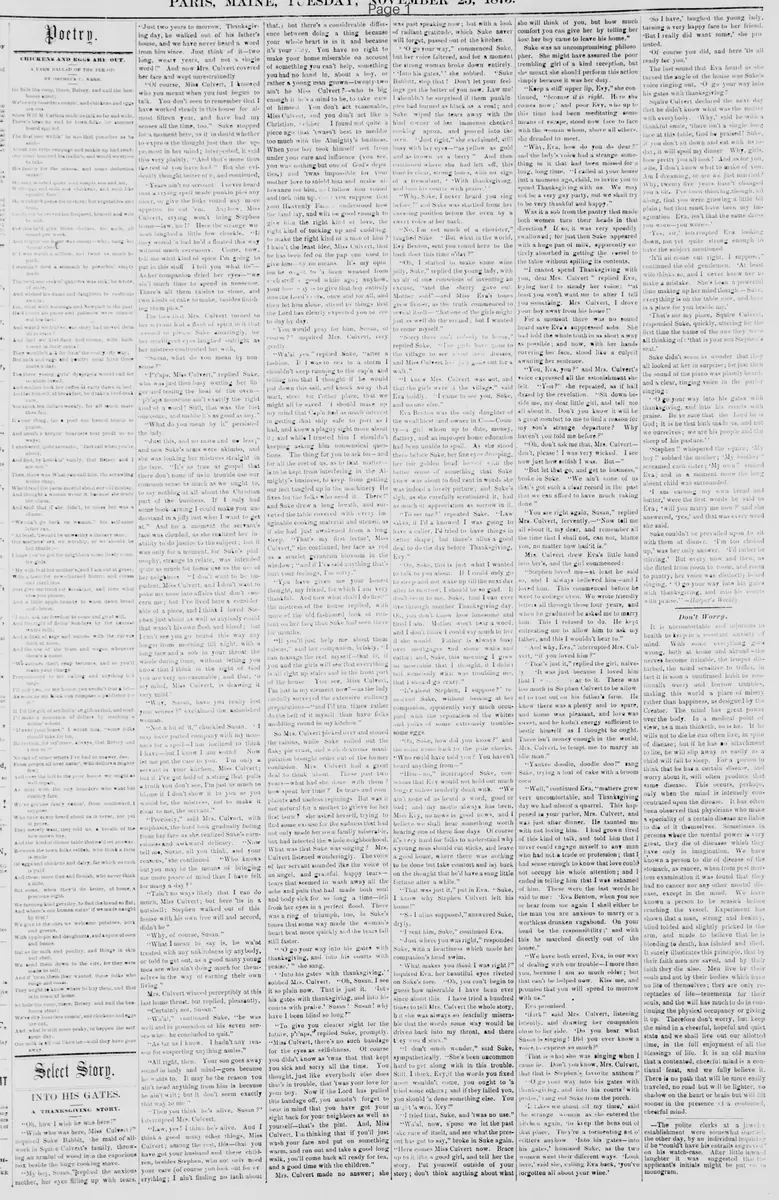
INTO HIS GATES.
A
THANKSGIVING STORY.
"Oh, how I wish he was here."
"Wish who was here, Mrs. Culvert?"
Inquired Suke Babbit, the maid of all-work
in Susie Culvert's family, throwing
an armful of wood into the capacious
box beside the huge cooking stove.
"My boy, Susan," replied the anxious
mother, her eyes filling up with tears.
Just two years to-morrow, Thanksgiving
day, he walked out of his father's
house, and we have never heard a word
from him since. Just think of it - two
long, weary years, and not a single
word!" And now Mrs. Culvert covered
her face and wept unrestrainedly.
"Of course, Mrs. Culvert, I knowed
who you meant when you first begun to
talk. You don't seem to remember that I
have worked steady in this house for al-
most fifteen year, and have had my
senses all the time, too." Suke stopped
for a moment here, as if in doubt whether
to express the thought just then uppermost in her mind; interpreted, it said
this very plainly, "And that's more than
the rest of you have had." But she evi-
dently thought better of it, and continued.
"Years ain't no account. I never heard
that a crying spell made punkin pies any
nicer, or give the folks round any more
appetite to eat 'em. Anyhow, Mrs.
Culvert, crying won't bring Stephen
home - law, no!" Here the strange wo-
man laughed a little low chuckle. "If
they would a had he'd a floated this way
without much ceremony. Come, now,
tell me what kind of spice I'm going to
put in this stuff. I tell you what 'tis" -
As her companion dried her eyes - "we
ain't much time to spend in nonsense.
There's all them raisins to stone, and
two kinds of cake to make, besides finish-
ing them pies."
The last time Mrs. Culvert turned to
her servant had a flash of spirit in it that
seemed to please Suke amazingly, for
her intelligent eyes laughed outright as
her mistress confronted her with,
"Susan, what do you mean by non-
sense?"
"P'raps, Mrs. Culvert," replied Suke,
who was just then busy wetting her fin-
ger and testing the heat of the oven -
"p'raps nonsense ain't exactly the right
kind of a word. Still, that was the first
one come, and mebbe it's as good as any."
"What do you mean by it?" persisted
the lady.
"Just this, and no more and no less,"
and now Suke's arms were akimbo, and
she was looking her mistress straight in
the face. "It's as true as gospel that
there don't none of us in trouble use our
common sense as much as we ought to,
to say nothing at all about the Christian
part of the business. If I only had
some book-larning I could make you un-
derstand in a jiffy just what I want to get
at." And for a moment the servant's
face was clouded, as she realized her in-
ability to do justice to the subject, but it
was only for a moment, for Suke's phil-
osophy, strange to relate, was intended
quite as much for home use as that of
her neighbors. "I don't want to be im-
pudent, Mrs. Culvert, and I don't want to
poke my nose into affurs that don't con-
cern me; but I've lived here a consider-
able of a piece, and I think I loved Ste-
phen just about as well as anybody could
that wasn't his own flesh and blood; but
I can't see you go round this way any
longer from morning till night, with a
long face and a sob in your throat the
whole during time, without letting you
know that I think in the sight of God
you are very uncasonable; and that, to
my mind, Mrs. Culvert, is drawing it
very mild."
"Say, Susan, have you really lost
your senses?" exclaimed the astonished
woman.
"Not a bit of it," chuckled Susan. "I
may have parted company with my man-
ners for a spell - I am inclined to think
I have - but I know I am sound. Now
let me put the case to you. I'm only a
servant in your kitchen, Mrs. Culvert;
but if I've got hold of a string that pulls
a truth you don't see, I'm just as much to
blame if I don't show it to you as you
would be, the mistress, not to make it
clear to me, the servant."
"Precisely," said Mrs. Culvert, with
emphasis, the hard look gradually fading
from her face as she realized Suke's earnestness and awkward delicacy. "Now
tell me, Susan, all you think, and your
reasons," she continued. "Who knows
but you may be the means of bringing
me more peace of mind than I have felt
for many a day?"
"Tain't no ways likely that I can do
much, Mrs. Culvert; but here 'tis in a
nutshell; Stephen walked out of this
house with his own free will and accord,
didn't he?"
"Why, of course, Susan."
"What I mean to say is, he wasn't
treated with any unkindness by anybody,
or told to get out, as a good many young
men are who ain't doing much for them-
selves in the way of earning their own
living?"
Mrs. Culvert winced perceptibly at this
last home thrust, but replied, pleasantly,
"Certainly not, Susan."
"Waal," continued Suke, "he was
well and in possession of his seven senses when he concluded to quit."
"As far as I know, I hadn't any rea-
son for suspecting anything amiss."
"All right, then. Your son goes away
sound in body and mind - goes because
he wants to. It may be the reason you
ain't heard anything from him is because
he ain't writ; but it don't seem exactly
that way to me."
"Then you think he's alive, Susan?"
interrupted Mrs. Culvert.
"Law, yes! I think he's alive. And I
think a good many other things, Mrs.
Culvert; among the rest, this - that you
have got your husband and these children,
besides Stephen, who not only need
your care (of course you look out for ev-
erything; I ain't finding no fault about
that), but there's a considerable differ-
ence between doing a thing because
your whole heart is in it and because
it's your duty. You have no right to
make your home miserable on account
of something you can't help, something
you had no hand in, about a boy, or
rather a young man grown - twenty-two
ain't he, Mrs. Culvert? - who is big
enough, if he's a mind to be, to take care
of himself. You don't act reasonable,
Mrs. Culvert, and you don't act like a
Christian, either. I found out quite a
piece ago that 'twasn't best to meddle
too much with the Almighty's business.
When your boy took himself out from
under your care and influence (you see,
you was nothing but one of God's deputies), and 'twas impossible for you
mother love to shield him and make al-
lowance for him, as I follow him round
and tuck him up, you suppose that
your Heavenly Father understood how
the land lay, and will be good enough to
give him the right kind of love, the
right kind of tucking up and cuddling
to make the right kind of a man of him?
I hain't the least idee, Mrs. Culvert, that
he has been fed on the pap you used to
give him - by no means. It's my opinion he ought to a been weaned from
such stuff good while ago; anyhow,
your duty is to give that boy entirely
into the Lord's hands, once and for all, and
then let him alone, attend to things that
the Lord has clearly expected you to see
to day by day.
"You would pray for him, Susan, of
course?" inquired Mrs. Culvert, very
gently.
"Waal, yes," replied Suke, "after a
fashion. If I was to sea in a storm I
shouldn't keep running to the cap'n and
telling him that I thought if he would
put down this sail, and knock away that
mast, steer for tother place, that we
might all be saved. I should make up
my mind that cap'n had as much interest
in getting that ship safe to port as I
had, and knew a plaguy sight more about
it; and while I trusted him I shouldn't
keep asking him nonsensical questions.
The thing for you to ask for - and for all the rest of us, as to that matter -
is to be kept from interfering in the Al-
mighty's business, to keep from getting
our feet tangled up in the machinery He
fixes for the folks who need it. There!"
and Suke drew a long breath, and surveyed the table covered with every imaginable cooking material and utensil, as
if she had just awakened from a long
sleep. "That's my first lecture, Mrs.
Culvert," she continued, her face as red
as a scarlet geranium blossom in the
window; "and if I've said anything that's
hurt your feelings, I'm sorry."
"You have given me your honest
thought, my friend, for which I am very
thankful. And now what shall I do first?"
the mistress of the house replied, with
more of the old fashioned look of content on her face than Suke had seen there
for months.
"If you'll just help me about them
raisins," said her companion, briskly, "I
can manage the rest myself - that is, if
you and the girls will see that everything
is all right up stairs and in the front part
of the house. You see, Mrs. Culvert,
I'm just in my element now" - as the lady
successfully surveyed the extensive culinary preparations - "and I'd ten times rather
do the heft of it myself than have folks
meddling round in my kitchen."
So Mrs. Culvert picked over and stoned
the raisins, while Suke rolled out the
flaky pie crust, and with dextrous manipulation brought order out of the former
confusion. Mrs. Culvert had a great
deal to think about. These past two
years - what had she done with them?
how spent her time? In tears and complaints and useless repinings. But was it
not natural for a mother to grieve for her
first born? she asked herself, trying to
find some excuse for the sadness that had
not only made her own family miserable,
but had infected the whole neighborhood.
What was that Suke was singing? Mrs.
Culvert listened wonderingly. The voice
of her servant sounded like the voice of
an angel, and grateful, happy tears -
tears that seemed to wash away all the
ache and pain that had made both soul
and body sick for so long a time - fell
from her eyes in a perfect flood. There
was a ring of triumph, too, in Suke's
tones that some way made the woman's
heart beat more quickly and the tears fall
still faster.
"'O go your way into his gates with
thanksgiving, and into his courts with
praise,'" she sang.
"Into his gates with thanksgiving,"
sobbed Mrs. Culvert. "Oh, Susan, I see
it so plain now. That is just it. Into
his gates with thanksgiving, and into his
courts with praise.' Susan! Susan! why
have I been blind so long?"
"To give you clearer sight for the
future, p'raps," replied Suke, promptly.
"Mrs. Culvert, there's no such bandage
for the eyes as selfishness. Of course
you didn't know as 'twas that that kept
you sick and sorry all the time. You
thought, just like everybody else does
that's in trouble, that 'twas your love for
your boy. Now if the Lord has pulled
this bandage off, you mustn't forget to
bear in mind that you have got your
sight back for your neighbors as well as
yourself - that's the pint. And, Mrs.
Culvert, I'm thinking that if you'll just
wash your face and put on something
warm, and run out and take a good long
walk, you'll come back all ready for tea,
and a good time with the children."
Mrs. Culvert made no answer; she
was past speaking now; but with a look
of radiant gratitude, which Suke never
will forget, passed out of the kitchen.
"O go your way," commenced Suke,
but her voice faltered, and for a moment
the strong woman broke down entirely.
"Into his gates," she sobbed. "Suke
Babbitt, stop that! Don't let your feelings get the better of you now. Law me!
I shouldn't be surprised if them punkin
pies had burned as black as a coal;" and
Suke wiped the tears away with the
hind corner of her immense checked
cooking apron, and peered into the
oven. "Just right," she exclaimed, still
busy with her eyes - "as yellow as gold
and as brown as a berry." And then
continued where she had left off, this
time in clear, strong tones, with no sign
of a tremulous. "With thanksgiving,
and into his courts with praise."
"Why, Suke, I never heard you sing
before;" and Suke was startled from her
kneeling position before the oven by a
sweet voice at her back.
"No, I'm not much of a chorister,"
laughed Suke. "But what in the world,
Eva Benton, sent you round here to the
back door this time o' day?"
"Oh, I started to make some wine
jelly, Suke," replied the young lady, with
an air of one conscious of inventing an
excuse, "and the sherry gave out.
Mother said" - and Miss Eva's tones
grew firmer, as the truth commenced to
reveal itself - "that one of the girls might
just as well do the errand; but I wanted
to come myself."
"Sorry there's nary a sherry to home,"
replied Suke. "I'm glad you've gone to
the village to see a cut heis dresses,
and Mrs. Culvert has gone out for a
walk."
"I knew Mrs. Culvert was out, and
that the girls were to the village," said
Eva boldly. "I came to see you, Suke,
and no one else."
Eva Benton was the only daughter of
the wealthiest man in C-- County - a girl whom up to date, money,
flattery, and an improper home education had been unable to spoil. As she stood
there before Suke, her fine eyes drooping,
her fair golden head bowed and the
better sense of something that Suke
knew was about to find vent in words she
was indeed a lovely picture; and Suke's
sigh, as she carefully scrutinized it, had
as much of appreciation as sorrow in it.
"To see me?" repeated Suke. "Law
sakes, if I'd a knowed I was going to
have a caller, I'd tried to have things in
better shape; but there's allus a good
deal to do the day before Thanksgiving,
Evy."
"Oh, Suke, this is just what I wanted
to talk to you about. If I could only go
to sleep and not wake up till the next day
after to-morrow, I should be so glad. It
doesn't seem to me, Suke, that I can ever
live through another Thanksgiving day.
Oh, you don't know how lonesome and
tired I am. Mother won't hear a word,
and I don't think I could say much to her
if she would. Father is always busy
over mortgages and stone walls and
cattle, and, Suke, this morning I grew
so miserable that I thought, if I didn't
tell somebody what was troubling me,
that I should go crazy."
"It's about Stephen, I suppose?" remarked Suke, without looking at her
companion, apparently very much occupied with the separation of the whites
and yolks of some extremely troublesome eggs.
"Oh, Suke, how did you know?" and
the color came back to the pale cheeks.
"Who could have told you? You haven't
heard anything from - "
"Hain't no," interrupted Suke, conscious that Evy would not hold out much
longer unless tenderly dealt with. "We
am't none of us heard a word, good or
bad; and my motto always has been,
Miss Evy, no news is good news, and I
believe we shall hear something worth
hearing one of these fine days. Of course
it's very hard for folks to understand why
a young man should cut sticks, and leave
a good home, where there was nothing
to be done but take comfort and lay back
on the thought that he'd have a snug little fortune after a while."
"That was just it," put in Eva. "Suke,
I know why Stephen Culvert left his
home!"
"So I allus supposed," answered Suke,
dryly.
"I sent him, Suke," continued Eva.
"Just where you was right," responded
Suke, with a heartiness which made her
companion's head swim.
"What makes you think I was right?"
inquired Eva, her beautiful eyes riveted
on Suke's face. "Oh, you can't begin to
guess how miserable I have been ever
since about this. I have tried a hundred
times to tell Mrs. Culvert the whole story,
but she was always so fearfully misera-
ble that the words some way would be
driven back into my throat, and there
they would stick."
"I don't much wonder," said Suke,
sympathetically. "She's been uncommon
hard to get along with in this trouble.
Still, I think, Evy, if the words you fixed
upon wouldn't come, you ought to 'a
tried some others; and if they failed you,
you should 'a done something else. You
might 'a writ, Evy!"
"I tried that, Suke, and 'twas no use."
"Waal, now, s'pose we let the past take care of itself, and see what the present has got to say," broke in Suke again.
"Here comes Mrs. Culvert now. Brace
up to it like a good girl, and tell her the
story. Put yourself outside of your
story; don't think anything about what
she will think of you, but how much comfort you can give her by telling her
how her boy came to leave his home."
Suke was an uncompromising philosopher. She might have assured the poor
trembling girl of a kind reception, but
she meant she should perform this action simply because it was her duty.
"Keep a stiff upper lip, Evy," she continued, "because it is right. Here she
comes now;" and poor Evy, who up to
this time had been meditating some means of escape, stood now face to face
with the woman whom, above all others,
she dreaded to meet.
"Why, Eva, how do you do, dear?"
and the lady's voice had a strange something in it that had been missed for a
long, long time. "I called at your house
just a moment ago, child, to invite you to
spend Thanksgiving with us. We may
not be a very gay party, but we shall try
to be very thankful and happy."
Was it a sob from the pantry that made
both women turn their heads in that
direction? If so, it was very speedily
swallowed; for just then Suke appeared
with a huge pan of milk, apparently entirely absorbed in getting the vessel to
the table without spilling its contents.
"I cannot spend Thanksgiving with
you, dear Mrs. Culvert," replied Eva,
trying hard to steady her voice: "at
least you won't want me to after I tell
you something. Mrs. Culvert, I drove
your boy away from his home!"
For a moment there was no sound
heard save Eva's suppressed sobs. She
had told the whole truth in as short a way
as possible; and now, with her hands
covering her face, stood like a culprit awaiting her sentence.
"You, Eva, you?" and Mrs. Culvert's
voice expressed all the astonishment she
felt. "You?" she repeated, as if half
dazed by the revelation. "Sit down beside me, my dear little girl, and tell me
all about it. Don't you know it will be
a great comfort to me to find a reason for
my son's strange departure?
Why
haven't you told me before?"
"Oh, don't ask me that, Mrs. Culvert -
don's, please! I was very wicked. I see
now just how selfish I was. But - "
"But let that go, and get to business,"
broke in Suke. "We ain't none of us
that's got such a clear record in the past
that we can afford to have much raking
done."
"You are right again, Susan," replied
Mrs. Culvert, fervently. - "Now tell me
all about it, my dear, and remember all
the time that I shall not, can not, blame
you, no matter how bad it is."
Mrs. Culvert drew Eva's little hand
into hers, and the girl commenced:
"Stephen loved me - at least he said
so, and I always believed him - and I
loved him. This commenced before he
went to college even. We wrote friendly
letters all through those four years, and
when he graduated he asked me to marry
him. This I refused to do. He kept
entreating me to allow him to ask my
father, and this I wouldn't hear to."
"And why, Eva," interrupted Mrs. Culvert, "if you loved him?"
"That's just it," replied the girl, naively. "It was just because I loved him
that I dared to it. There was
too much in Stephen Culvert to be allowed to rust out on his father's farm. He
knew there was a plenty and to spare,
and home was pleasant, and love was
sweet, and he hadn't energy sufficient to
bestir himself as I thought he ought.
There isn't money enough in the world,
Mrs. Culvert, to tempt me to marry an
idle man."
"Yankee doodle, doodle doo!" sang
Suke, trying a loaf of cake with a broom
straw.
"Well," continued Eva, "matters grew
very uncomfortable, and Thanksgiving
day we had almost a quarrel. This happened in your parlor, Mrs. Culvert, and
was just after dinner. He taunted me
with not loving him. I had grown tired
of this kind of talk, and told him that I
never could engage myself to any man
who had not a trade or profession; that I
had sense enough to know that love could
not occupy his whole attention; and I
ended in telling him that I was ashamed
of him. These were the last words he
said to me: 'Eva Benton, when you see
or hear from me again I shall either be
the man you are anxious to marry or a
worthless drunken vagabond. On your
head be the responsibility;' and with
this he marched directly out of the
house."
"We have both erred, Eva, in our way
of dealing with our trouble - I more than
you, because I am so much older; but
that can't be helped now. Kiss me, and
promise that you will spend to-morrow
with us."
Eva promised.
"Hark!" said Mrs. Culvert, listening
intently, and drawing her companion
close to her side. "Do you hear what
Susan is singing! Did you ever know a
voice to express so much?"
"That is what she was singing when I
came in. Don't you know, Mrs. Culvert,
that that is Stephen's favorite anthem?
"O go your way into his gates with
thanksgiving, and into his courts with
praise.'"
"O go your way into his gates with
thanksgiving, and into his courts with
praise."
"I takes me about all my time," said
the strange woman as she entered the
kitchen again, "to keep the hens out of
that place. They're a tormenting set of
critters anyhow. Into his gates - into
his gates," hummed Suke, as the two
women went their different ways. "Look
here," said she, calling Eva back, "you've
forgotten all about your wine."
So I have," laughed the young lady,
turning a very happy face to her friend.
"But I really did want some," she protested.
"Of course you did, and here 'tis all
ready for you."
The last sound that Eva heard as she
turned the angle of the house was Suke's
voice ringing out, "O go your way into
his gates with thanksgiving!"
Squire Culvert declared the next day
that he didn't know what was the matter
with everybody. "Why," said he with
thankful smile, "there isn't a single long
face at this table, God be praised. Suke,
if you don't sit down and eat with us today, it will spoil my dinner. Why, girls,
how pretty you all look! And as for you,
wife, I don't know what to make of you.
Am I dreaming, or are we just married?
Why, twenty-five years hasn't changed
you a bit. I've been thinking, though, all
along, that you were growing a little bit
plain; but that must have been my imagination. Eva, isn't that the same dress
you wore - you wore - "
"Yes, sir," interrupted Eva looking
down, not yet quite strong enough to
have the subject mentioned.
"It'll all come out right, I suppose,"
continued the old gentleman. "At least
wife thinks so, and I never knew her to
make a mistake. She's been a powerful
time making up her mind though. - Suke,
everything is on the table now, and here
is a place for you beside me."
"That's not my place, Squire Culvert,"
responded Suke, quickly, uttering for the
first time the name of the one they were
all thinking of: "that is your son Stephen's seat."
Suke didn't seem to wonder that they
all looked at her in surprise; for just then
the sound of the piano was plainly heard,
and a clear, ringing voice in the parlor
singing:
"O go your way into his gates with
thanksgiving, and into his courts with
praise. Be ye sure that the Lord he is
God; it is he that hath made us, and not
we ourselves; we are his people and the
sheep of his pasture."
"Stephen," whispered the squire; "My
boy!" sobbed the mother; "My brother!"
screamed each sister; "My own!" smiled
Eva; and in a moment more the long
absent child was surrounded.
"I am earning my own bread and
butter," were the first words he said to
Eva; "will you marry me now?" and she
answered, "yes," and that was every word
she said.
Suke couldn't be prevailed upon to sit
with them at dinner. "I'm too choked
up," was her only answer. "I'd rather be
stirring." But every now and then, as
she flitted from room to room, and room
to pantry, her voice was distinctly heard
singing, "O go your way into his gates
with thanksgiving, and into his courts
with praise." - Harper's Weekly
What sub-type of article is it?
What themes does it cover?
What keywords are associated?
What entities or persons were involved?
Where did it happen?
Story Details
Key Persons
Location
C County
Event Date
Thanksgiving Day, Two Years Prior
Story Details
Mrs. Culvert grieves her son Stephen's absence after he left home two years ago. Servant Suke advises trusting God. Eva reveals she urged Stephen to leave to pursue ambition, as she loved him but refused marriage without his independence. On Thanksgiving, Stephen returns self-sufficient, proposes to Eva, and the family reunites in joy and faith.