Thank you for visiting SNEWPapers!
Sign up free
Rogue River Courier
Grants Pass, Josephine County, Oregon
What is this article about?
Captain Richard P. Hobson advocates for a strong U.S. navy and adequate army as essential for national security, emphasizing sea power over land forces, and promoting international organization for global peace. He warns of vulnerabilities without preparedness and envisions U.S. leadership in world disarmament.
Merged-components note: Merged the title, main article on page 1, and continuation on page 2 into a single coherent editorial piece on national defense, relabeling from 'story' to 'editorial' based on opinionated content and Hobson's speech.
Clippings
1 of 2
OCR Quality
Full Text
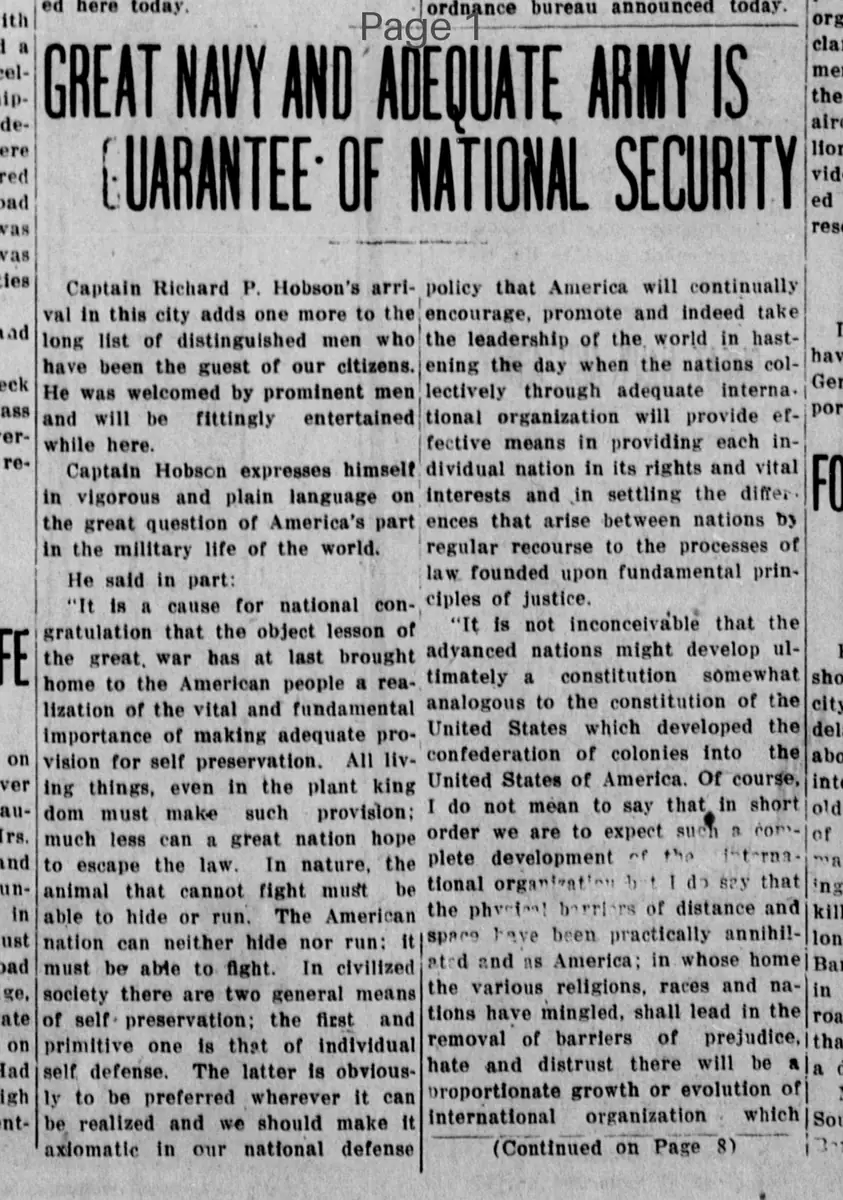
Captain Richard P. Hobson's arrival in this city adds one more to the long list of distinguished men who have been the guest of our citizens.
He was welcomed by prominent men and will be fittingly entertained while here.
Captain Hobson expresses himself in vigorous and plain language on the great question of America's part in the military life of the world.
He said in part:
"It is a cause for national congratulation that the object lesson of the great war has at last brought home to the American people a realization of the vital and fundamental importance of making adequate provision for self preservation. All living things, even in the plant kingdom must make such provision; much less can a great nation hope to escape the law. In nature, the animal that cannot fight must be able to hide or run. The American nation can neither hide nor run: it must be able to fight. In civilized society there are two general means of self preservation; the first and primitive one is that of individual self defense. The latter is obviously to be preferred wherever it can be realized and we should make it axiomatic in our national defense policy that America will continually encourage, promote and indeed take the leadership of the world in hastening the day when the nations collectively through adequate international organization will provide effective means in protecting each individual nation in its rights and vital interests and in settling the differences that arise between nations by regular recourse to the processes of law founded upon fundamental principles of justice.
"It is not inconceivable that the advanced nations might develop ultimately a constitution somewhat analogous to the constitution of the United States which developed the confederation of colonies into the United States of America. Of course, I do not mean to say that, in short order we are to expect such a complete development of the international organization but I do say that the physical barriers of distance and space have been practically annihilated and as America, in whose home the various religions, races and nations have mingled, shall lead in the removal of barriers of prejudice, hate and distrust there will be a proportionate growth or evolution of international organization which
(Continued on Page 8)
GREAT NAVY AND ARMY
(Continued from page 1)
will on a world scale be the reproduction of an evolution that has been taking place between families and clans and tribes in the formation of nations and empires.
The time has come for Americans to think in the terms of nations and continents as their forefathers thought in terms of states and colonies and for Americans to grapple with the question of the development of a constitution of the world as our forefathers developed the constitution of the United States, and just in proportion as such an international organization develop will the nations of the earth be able to have recourse to collective means of self-defense.
"The forces of nations are of two essential kinds--land forces founded upon the enlistment of men and sea forces founded upon the building and maintenance of ships. Of these two kinds of forces, when there is a choice between them, manifestly the one to be chosen rather than the other, is naval force and the use of property so the men may remain in productive pursuits and the body of the nation not subjected to the burdens of militarism.
"Here in America our contact with the great military powers of the world is over the water.
Consequently to a larger measure than any other nation, can we avail ourselves of the advantages of sea power.
I do not wish to discourage in the slightest the wholesome impulse of our people at last to organize for expansion and development of efficiency, the land forces, for there is no danger of excessive militarism in America. On the contrary, our fundamental weakness and permanent error will spring from lethargy and lack of interest in the question of national defense, on the part of our people. But I do not hesitate to say that the permanent basis for American defense will be the maintenance in the Atlantic ocean of a fleet superior to the navy of any military nation of Europe and the maintenance in the Pacific ocean of a fleet greater than the navy of a military nation of Asia and our two fleets being greater than the navy of any nation in the world, together with a merchant marine greater than that of any other nation.
The urgency of providing for such measures cannot be overstated. The oceans are no longer barriers to protect us but means of great armies quickly reaching our shores if in control of the sea.
In an almost incredible short length of time, great armies from across the water gaining control of the sea could strike our shores and in the absence of a mobile army of defense could take our coast line cities and levy upon billions of the national wealth.
It is vain to imagine they would not thus levy in view of what has been taking place in Europe. The enemy armies could then retire with their booty long before any adequate force could be provided by us to inflict serious injury.
Nor could we pursue the enemy across the water.
On the contrary, we would be compelled to submit to a humiliating peace in order to get ready to fight the war over again.
"When America's white arms stretch across the Atlantic and the Pacific in the form of great fleets and she commands to troubled waters so long lashed by storms of war, 'Peace, be still' a great calm will then reign upon the deep, the organic forces of evolution can then operate. Nations with great armies will rapidly find their armaments useless and will the more readily join the American leadership in developing the international organization as pointed out above. The nations can finally find security and justice permitting them to lay aside their armaments leading at last toward the peace of the world."
What sub-type of article is it?
What keywords are associated?
What entities or persons were involved?
Editorial Details
Primary Topic
Advocacy For Strong Navy And Army For National Security And World Peace
Stance / Tone
Vigorous Advocacy For Naval Preparedness And International Organization
Key Figures
Key Arguments