Thank you for visiting SNEWPapers!
Sign up free
Alexandria Daily Advertiser
Alexandria, Virginia
What is this article about?
Pamphlet summarizes the 1806 US-British Treaty, renewing Jay Treaty provisions on commerce, navigation, neutrality, and boundaries, with new clauses on slave trade and reservations regarding French decrees. (187 characters)
Clipping
OCR Quality
Full Text
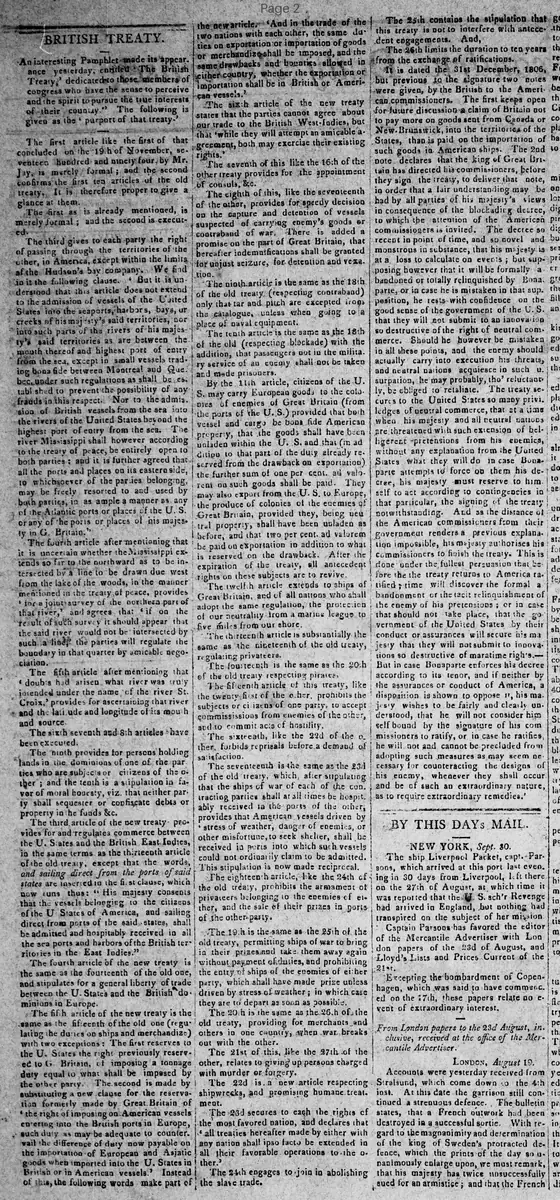
An interesting Pamphlet made its appearance yesterday, concerning The British Treaty, dedicated to those members of congress who have the sense to perceive and the spirit to pursue the true interests of their country. The following is given as its purport of that treaty-
The first article like the first of that concluded on the 19th of November, seventeen hundred and ninety four, by Mr. Jay, is merely formal; and the second confirms the first ten articles of the old treaty. It is therefore proper to give a glance at them.
The first as is already mentioned, is merely formal; and the second is executed:
The third gives to each party the right of passing through the territories of the other, in America, except within the limits of the Hudson's bay company. We find in it the following clause: But it is understood that this article does not extend to the admission of vessels of the United States into the seaports, harbors, bays, or creeks of his majesty's said territories, nor into such parts of the rivers of his majesty said territories as are between the mouth thereof and highest port of entry from the sea, except in small vessels trading bona fide between Montreal and Quebec, under such regulations as shall be established to prevent the possibility of any frauds in this respect. Nor to the admission of British vessels from the sea into the rivers of the United States beyond the highest port of entry from the sea. The river Mississippi shall however according to the treaty of peace, be entirely open to both parties; and it is further agreed that all the ports and places on its eastern side, to whosoever of the parties belonging, may be freely resorted to and used by both parties, in as ample a manner as any of the Atlantic ports or places of the U. S. or any of the ports or places of his majesty in G. Britain."
The fourth article after mentioning that it is uncertain whether the Mississippi extends so far to the northward as to be intersected by a line to be drawn due west from the lake of the woods, in the manner mentioned in the treaty of peace, provides for a joint survey of the northern part of that river, and agrees that if on the result of such survey it should appear that the said river would not be intersected by such a line the parties will regulate the boundary in that quarter by amicable negotiation.
The fifth article after mentioning that doubts had arisen what river was truly intended under the name of the river St. Croix, provides for ascertaining that river and the latitude and longitude of its mouth and source.
The sixth seventh and eighth articles have been executed.
The ninth provides for persons holding lands in the dominions of one of the parties who are subjects or citizens of the other; and the tenth is a stipulation in favor of moral honesty, viz. that neither party shall sequester or confiscate debts or property in the funds etc.
The third article of the new treaty provides for and regulates commerce between the U. States and the British East Indies, in the same terms as the thirteenth article of the old treaty, except that the words, and sailing direct from the ports of said states are inserted in the first clause, which now runs thus: "His majesty consents that the vessels belonging to the citizens of the U States of America, and sailing direct from ports of the said states, shall be admitted and hospitably received in all the sea ports and harbors of the British territories in the East Indies."
The fourth article of the new treaty is the same as the fourteenth of the old one, and stipulates for a general liberty of trade between the U. States and the British dominions in Europe.
The fifth article of the new treaty is the same as the fifteenth of the old one (regulating the duties on ships and merchandise) with two exceptions: The first reserves to the U. States the right previously reserved to G. Britain, of imposing a tonnage duty equal to what shall be imposed by the other party. The second is made by substituting a new clause for the reservation formerly made by Great Britain of the right of imposing on American vessels entering into the British ports in Europe, such duty as may be adequate to countervail the difference of duty now payable on the importation of European and Asiatic goods when imported into the U. States in British or in American vessels. Instead of this, the following words make part of the fifth article, (And in the trade of the two nations with each other, the same duties on exportation or importation of goods or merchandise shall be imposed, and the same drawbacks and bounties allowed in either country, whether the exportation or importation shall be in British or American vessels.
The sixth article of the new treaty states that the parties cannot agree about our trade to the British West-Indies, but that while they will attempt an amicable agreement, both may exercise their existing rights.
The seventh of this like the 16th of the other treaty provides for the appointment of consuls, etc.
The eighth of this, like the seventeenth of the other, provides for speedy decision on the capture and detention of vessels suspected of carrying enemy's goods or contraband of war. There is added a promise on the part of Great Britain, that hereafter indemnifications shall be granted for unjust seizure, for detention and vexation.
The ninth article is the same as the 18th of the old treaty (respecting contraband) only that tar and pitch are excepted from the catalogue, unless when going to a place of naval equipment.
The tenth article is the same as the 18th of the old (respecting blockade) with the addition, that passengers not in the military service of an enemy shall not be taken and made prisoners.
By the eleventh article, citizens of the U. S. may carry European goods to the colonies of enemies of Great Britain (from the ports of the U.S.) provided that both vessel and cargo be bona fide American property, that the goods shall have been unladen within the U. S. and that (in addition to that part of the duty already reserved from the drawback on exportation) the further sum of one per cent. ad valorem on such goods shall be paid. They may also export from the U. S. to Europe, the produce of colonies of the enemies of Great Britain, provided they, being neutral property, shall have been unladen as before, and that two per cent. ad valorem be paid on exportation in addition to what is reserved on the drawback. After the expiration of the treaty, all antecedent rights on these subjects are to revive.
The twelfth article extends to ships of Great Britain, and of all nations who shall adopt the same regulation, the protection of our neutrality from a marine league to five miles from our shore.
The thirteenth article is substantially the same as the nineteenth of the old treaty, regulating privateers.
The fourteenth is the same as the 20th of the old treaty respecting pirates.
The fifteenth article of this treaty, like the twenty first of the other, prohibits the subjects or citizens of one party, to accept commissions from enemies of the other, and to commit acts of hostility.
The sixteenth, like the 22d of the other, forbids reprisals before a demand of satisfaction.
The seventeenth is the same as the 23d of the old treaty, which, after stipulating that the ships of war of each of the contracting parties shall at all times be hospitably received in the ports of the other, provides that American vessels driven by stress of weather, danger of enemies, or other misfortune, to seek shelter, shall be received in ports into which such vessels could not ordinarily claim to be admitted. This stipulation is now made reciprocal.
The eighteenth article, like the 24th of the old treaty, prohibits the armament of privateers belonging to the enemies of either, and the sale of their prizes in ports of the other party.
The 19th is the same as the 25th of the old treaty, permitting ships of war to bring in their prizes and take them away again without payment of duties, and prohibiting the entry of ships of the enemies of either party, which shall have made prize unless driven by stress of weather; in which case they are to depart as soon as possible.
The 20th is the same as the 26th of the old treaty, providing for merchants and others in one country when war breaks out with the other.
The 21st of this, like the 27th of the other, relates to giving up persons charged with murder or forgery.
The 22d is a new article respecting shipwrecks, and promising humane treatment.
The 23d secures to each the rights of the most favored nation, and declares that all treaties hereafter made by either with any nation shall ipso facto be extended in all their favorable operations to the other.
The 24th engages to join in abolishing the slave trade.
The 25th contains the stipulation that this treaty is not to interfere with antecedent engagements. And,
The 26th limits the duration to ten years from the exchange of ratifications. It is dated the 31st December, 1806, but previous to the signature two notes were given, by the British to the American commissioners. The first keeps open for future discussion a claim of Britain not to pay more on goods sent from Canada or New Brunswick, into the territories of the States, than is paid on the importation of such goods in American ships. The 2d note declares that the King of Great Britain has directed his commissioners, before they sign the treaty, to deliver that note, in order that a fair understanding may be had by all parties of his majesty's views in consequence of the blockading decree, to which the attention of the American commissioners is invited. The decree so recent in point of time, and so novel and monstrous in substance, that his majesty is at a loss to calculate on events; but supposing however that it will be formally abandoned or totally relinquished by Bonaparte, or in case he is mistaken in that supposition, he rests with confidence, on the good sense of the government of the U. S. that they will not submit to an innovation so destructive of the right of neutral commerce. Should he however be mistaken in all these points, and the enemy should actually carry into execution his threats, and neutral nations acquiesce in such usurpation, he may probably, tho' reluctantly, be obliged to retaliate. The treaty secures to the United States so many privileges of neutral commerce, that at a time when his majesty and all neutral nations are threatened with such extension of belligerent pretensions from his enemies, without any explanation from the United States what they will do in case Bonaparte attempts to force on them his decree, his majesty must reserve to himself to act according to contingencies in that particular, the signing of the treaty notwithstanding. And as the distance of the American commissioners from their government renders a previous explanation impossible, his majesty authorises his commissioners to finish the treaty. This is done under the fullest persuasion that before the treaty returns to America ratified time will discover the formal abandonment or the tacit relinquishment of the enemy of his pretensions; or in case that should not take place, that the government of the United States by their conduct or assurances will secure his majesty that they will not submit to innovations so destructive of maritime rights. But in case Bonaparte enforces his decree according to its tenor, and if neither by the assurances or conduct of America, a disposition is shown to oppose it, his majesty wishes to be fairly and clearly understood, that he will not consider himself bound by the signature of his commissioners to ratify, or in case he ratifies he will not and cannot be precluded from adopting such measures as may seem necessary for counteracting the designs of his enemy, whenever they shall occur and be of such an extraordinary nature, as to require extraordinary remedies."
What sub-type of article is it?
What keywords are associated?
What entities or persons were involved?
Where did it happen?
Foreign News Details
Primary Location
Great Britain
Event Date
31st December, 1806
Key Persons
Outcome
new treaty confirms prior articles on commerce, navigation, and neutrality; regulates trade with british east indies and europe; addresses west indies trade disputes; includes provisions on contraband, blockades, privateers, and slave trade abolition; reservations on french blockading decree and potential british retaliation.
Event Details
Pamphlet details the new British Treaty, dated 31st December 1806, which renews and modifies the 1794 Jay Treaty. It covers articles on territorial passage rights (excluding Hudson's Bay), Mississippi River access, boundary surveys for St. Croix and Mississippi, commerce with British East Indies and Europe, duties and drawbacks, West Indies trade negotiations, consuls, captures, contraband (excluding tar and pitch), blockades, neutral trade protections, privateers, pirates, reprisals, shipwrecks, most favored nation status, slave trade abolition, and duration of ten years. Includes British notes reserving rights on Canadian trade duties and responses to French decrees.